
Quick Answer
Pecking order is the natural social hierarchy chickens establish to determine access to food, water, nesting boxes, and roost space. Normal pecking order involves brief chasing, posturing, and occasional light pecks that rarely cause injury. You should intervene when pecking becomes aggressive enough to cause bleeding, bare patches larger than a quarter, isolation of a bird from food and water, or when a chicken shows signs of severe stress like refusing to leave a corner for more than a day.
Key Takeaways
- Pecking order is natural and necessary for flock harmony, with most hierarchies established within 2-6 weeks through posturing and minor confrontations
- Normal pecking order behavior includes brief chasing, chest bumping, feather pulling without bald spots, and temporary squabbles that resolve quickly
- Intervention is required when you see blood, wounds, bald patches larger than a quarter, a bird being denied access to food/water for extended periods, or constant targeting of one individual
- New bird integration temporarily disrupts pecking order and requires a slow introduction process over 2-4 weeks to minimize aggression
- Removing an injured bird can make reintroduction difficult because the flock may treat them as a new member again
- Blood triggers escalation because chickens are attracted to the color red and will peck at wounds, turning normal hierarchy disputes into dangerous situations
- Common mistakes include intervening too early in normal disputes, adding only one new bird at a time, or reintroducing birds too quickly after separation
- Roosters influence hierarchy by mediating disputes between hens and typically sit at the top of the pecking order
- Space and resources matter because overcrowding and competition for limited food/water stations intensify pecking order aggression
What Does Pecking Order Mean in Chickens?
Pecking order in chickens refers to the social ranking system where each bird holds a specific position from most dominant to least dominant. This hierarchy determines which chickens eat first, get the best roosting spots, access nesting boxes without challenge, and receive priority in other flock activities.
The term “pecking order” comes from the literal pecking behavior chickens use to establish and maintain their rank. Higher-ranking birds can peck lower-ranking ones without retaliation, while subordinate chickens must yield space and resources to their superiors.
Key characteristics of chicken pecking order:
- Linear hierarchy: Most flocks develop a straight-line ranking from alpha to omega, though some form triangle relationships where bird A dominates B, B dominates C, but C can challenge A
- Gender-based divisions: Roosters typically rank above hens, with separate hierarchies often existing within each gender group
- Stable but flexible: Once established, pecking order remains relatively constant unless flock composition changes, a bird becomes ill, or a lower-ranked chicken successfully challenges a superior
- Reduces overall conflict: A clear hierarchy actually decreases fighting because each bird knows their place and avoids unnecessary confrontations
The pecking order serves an evolutionary purpose by organizing flock behavior and reducing chaos during feeding, roosting, and other group activities.
How Do Chickens Establish Pecking Order?
Chickens establish pecking order through a series of confrontations that escalate from subtle body language to physical challenges. The process typically begins when birds first meet or when flock composition changes, with most hierarchies solidifying within 2-6 weeks depending on flock size and individual personalities.
The establishment process follows these stages:
- Visual assessment (first few hours): Chickens size each other up through staring, standing tall, and puffing out chest feathers
- Posturing and threats (days 1-3): Birds engage in chest bumping, wing spreading, and hackle raising without actual contact
- Minor physical challenges (week 1-2): Light pecks to the head or back, brief chasing, and feather pulling that doesn’t remove feathers
- Submission signals (ongoing): Lower-ranking birds crouch, move away quickly, or avoid eye contact when approached by superiors
- Maintenance behaviors (after establishment): Occasional reminder pecks to reinforce hierarchy without full confrontations
Factors that influence how quickly and peacefully pecking order establishes:
- Flock size: Smaller flocks (3-6 birds) establish hierarchy faster than large flocks (20+ birds) where more relationships must be sorted
- Available space: Crowded conditions intensify competition and prolong the establishment period
- Age differences: Mixed-age flocks often establish order more quickly because younger birds naturally defer to mature hens
- Breed temperament: Docile breeds like Orpingtons and Cochins establish gentler hierarchies than assertive breeds like Rhode Island Reds or Leghorns
- Resource abundance: Multiple feeding stations, waterers, and roost space reduce competition during the critical establishment phase
Choose to provide extra resources during integration periods if you want to minimize the intensity of pecking order disputes.
Pecking Order vs Bullying: How to Tell the Difference
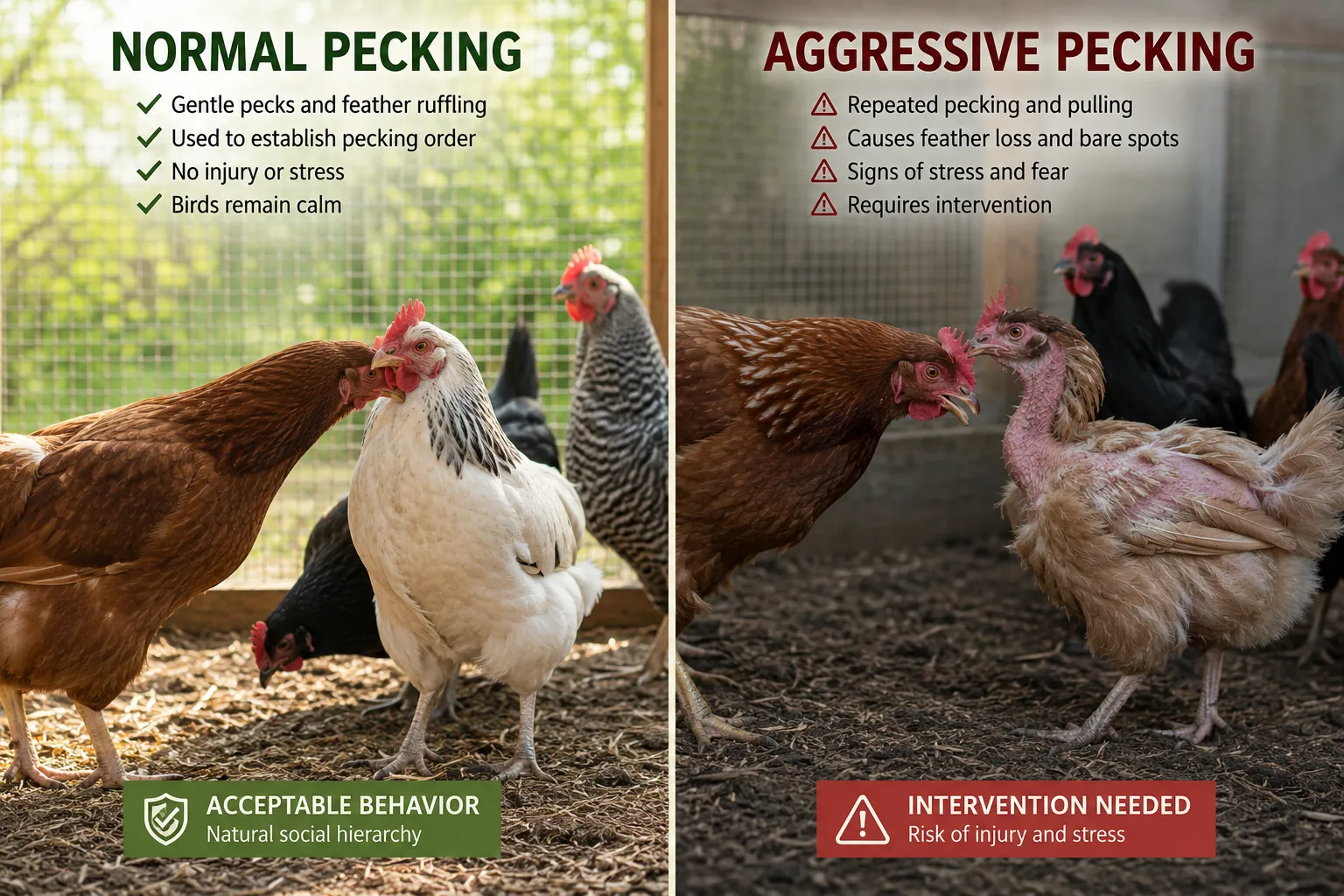
Normal pecking order establishment involves brief, distributed confrontations where multiple birds challenge each other and disputes resolve within seconds to minutes. Bullying occurs when one or more chickens relentlessly target a specific individual, preventing them from accessing resources and causing visible physical or psychological harm.
Normal pecking order looks like:
- Confrontations last seconds, not minutes or hours
- The targeted bird changes (today bird A pecks bird B, tomorrow bird C pecks bird A)
- Pecked birds can still access food, water, and roost space
- No blood, wounds, or bald patches larger than a quarter
- Birds resume normal activities (foraging, dust bathing, roosting together) between disputes
- Submissive birds can retreat and the aggressor doesn’t pursue relentlessly
Bullying behavior includes:
- One bird is consistently targeted by one or multiple flock members
- Chasing continues even after the victim shows submission
- The targeted bird is blocked from feeders, waterers, or coop entry
- Visible injuries including bleeding, large bald patches, or limping
- The victim isolates themselves in corners, refuses to roost with the flock, or stops eating
- Attacks occur multiple times per hour throughout the day
- The aggressor seeks out the victim rather than waiting for natural encounters
Common mistake: Intervening during normal pecking order establishment because it looks aggressive. Brief chasing and a few pecks are necessary for hierarchy formation. Only intervene when the behavior crosses into the bullying category described above.
If you’re unsure, observe for 15-30 minutes. Normal pecking order disputes will include multiple different interactions between various flock members. Bullying will show a clear pattern of one bird being singled out repeatedly.
When Is Pecking Order Normal and When Is It Too Aggressive?
Pecking order is normal when confrontations are brief, distributed among multiple birds, cause no significant injury, and result in a stable hierarchy within 2-6 weeks. It becomes too aggressive when any bird sustains bleeding wounds, develops bald patches larger than a quarter, is denied access to food or water for extended periods, or shows signs of severe stress like refusing to leave hiding spots.
Normal pecking order intensity:
- Light pecks that don’t break skin or remove feathers
- Brief chasing (under 30 seconds) that ends when the subordinate bird moves away
- Chest bumping and wing spreading without sustained physical contact
- Minor feather ruffling that smooths back down
- Temporary squabbles at feeders that resolve when one bird yields
- All birds still eat, drink, and roost normally despite occasional confrontations
Too aggressive indicators requiring intervention:
- Blood: Any bleeding from pecking wounds, even small amounts, because chickens will target red areas and escalate attacks
- Bare skin: Bald patches larger than a quarter where feathers have been pulled out, especially on the back, head, or vent area
- Resource denial: A bird being blocked from food or water for more than 2-3 hours
- Isolation: A chicken spending entire days hiding in corners or refusing to exit the coop
- Limping or lethargy: Physical injuries affecting movement or a bird becoming listless from stress
- Constant targeting: One bird receiving attacks every few minutes throughout the day
- Vent pecking: Any pecking at the vent area, which can quickly become fatal
Edge case: During the first 3-5 days of integration, slightly elevated aggression is normal as hierarchy establishes. However, blood or severe injuries are never acceptable even during this period and require immediate intervention.
Monitor new integrations at least 3-4 times daily during the first week to catch escalating aggression before it causes serious harm.

Signs You Need to Intervene in Chicken Pecking Order
You need to intervene when you observe bleeding, wounds, bald patches larger than a quarter, a bird being consistently denied access to food or water, extreme isolation lasting more than 24 hours, or any pecking directed at the vent area. These signs indicate the situation has moved beyond normal hierarchy establishment into dangerous territory.
Immediate intervention required (within hours):
- Any visible blood on feathers, comb, wattles, or body
- Vent pecking or any attention to the rear area
- Open wounds where skin is broken
- Severe limping or inability to move normally
- Complete food/water denial where a bird hasn’t eaten or drunk in 6+ hours
- Unresponsive behavior where a bird doesn’t react to your approach
Intervention needed within 24 hours:
- Bald patches larger than a quarter, especially on back, head, or neck
- Constant targeting where one bird receives attacks every 5-10 minutes
- Refusal to roost with the flock for multiple nights
- Corner hiding where a bird stays in one spot all day
- Significant feather loss with visible skin showing in multiple areas
- Stress behaviors like panting, hunched posture, or closed eyes during the day
Monitor closely but may not require intervention yet:
- Small bald spots (smaller than a quarter) that aren’t growing
- Brief daily chasing that lasts under 30 seconds
- Temporary feeder squabbles where the subordinate bird can access food within minutes
- Minor feather ruffling without feather loss
- A bird choosing to stay separate but still eating, drinking, and moving normally
Decision rule: If you’re questioning whether to intervene, take photos and check again in 2-4 hours. Worsening conditions (larger bald spots, new injuries, increased isolation) mean intervention is needed. Stable or improving conditions suggest the hierarchy is settling naturally.
How Long Does It Take for Chickens to Establish Pecking Order?
Chickens typically establish pecking order within 2-6 weeks, with small flocks (3-6 birds) often settling within 2-3 weeks and larger flocks (15+ birds) requiring 4-6 weeks or longer. The timeline varies based on flock size, available space, resource abundance, age differences, and individual bird personalities.
Typical timeline for pecking order establishment:
- Days 1-3: Intense posturing, frequent confrontations, elevated stress, minimal physical contact
- Week 1: Physical challenges increase, clear dominant and submissive birds emerge, confrontation frequency peaks
- Weeks 2-3: Hierarchy becomes clearer, confrontations decrease as birds learn their rank, most relationships solidify
- Weeks 4-6: Fine-tuning of middle-rank positions, occasional challenges but mostly stable, near-normal flock behavior
- After 6 weeks: Established hierarchy with only occasional reminder pecks to maintain order
Factors that extend the establishment period:
- Large flock size: Each bird must establish relationships with every other bird, creating exponentially more interactions in large groups
- Similar-aged birds: When all chickens are the same age and size, dominance is harder to determine and challenges continue longer
- Limited space: Overcrowding prevents subordinate birds from escaping, leading to repeated confrontations
- Insufficient resources: One feeder or waterer forces constant competition rather than allowing birds to avoid each other
- Frequent flock changes: Adding or removing birds restarts the establishment process
Factors that speed establishment:
- Mixed ages (mature hens with younger pullets naturally establish hierarchy faster)
- Abundant space (minimum 4 square feet per bird indoors, 10 square feet per bird in runs)
- Multiple resource stations (2-3 feeders and waterers for flocks over 10 birds)
- Docile breed mixes (avoiding highly aggressive breeds)
Common mistake: Adding new birds every few weeks, which continuously disrupts the hierarchy and prevents it from ever fully stabilizing. Instead, make flock changes all at once or wait at least 6-8 weeks between additions.
If pecking order hasn’t stabilized after 6 weeks and you’re still seeing frequent aggressive confrontations, evaluate space, resources, and whether specific individuals are causing problems that require removal.
What Happens If You Don’t Intervene in Severe Pecking?
If you don’t intervene in severe pecking, the targeted chicken can suffer fatal injuries from blood loss, infection, or cannibalistic behavior where multiple flock members attack wounds. Even non-fatal cases can result in permanent injury, chronic stress that stops egg production, and a traumatized bird that never fully integrates with the flock.
Escalation pattern without intervention:
- Initial injury: Aggressive pecking creates a small wound or bald patch
- Red attraction: Chickens are drawn to the color red and begin targeting the injury site
- Wound expansion: Multiple birds peck at the same area, enlarging the wound
- Cannibalistic behavior: In severe cases, chickens peck into body cavities, causing fatal injuries
- Flock-wide aggression: Other birds learn that attacking this individual is acceptable, making reintegration nearly impossible
Consequences of delayed intervention:
- Infection: Open wounds in coop environments quickly become infected, requiring veterinary antibiotics
- Permanent feather loss: Severe damage to feather follicles can prevent regrowth in affected areas
- Chronic stress: Traumatized birds may never resume normal egg production or behavior
- Death: Vent pecking, severe head wounds, or infections can be fatal within 24-48 hours
- Learned aggression: The flock develops a pattern of attacking weak members, creating ongoing management problems
Real-world example: A backyard keeper noticed minor pecking on a hen’s back but decided to “let them work it out.” Within three days, the bald patch grew from quarter-sized to palm-sized, the hen stopped eating, and infection set in. The bird required two weeks of isolation, antibiotic treatment, and could never be safely reintroduced to that flock.
Edge case: Sometimes removing an injured bird for treatment makes reintegration even harder because the flock treats them as a new member. In these situations, you may need to remove the aggressor instead of the victim, or use a temporary barrier that allows the injured bird to remain visible to the flock while healing.
The key is catching problems early, when you first see blood or large bald patches, rather than waiting to see if it resolves naturally.
How to Stop Aggressive Pecking in Chickens
Stop aggressive pecking by immediately separating injured birds to prevent further harm, identifying and addressing the root cause (overcrowding, boredom, insufficient resources), and using temporary barriers or pinless peepers on aggressors if the behavior continues. Most aggressive pecking stems from environmental stressors rather than individual bird personality.
Immediate steps when you discover aggressive pecking:
- Separate the victim if there’s blood or severe injury, place in a quiet, comfortable space with food and water
- Clean wounds with saline solution and apply blu-kote (purple wound spray) to hide red coloring that attracts pecking
- Identify the aggressor(s) by observing the flock for 15-30 minutes to see who initiates attacks
- Check for blood on beaks which indicates recent aggressive pecking
Environmental modifications to reduce aggression:
- Increase space: Provide minimum 4 square feet per bird indoors and 10 square feet in outdoor runs
- Add resources: Install multiple feeding and watering stations so subordinate birds have options
- Provide enrichment: Hang cabbage or lettuce for pecking, add roosts at varying heights, create dust bathing areas
- Improve ventilation: Poor air quality and ammonia buildup increase stress and aggression
- Adjust lighting: Reduce light intensity or use red bulbs, which make it harder for chickens to see red blood
- Add hiding spots: Create visual barriers with pallets, branches, or coop furniture so subordinate birds can escape line of sight
Interventions for persistent aggressors:
- Pinless peepers: Plastic blinders that attach to nostrils and partially block forward vision, preventing accurate pecking (remove after 2-3 weeks)
- Temporary separation: Remove the aggressor (not the victim) for 3-5 days, which often lowers their rank when reintroduced
- Rehoming: If a bird continues severe aggression despite interventions, removing them permanently may be necessary for flock safety
Common mistakes to avoid:
- Separating the victim long-term, which makes reintegration harder
- Adding only environmental enrichment without addressing space or resource issues
- Assuming aggressive pecking is “just their personality” without investigating environmental causes
- Reintroducing injured birds before wounds are completely healed and feathers have regrown
Decision rule: Choose environmental modifications first for flock-wide aggression. Use pinless peepers or separation for individual aggressors who continue targeting specific birds despite improved conditions.
Most aggressive pecking resolves within 1-2 weeks once you address the underlying environmental stressors.
Can You Reintroduce a Chicken After Removing It from the Flock?
You can reintroduce a chicken after removal, but the flock will often treat them as a new member and restart pecking order establishment, especially if the separation lasted more than 5-7 days. Success depends on the length of separation, the reason for removal, and using proper reintroduction techniques that minimize aggression.
Reintroduction success factors:
- Separation length: Under 3 days usually allows smooth reintegration; over 7 days typically requires full reintroduction protocol
- Visibility during separation: Birds kept in a see-but-not-touch setup (wire barrier) maintain flock recognition better than completely isolated birds
- Reason for removal: Birds removed for injury face harder reintegration than those separated for illness without visible wounds
- Flock stability: Established, calm flocks accept returning members more easily than flocks still sorting hierarchy
Reintroduction protocol for separations over 5 days:
- Ensure full healing: Wait until all wounds are closed, feathers have started regrowing, and the bird shows normal energy levels
- Parallel housing (3-5 days): Place the returning bird in a wire cage or fenced area within the coop where everyone can see and hear each other
- Supervised free-ranging (2-3 days): Let the returning bird join the flock in a large outdoor space where there’s room to escape, supervising for 1-2 hours daily
- Evening reintroduction: Place the returning bird on the roost after dark when chickens are calm and less likely to fight
- Morning monitoring: Watch closely the next morning for aggressive confrontations and be ready to intervene if severe pecking starts
Signs reintroduction is going well:
- Brief confrontations that resolve within seconds
- The returning bird can access food and water
- No blood or new injuries after 24 hours
- The bird roosts with the flock at night
Signs reintroduction is failing:
- Constant chasing lasting minutes at a time
- The returning bird is blocked from resources
- New injuries or blood within the first few hours
- The bird refuses to leave a corner or hiding spot
Alternative approach: If reintroducing the victim fails repeatedly, consider removing the original aggressor instead. Sometimes the flock dynamic has shifted to make the victim a permanent target, and removing the instigator is the only solution.
Common mistake: Rushing reintroduction because you feel bad about the separated bird being alone. Premature reintegration before full healing often results in immediate re-injury and an even longer separation period.
Plan for 2-3 weeks total when removing an injured bird, 1 week for healing and 1-2 weeks for gradual reintroduction.
Pecking Order with New Chickens Added to Existing Flock
Adding new chickens to an existing flock temporarily disrupts the established pecking order and triggers a new hierarchy establishment period that typically lasts 2-4 weeks. The existing flock will challenge newcomers to determine where they fit in the ranking, with aggression intensity depending on introduction method, age differences, and flock size.
Why new additions disrupt pecking order:
- Existing flock members must reassess their rank relative to newcomers
- Established birds defend their territory and resources from perceived intruders
- New birds don’t know the existing hierarchy and may inadvertently challenge high-ranking members
- The total number of relationships in the flock increases (in a flock of 6, adding 2 birds creates 28 total relationships instead of 15)
Best practices for adding new chickens:
Quarantine first (14-21 days): Keep new birds completely separated to prevent disease transmission and allow observation for illness
Use see-but-not-touch introduction (7-10 days): House new birds in a wire cage or fenced section within the coop where both groups can see, hear, and smell each other without physical contact
Add multiple birds at once: Introducing 2-3 new chickens together gives them allies and distributes aggression across multiple targets instead of one
Match ages when possible: Adding similar-aged birds creates more balanced challenges than introducing young pullets to mature hens
Provide extra resources: Set up multiple feeders, waterers, and roost spaces before integration to reduce competition
Integrate in large spaces first: Let birds meet in a spacious run or free-range area where subordinates can escape rather than in the confined coop
Time it right: Integrate during evening hours or place new birds on roosts after dark for a calmer first encounter
Age-specific considerations:
- Adding chicks to adult flock: Wait until chicks are at least 16-18 weeks old and similar size to adults to prevent serious injury
- Adding adults to established flock: Expect 3-4 weeks of elevated aggression as hierarchy completely reorganizes
- Adding pullets starting to lay: Expect competition for nesting boxes in addition to general hierarchy disputes
Common mistakes:
- Adding only one new bird, who becomes the sole target of aggression with no allies
- Introducing new birds without a see-but-not-touch period, leading to immediate attacks
- Adding birds in the confined coop space rather than a larger outdoor area
- Insufficient resources forcing constant competition during the critical integration period
Decision rule: Choose to add 2-3 birds at once if your flock is under 10 birds. For larger flocks (15+), you can add single birds more successfully because aggression is distributed across more flock members.
Expect some confrontations during integration, but monitor closely for the signs of excessive aggression discussed earlier in this article.
Do Roosters Affect Pecking Order Hierarchy?
Roosters significantly affect pecking order hierarchy by typically ranking at the top above all hens, mediating disputes between hens, and sometimes reducing overall flock aggression through their presence. However, roosters can also cause problems if they’re overly aggressive, if multiple roosters compete for dominance, or if the rooster-to-hen ratio is imbalanced.
How roosters influence flock hierarchy:
- Top position: Roosters almost always rank above hens in the pecking order, with dominant roosters having first access to food and prime roost spots
- Dispute mediation: Good roosters break up hen fights by stepping between combatants or vocalizing warnings
- Resource allocation: Roosters often call hens to food sources and allow them to eat first, which can reduce competition
- Protection behavior: Roosters alert the flock to threats and position themselves between danger and hens, creating a sense of security that reduces stress-related aggression
- Mating hierarchy: Roosters preferentially mate with higher-ranking hens, which can intensify competition among hens for status
Multiple rooster dynamics:
When you keep multiple roosters, they establish their own hierarchy that can be more aggressive than hen hierarchies:
- Rooster-to-rooster aggression: Young roosters challenge older ones, leading to fights that can cause serious injury
- Flock division: In large spaces, multiple roosters may divide the flock into sub-groups, each with its own hierarchy
- Hen harassment: Too many roosters (ratio worse than 1:8) leads to over-mating that stresses hens and can cause feather loss and injuries
Ideal rooster ratios:
- 1 rooster to 8-12 hens: Optimal for most backyard flocks
- 1 rooster to 6-8 hens: Minimum to prevent over-mating
- No roosters: Perfectly viable option; hen-only flocks establish stable hierarchies without rooster influence
When roosters cause pecking order problems:
- Aggressive roosters: Some roosters attack hens rather than protecting them, requiring removal
- Rooster fights: Multiple roosters in small spaces create constant conflict
- Favoritism: Roosters who over-mate favorite hens can cause injuries that trigger pecking from other flock members
Edge case: In hen-only flocks, the most dominant hen sometimes adopts rooster-like behaviors including crowing, mounting other hens, and taking on a protective role. This is normal and doesn’t indicate a problem.
Decision rule: Keep a rooster if you want fertile eggs, natural flock protection, or enjoy their presence. Skip the rooster if you live in areas with noise restrictions, have a small flock (under 6 hens), or want to avoid the complexity of managing rooster behavior.
Common Mistakes When Trying to Fix Pecking Order Problems
The most common mistakes when addressing pecking order problems include intervening too early in normal hierarchy establishment, separating the victim instead of the aggressor, adding insufficient space or resources, rushing reintroduction after separation, and adding only one new bird at a time. These errors often worsen the situation rather than resolving it.
Top mistakes and how to avoid them:
Mistake 1: Intervening in normal pecking order
- Why it’s wrong: Brief confrontations are necessary for hierarchy establishment
- How to avoid: Only intervene when you see blood, large bald patches, resource denial, or extreme isolation
- What to do instead: Observe for 15-30 minutes to distinguish normal disputes from bullying
Mistake 2: Separating the victim long-term
- Why it’s wrong: Removal makes the victim a “new” bird when reintroduced, often restarting aggression
- How to avoid: Only separate if there’s immediate danger; keep separation under 5 days when possible
- What to do instead: Use in-flock barriers or remove the aggressor instead
Mistake 3: Insufficient space and resources
- Why it’s wrong: Overcrowding and competition intensify natural hierarchy disputes into dangerous aggression
- How to avoid: Provide minimum 4 square feet per bird indoors, 10 square feet in runs, and multiple resource stations
- What to do instead: Add space or reduce flock size before problems escalate
Mistake 4: Adding one new bird alone
- Why it’s wrong: A single newcomer becomes the sole target of flock aggression with no allies
- How to avoid: Add 2-3 birds at once, or wait to add singles to very large flocks (15+ birds)
- What to do instead: Plan additions in small groups or use extended see-but-not-touch introduction periods
Mistake 5: Rushing reintroduction
- Why it’s wrong: Returning injured birds before full healing triggers immediate re-injury
- How to avoid: Wait until wounds are closed, feathers regrowing, and use gradual reintroduction protocol
- What to do instead: Plan for 2-3 weeks total (healing plus reintroduction)
Mistake 6: Ignoring environmental stressors
- Why it’s wrong: Aggressive pecking often stems from boredom, poor ventilation, or inadequate lighting rather than individual bird personality
- How to avoid: Assess coop conditions, enrichment, and resource distribution before blaming specific birds
- What to do instead: Address environmental factors first, then consider individual interventions
Mistake 7: Reintroducing during peak activity hours
- Why it’s wrong: Daytime introductions when chickens are active and alert trigger immediate confrontations
- How to avoid: Place returning or new birds on roosts after dark when the flock is calm
- What to do instead: Use evening reintroduction and monitor closely the next morning
Mistake 8: Treating all aggression the same
- Why it’s wrong: Normal pecking order, bullying, and environmental stress require different solutions
- How to avoid: Carefully observe to identify the specific problem before intervening
- What to do instead: Use the decision rules throughout this article to match solutions to problems
Mistake 9: Giving up too quickly
- Why it’s wrong: Pecking order establishment takes 2-6 weeks; expecting instant harmony leads to unnecessary interventions
- How to avoid: Set realistic expectations and monitor progress over weeks, not days
- What to do instead: Track improvements (fewer confrontations, shorter disputes, better resource access) even if perfection hasn’t arrived
Decision rule: If your first intervention doesn’t work within 3-5 days, reassess whether you’ve correctly identified the problem rather than trying the same solution repeatedly.
Is Blood During Pecking Order Establishment Normal or an Emergency?
Blood during pecking order establishment is always an emergency requiring immediate intervention, not a normal part of hierarchy formation. While minor feather ruffling and light pecks are normal, any pecking that breaks skin and causes bleeding indicates the situation has escalated beyond acceptable levels and will likely worsen without intervention.
Why blood is never acceptable:
- Red attraction: Chickens are instinctively drawn to the color red and will peck at bloody areas, turning a small wound into a severe injury
- Flock-wide targeting: Once one chicken draws blood, other flock members often join in attacking the same spot
- Rapid escalation: Blood-pecking can progress from minor wound to life-threatening injury within hours
- Cannibalistic behavior: In severe cases, chickens will peck into body cavities, causing fatal injuries
- Infection risk: Open wounds in coop environments quickly become infected
Immediate actions when you see blood:
- Separate the injured bird immediately to prevent further attacks
- Clean the wound with saline solution or clean water
- Apply blu-kote or purple wound spray to hide the red color that attracts pecking
- Assess wound severity: Deep wounds, vent injuries, or heavy bleeding require veterinary care
- Identify the aggressor by observing the flock for blood on beaks
- Address the root cause: Evaluate space, resources, and environmental stressors
Common sources of blood during pecking order:
- Comb and wattle injuries: Common in rooster fights or when hens challenge each other
- Back and neck wounds: Result from mounting behavior or aggressive pecking
- Vent pecking: Extremely dangerous and often fatal if not stopped immediately
- Toe and foot injuries: Can occur during roost disputes
Edge case: Very minor blood (a tiny spot on a comb from a single peck) that you catch immediately and treat with blu-kote may not require separation if you can monitor constantly for the next 2-3 hours. However, any blood that other flock members have noticed or any wound larger than a pinprick requires separation.
Common mistake: Thinking “a little blood is normal during integration” and waiting to see if it gets worse. Blood always gets worse without intervention because chickens will continue targeting the wound.
Decision rule: If you see blood, separate first and assess second. It’s easier to reintroduce a bird after a few hours if the wound is minor than to treat severe injuries that develop from delayed intervention.
Plan to keep injured birds separated until wounds are completely closed and scabbed over, which typically takes 5-10 days depending on severity.
Best Way to Integrate New Birds Without Disrupting Pecking Order
The best way to integrate new birds without disrupting pecking order is to use a gradual see-but-not-touch introduction over 7-14 days, add multiple birds at once rather than singles, provide abundant space and resources, and conduct the final integration in a large outdoor area during evening hours. This approach minimizes aggression while allowing the flock to establish a new hierarchy with less stress.
Complete integration protocol:
Phase 1: Quarantine (14-21 days)
- Keep new birds completely separated in a different building or area
- Monitor for signs of illness before exposing your existing flock
- Allow new birds to settle and reduce transport stress
Phase 2: Visual Introduction (7-10 days)
- Place new birds in a wire cage or fenced section within or adjacent to the main coop
- Ensure both groups can see, hear, and smell each other but cannot make physical contact
- Position the barrier so new birds can access their own food and water without competition
- Watch for curiosity rather than aggression as a sign of readiness to progress
Phase 3: Supervised Free-Ranging (2-4 days)
- Let both groups into a large outdoor space (the bigger the better) during the day
- Supervise for 1-2 hours, watching for excessive aggression
- Separate groups back into their respective spaces at night
- Provide multiple feeding and watering stations in the shared space
- Add distractions like treats, hanging vegetables, or new enrichment items
Phase 4: Evening Integration (Day 1)
- After dark, place new birds directly on the roost next to existing flock members
- Chickens are calmer at night and less likely to fight
- Check that new birds are actually roosting and haven’t been pushed off
Phase 5: Morning Monitoring (Days 1-7)
- Be present when birds wake up to monitor first interactions
- Watch for signs of excessive aggression requiring intervention
- Ensure new birds can access food and water
- Expect some confrontations but intervene if blood or severe chasing occurs
Phase 6: Ongoing Observation (Weeks 2-4)
- Check flock 3-4 times daily for the first week
- Monitor for injuries, bald patches, or birds being denied resources
- Watch for signs that hierarchy is stabilizing (fewer confrontations, birds roosting together peacefully)
Additional strategies to minimize disruption:
- Add during molting season: Existing flock members are less aggressive when molting
- Increase coop size before adding birds: Give the flock time to adjust to new space before introducing new members
- Match ages: Similar-aged birds establish hierarchy more peacefully than mixing very young with mature birds
- Choose compatible breeds: Avoid mixing highly aggressive breeds with docile ones
- Provide multiple roost levels: More roosting options reduce competition for prime spots
- Add visual barriers: Pallets, branches, or coop furniture create escape routes and break line of sight
Red flags that integration is failing:
- Blood or open wounds within the first 24 hours
- New birds unable to access food or water after 2-3 days
- Constant chasing (multiple times per hour) continuing beyond the first week
- New birds refusing to enter the coop at night after 3-4 days
Decision rule: If integration fails after following this protocol, separate groups again for another 5-7 days of visual introduction before retrying. Some flocks require extended introduction periods, especially if the existing flock is small (under 6 birds) or has been together for years without changes.
Most successful integrations show significant improvement by day 3-4, with near-normal flock behavior by week 3.
FAQ
How can you tell which chicken is at the top of the pecking order?
The top chicken (alpha) eats first at feeders, claims the best roosting spot (usually highest and center), can peck any other bird without retaliation, and displays confident body language with head held high and chest out. Other chickens move out of the alpha’s way without being pecked.
Can pecking order change once it’s established?
Yes, pecking order can change when new birds are added, a dominant bird becomes ill or injured, a lower-ranked bird successfully challenges a superior, or during molting when birds are vulnerable. Changes are more common in young flocks (under 1 year) than in established mature flocks.
Should you separate chickens that are fighting?
Separate chickens only if fighting causes blood, wounds, or one bird is being denied access to food and water. Brief confrontations with chasing and light pecking are normal pecking order establishment and shouldn’t be interrupted. Use the blood test: if there’s blood, separate immediately.
How do you introduce baby chicks to adult chickens?
Wait until chicks are 16-18 weeks old and similar size to adults before introducing them. Use the gradual see-but-not-touch protocol for 7-14 days, add at least 2-3 chicks together, and conduct final integration in a large outdoor space. Never introduce chicks under 12 weeks to adult flocks due to size difference and injury risk.
What does it mean when one chicken pecks another’s head?
Head pecking is a dominance behavior where higher-ranking chickens remind lower-ranking ones of their position in the hierarchy. Occasional head pecks are normal, but constant head pecking that causes bald spots or wounds indicates bullying requiring intervention.
Do chickens remember pecking order after being separated?
Chickens remember pecking order for about 3-5 days of separation. After 7+ days apart, the flock often treats the returning bird as new and restarts hierarchy establishment. Keeping separated birds visible to the flock (behind wire) helps maintain recognition.
Can you have a flock with all hens and no rooster?
Yes, hen-only flocks are common and establish stable pecking orders without roosters. The most dominant hen may adopt some rooster-like behaviors (crowing, protective posturing) but this is normal. Hens lay eggs without a rooster, though eggs won’t be fertile.
Why is my chicken pecking herself?
Self-pecking usually indicates external parasites (mites, lice), skin irritation, boredom, or nutritional deficiencies rather than pecking order issues. Check for parasites, ensure proper diet with adequate protein, and provide enrichment activities. Self-pecking is different from flock pecking order behavior.
How many chickens do you need for a pecking order?
Pecking order forms with as few as two chickens and becomes more complex as flock size increases. Flocks of 3-6 birds establish simple linear hierarchies, while larger flocks (10+) develop more complex social structures with sub-groups and triangle relationships.
What time of day is pecking order worst?
Pecking order confrontations are typically most intense during morning feeding time and evening roosting time when chickens compete for resources and prime sleeping spots. Mid-day free-ranging usually shows the least hierarchy-related aggression because birds are spread out foraging.
Should you remove an aggressive chicken from the flock?
Remove an aggressive chicken only after trying environmental modifications (more space, resources, enrichment) and temporary interventions (pinless peepers, short separation). If a bird continues causing blood or severe injuries despite these efforts, permanent removal through rehoming may be necessary for flock safety.
Can you reintroduce a rooster after removing him?
Reintroducing a rooster after removal is more difficult than reintroducing hens because roosters are more territorial and aggressive about hierarchy. Follow the gradual integration protocol and expect 3-4 weeks of elevated aggression. If the flock has established a new rooster hierarchy in his absence, reintroduction may fail.


