Quick Answer
Adding artificial light to your chicken coop in winter can maintain egg production by extending daylight hours to 14-16 hours daily, but it prevents your flock’s natural rest period and may shorten their productive lifespan. Whether you should light the coop depends on whether you prioritize consistent winter eggs or long-term hen health and natural molting cycles. Most backyard chicken keepers can choose either approach successfully, but the decision should align with your flock management philosophy and egg needs.
Key Takeaways
- Chickens naturally stop or reduce laying in winter when daylight drops below 12-14 hours per day
- Artificial lighting can maintain egg production by supplementing morning hours to reach 14-16 total light hours
- Using coop lights prevents natural molting and rest periods, potentially reducing a hen’s total lifetime egg production
- LED bulbs (40-60 watt equivalent) on timers are the safest and most cost-effective lighting option
- Sudden light changes stress chickens more than consistent darkness or consistent supplemental lighting
- Heritage breeds are more sensitive to artificial lighting than production breeds
- Running a coop light costs approximately $3-8 per winter season depending on your electricity rates
- Many backyard flock owners choose natural cycles and accept reduced winter eggs for better long-term hen health
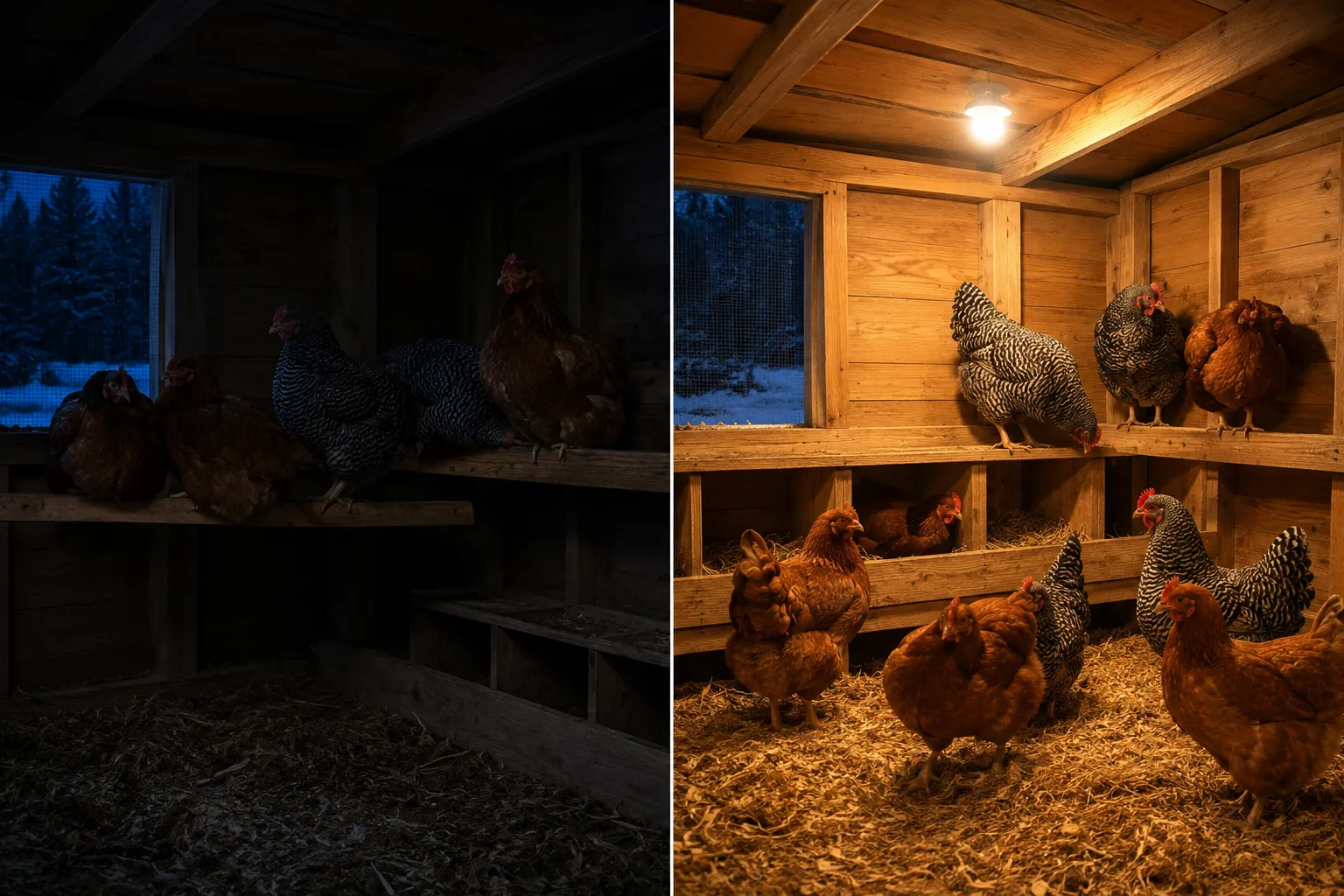
Why Do Chickens Stop Laying Eggs in Winter?
Chickens reduce or stop egg production in winter because shorter daylight hours trigger hormonal changes that shut down their reproductive system. The hen’s pituitary gland responds to light entering through the eye, and when daylight drops below 12-14 hours daily, it stops releasing the hormones needed for egg formation.
This natural slowdown serves an important biological purpose. Winter egg-laying pause allows hens to:
- Conserve energy during cold weather when food was historically scarce
- Molt and replace feathers that provide essential insulation
- Rest their reproductive system after months of continuous egg production
- Rebuild calcium and protein reserves depleted by shell formation
The daylight threshold varies slightly by breed. Production breeds like Leghorns may continue laying with as little as 12 hours of light, while heritage breeds often require 14 hours or more. Age also matters, pullets in their first year often lay through winter better than older hens, even without supplemental light.
Common mistake: Assuming chickens stop laying because of cold temperatures alone. While extreme cold affects production, daylight length is the primary trigger. Well-insulated coops in Alaska still see reduced laying without artificial light, while outdoor flocks in mild Southern winters also slow down as days shorten.
How Does Artificial Light Affect Chicken Egg Production?
Artificial light maintains egg production by tricking the hen’s pituitary gland into continuing hormone release as if spring conditions persisted year-round. When you supplement natural daylight to reach 14-16 total hours, most hens will continue their laying cycle without the winter break.
The mechanism is straightforward: light enters the chicken’s eye and stimulates the hypothalamus, which signals the pituitary gland to release reproductive hormones. These hormones trigger ovulation and egg formation. The hen’s body doesn’t distinguish between natural sunlight and artificial light for this hormonal response.
However, continuous production comes with trade-offs:
Immediate effects:
- Egg production continues at 60-80% of summer rates for most breeds
- Hens skip or delay their natural molt
- Energy demands increase during the coldest months
- Feed consumption rises to support ongoing egg production
Long-term consequences:
- Total lifetime egg production may decrease (hens have a finite number of eggs)
- Reproductive system wear accumulates without rest periods
- Some hens may experience earlier decline in laying quality
- Calcium depletion can occur without proper supplementation
Choose artificial lighting if: You need consistent eggs through winter, keep production breeds, provide high-quality feed year-round, and plan to retire hens after 2-3 years anyway.
Skip artificial lighting if: You prioritize hen longevity, keep heritage breeds, can manage with fewer winter eggs, or want to observe natural chicken behavior and cycles.
How Many Hours of Light Do Chickens Need to Lay Eggs in Winter?
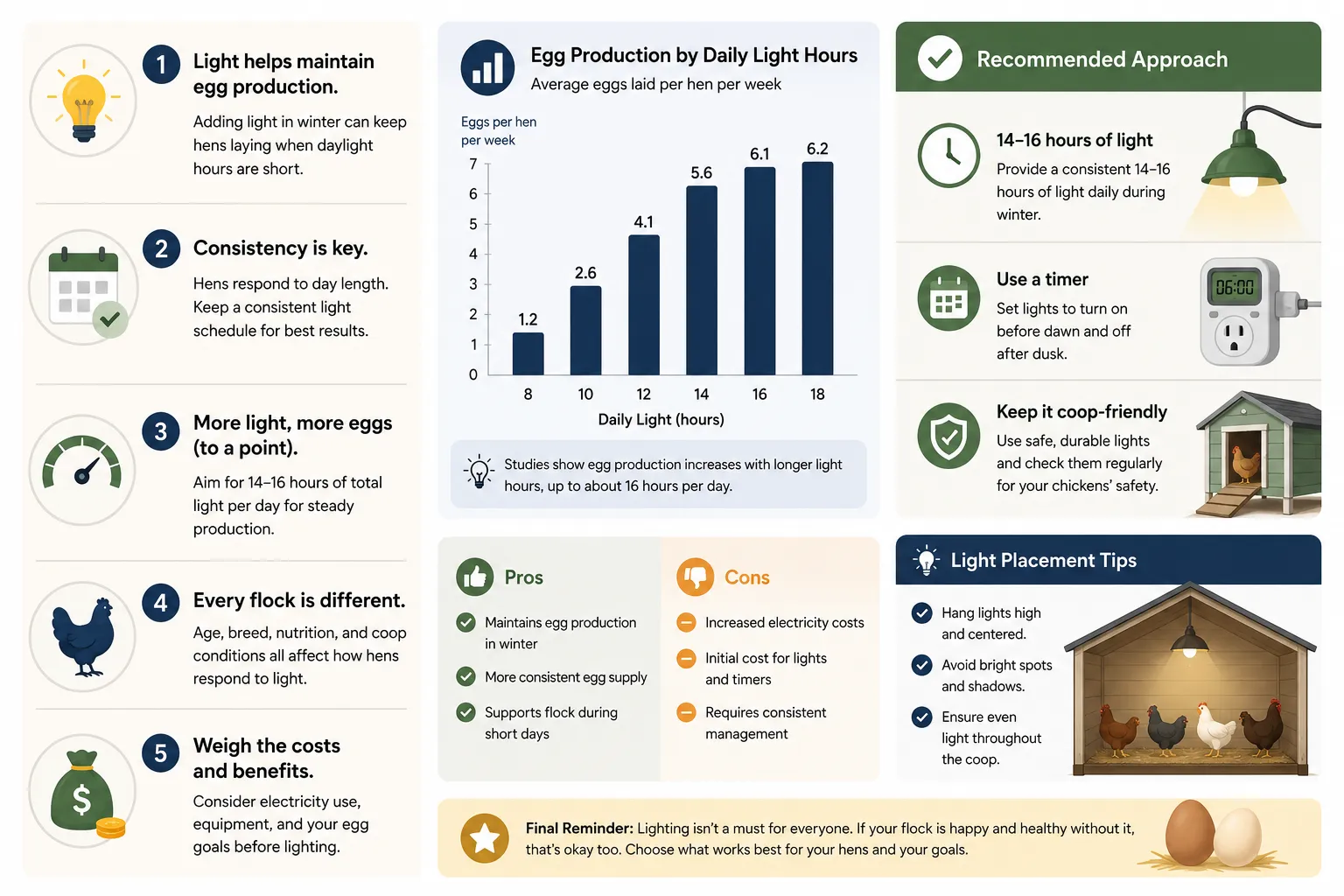
Chickens need 14-16 hours of combined natural and artificial light per day to maintain consistent egg production during winter months. Most experts recommend targeting 14-15 hours as the sweet spot that supports laying without pushing hens into excessive production stress.
Here’s how to calculate your lighting needs:
- Determine natural daylight hours in your location during winter (typically 8-10 hours at the winter solstice in most of the U.S.)
- Calculate the gap to reach 14-15 total hours
- Add light in the morning rather than evening to avoid disrupting natural roosting behavior
Example calculation:
- Natural daylight: 9 hours (December in Ohio)
- Target total: 14 hours
- Supplemental light needed: 5 hours
- Timer setting: Light on at 5:00 AM, off at 10:00 AM when natural light takes over
Why morning lighting works better: Chickens naturally roost at dusk regardless of light levels. If you extend evening light and it suddenly shuts off, hens may be caught away from roosts in darkness, causing stress and potential injury. Morning light allows them to wake gradually and roost naturally at sunset.
Never exceed 16 hours of light. Hens need darkness for proper rest, and excessive light hours can lead to reproductive problems, stress behaviors, and poor egg quality.
Is It Safe to Add Lights to a Chicken Coop?
Adding lights to a chicken coop is safe when you follow basic fire prevention and electrical safety guidelines, but improper installation creates serious fire hazards in the dusty, straw-filled coop environment. Coop fires from heat lamps and poorly installed lighting cause significant losses every winter.
Safe lighting practices:
- Use LED bulbs only (they produce minimal heat and last years)
- Install fixtures rated for damp/dusty locations with protective covers
- Keep all wiring and fixtures away from bedding, roosts, and nesting boxes
- Use GFCI-protected outlets to prevent electrical shocks
- Secure all cords so chickens cannot peck or roost on them
- Never use heat lamps for lighting purposes (extreme fire risk)
Fixture placement guidelines:
- Mount lights at least 6 feet high where possible
- Position away from direct contact with birds
- Ensure bulbs cannot touch any combustible materials
- Use enclosed fixtures that contain broken bulbs
Electrical safety checklist:
- ✓ Outdoor-rated extension cords if running power to the coop
- ✓ Weatherproof junction boxes for any connections
- ✓ Regular inspection for frayed wires or loose connections
- ✓ Proper grounding of all electrical components
- ✓ Consider battery-powered LED options for small coops
Common mistake: Using heat lamps for both warmth and light. Heat lamps cause numerous coop fires annually when they fall, break, or contact bedding. Chickens tolerate cold well with proper shelter, they don’t need supplemental heat in most climates, and lighting should never double as a heat source.
What Kind of Light Bulb Should I Use in a Chicken Coop?
LED bulbs in the 40-60 watt incandescent equivalent range (5-9 actual watts) are the best choice for chicken coops because they’re energy-efficient, produce minimal fire-risk heat, last for years, and provide adequate light intensity for hormone stimulation. Choose bulbs with a color temperature of 5000-6500K (daylight spectrum) for best results.
LED advantages for coops:
- Extremely low heat output (safe around straw and wood)
- 15,000-25,000 hour lifespan (multiple seasons without replacement)
- Minimal electricity cost (pennies per day)
- Instant full brightness in cold temperatures
- Durable construction resists vibration and pecking
Bulb specifications to look for:
- Wattage: 5-9 actual watts (40-60W equivalent)
- Color temperature: 5000-6500K (cool white/daylight)
- Lumens: 450-800 (adequate for most coop sizes)
- Base type: Standard E26 for easy replacement
- Rating: Damp or wet location rated
Bulbs to avoid:
- ❌ Incandescent bulbs (fire hazard, high energy cost, frequent replacement)
- ❌ Heat lamps (extreme fire risk, unnecessary heat)
- ❌ CFLs (contain mercury, perform poorly in cold, fragile)
- ❌ Colored bulbs (red or yellow light may not trigger proper hormonal response)
Coverage rule: One 60W-equivalent LED bulb adequately lights approximately 100-150 square feet of coop space. For larger coops, use multiple fixtures spaced evenly rather than one high-wattage bulb.
Budget option: Basic LED bulbs from hardware stores work fine, you don’t need expensive “poultry-specific” bulbs. A quality LED bulb costs $3-8 and will last several years of daily use.
Pros and Cons of Using Artificial Light for Winter Egg Laying
Pros:
✅ Consistent egg supply through winter months when grocery store prices often rise
✅ Predictable production makes meal planning and egg-selling easier for small farms
✅ Better feed conversion since hens continue productive output rather than just maintenance
✅ Delayed molting can be scheduled for more convenient times
✅ Economic benefit for those selling eggs or relying on home production
✅ Works well with production breeds bred for high output
Cons:
❌ Eliminates natural rest period that allows reproductive system recovery
❌ May reduce total lifetime eggs by accelerating the hen’s finite egg supply
❌ Prevents natural molting which is essential for feather quality and health
❌ Increases winter feed costs to support ongoing production during cold weather
❌ Higher calcium demands without the natural break to rebuild reserves
❌ Potential stress from continuous production without seasonal rhythm
❌ Requires infrastructure (electricity, timers, fixtures) and ongoing monitoring
The middle-ground approach: Some chicken keepers use a compromise strategy, they provide supplemental light for only part of the winter (November through January) to reduce the egg-laying gap without eliminating rest entirely. This gives hens a shorter break while still providing some winter eggs.
Decision framework:
- Use lighting: Production breeds, commercial operations, egg-selling businesses, short-term flock management (2-3 year cycles)
- Skip lighting: Heritage breeds, hobby flocks, long-term hen keeping (5+ years), natural farming philosophy, adequate egg storage from fall surplus
Will Lighting the Coop Stress Out My Chickens?
Gradual, consistent lighting does not significantly stress chickens, but sudden changes in light schedules or abrupt transitions between lit and dark periods can cause behavioral problems and anxiety. The key to stress-free supplemental lighting is consistency and proper timing.
Low-stress lighting practices:
Gradual introduction: When starting supplemental light, increase duration by 30 minutes per week until reaching your target 14-15 hours. Sudden jumps from 9 to 15 hours can disrupt sleep patterns and cause stress behaviors.
Morning-only supplementation: Adding light before dawn allows natural sunset roosting, which is less disruptive than artificial evening light that shuts off suddenly.
Consistent schedule: Use a timer to maintain exact lighting times daily. Chickens thrive on routine, and irregular lighting confuses their circadian rhythms.
Appropriate intensity: Dim lighting (40-60W equivalent) is sufficient, excessively bright lights can cause agitation and prevent proper rest during dark hours.
Signs your lighting is causing stress:
- Increased pecking or aggression
- Hens avoiding the coop during lit hours
- Disrupted roosting patterns
- Decreased feed intake
- Feather picking or other stress behaviors
Common mistake: Using motion-activated lights that turn on and off throughout the night. This severely disrupts sleep and causes significant stress. Lighting should follow a predictable, timer-controlled schedule.
The natural alternative: If you notice stress behaviors after introducing lighting, consider whether the winter egg production is worth the welfare trade-off. Many backyard flock owners find that accepting natural cycles creates calmer, healthier birds.
Natural Egg Laying vs Artificial Light for Backyard Chickens
Natural egg laying follows seasonal rhythms with peak production in spring and summer, reduced laying in fall, and minimal to no eggs in winter, while artificial lighting maintains more consistent year-round production at the cost of eliminating natural rest periods. For backyard chicken keepers, the choice depends on egg needs, flock philosophy, and hen welfare priorities.
Natural egg laying pattern:
- Spring (March-May): Peak production, 5-7 eggs per week per hen
- Summer (June-August): Strong production, 4-6 eggs per week, may slow in extreme heat
- Fall (September-November): Declining production, 2-4 eggs per week
- Winter (December-February): Minimal production, 0-2 eggs per week or complete stop
Artificial lighting pattern:
- Year-round: Consistent 4-5 eggs per week per hen (60-80% of peak rates)
- No seasonal variation in production levels
- Predictable output for planning and potential sales
Natural approach advantages:
- Hens get essential rest and recovery time
- Natural molting produces better feather quality
- Aligns with sustainable, natural farming philosophy
- Lower winter feed costs during non-laying period
- Potentially longer productive lifespan
- No infrastructure or electricity costs
Artificial lighting advantages:
- Consistent egg supply for family needs
- Better economics for egg-selling operations
- Easier flock management with predictable output
- Maximizes production from limited coop space
- Works well with production breeds designed for high output
Hybrid strategies that work:
- Partial supplementation: Light the coop December-January only, allowing rest in late fall and early spring
- Rotating groups: Keep two flocks on opposite schedules so one always produces
- Breed selection: Keep some production breeds (light them) and some heritage breeds (natural cycles) for year-round eggs without lighting everyone
- Preserve surplus: Freeze, water-glass, or pickle abundant spring/summer eggs for winter use
Choose natural cycles if: You keep 6+ hens (surplus spring eggs cover winter gaps), prioritize animal welfare, enjoy seasonal eating patterns, or keep chickens primarily as pets with eggs as a bonus.
Choose artificial lighting if: You have limited coop space, sell eggs, keep fewer than 4 hens, or depend on consistent egg supply for dietary or economic reasons.
How Much Does It Cost to Run a Light in a Chicken Coop All Winter?
Running a single LED light in your chicken coop for winter costs approximately $3-8 for the entire season (November through February) depending on your local electricity rates and daily usage hours. This minimal expense makes supplemental lighting economically viable even for small backyard flocks.
Cost calculation example:
Assumptions:
- 9-watt LED bulb (60W equivalent)
- 5 hours daily supplemental light
- 120 days (4 months of winter)
- $0.13 per kWh (U.S. average residential rate in 2026)
Math:
- Daily consumption: 9 watts × 5 hours = 45 watt-hours = 0.045 kWh
- Daily cost: 0.045 kWh × $0.13 = $0.006 (less than one cent)
- Season cost: $0.006 × 120 days = $0.72
Cost range by electricity rates:
- Low rates ($0.10/kWh): ~$0.54 per season
- Average rates ($0.13/kWh): ~$0.72 per season
- High rates ($0.20/kWh): ~$1.08 per season
Additional costs to consider:
Initial setup:
- LED bulb: $3-8 (lasts multiple years)
- Timer: $8-15 (one-time purchase)
- Fixture (if needed): $10-25
- Extension cord (if needed): $10-20
- Total initial investment: $30-70
Ongoing costs:
- Electricity: $0.70-1.00 per winter
- Bulb replacement: $3-8 every 3-5 years
- Annual operating cost: ~$1-2
Economic comparison:
If each hen produces 2-3 additional eggs per week with lighting (conservative estimate), that’s 8-12 eggs per month per hen, or 32-48 eggs over four winter months. At $4-6 per dozen for quality eggs, the lighting investment pays for itself many times over if you would otherwise buy eggs.
Cost per additional egg: Approximately $0.02-0.04 when factoring in electricity and equipment amortization, far less than purchasing eggs.
Money-saving tip: Use a simple mechanical timer rather than smart plugs or WiFi timers. Basic timers cost less, never lose programming during power outages, and don’t require batteries or internet connectivity.
Do Heritage Breed Chickens Need Coop Lighting in Winter?
Heritage breed chickens are more sensitive to artificial lighting than production breeds and generally respond better to natural seasonal cycles, making supplemental lighting less necessary and potentially more disruptive for these traditional varieties. Most heritage breeds will stop laying almost completely in winter regardless of lighting, and forcing production can compromise their health and longevity.
Why heritage breeds differ:
Heritage breeds like Brahmas, Cochins, Orpingtons, and Plymouth Rocks evolved over centuries with natural seasonal rhythms. Their genetics prioritize:
- Slower maturation and longer productive lifespan
- Strong brooding instincts and mothering abilities
- Cold hardiness and survival traits
- Natural molting and rest periods
Production breeds (Leghorns, Rhode Island Reds, Sex Links) were selectively bred in the 20th century specifically for high egg output and respond more predictably to artificial lighting.
Heritage breed lighting response:
Breeds that may respond to lighting:
- Australorps (dual-purpose, moderate production)
- Plymouth Rocks (relatively good winter layers)
- Rhode Island Reds (heritage strain, not production strain)
Breeds that poorly respond to lighting:
- Brahmas (naturally winter-dormant)
- Cochins (prioritize brooding over laying)
- Silkies (minimal layers year-round)
- Marans (strong seasonal patterns)
Best practices for heritage breeds:
- Allow natural cycles for optimal long-term health and longevity
- Plan for winter egg shortage by keeping adequate flock size
- Preserve summer surplus through freezing or water-glassing
- Focus on breed strengths (meat, brooding, pest control) rather than forcing winter eggs
- If lighting is necessary, use minimal supplementation (12-13 hours total, not 14-16)
Mixed flock strategy: Keep a few production breeds for winter eggs and heritage breeds for other qualities. Light only the production breeds’ section if you have divided coop space, or accept that heritage breeds will free-ride on lighting without significant production increase.
Common mistake: Expecting heritage breeds to match production breed output with lighting. Even with supplemental light, most heritage breeds will lay 1-2 eggs per week in winter versus 4-5 for production breeds.
Common Mistakes When Adding Lights to a Chicken Coop
Mistake 1: Adding evening light instead of morning light
Evening supplementation causes hens to be caught away from roosts when lights suddenly shut off, leading to stress, injuries, and disrupted flock hierarchy. Always supplement morning hours before natural dawn, allowing natural sunset roosting behavior.
Mistake 2: Starting with full 14-16 hour days immediately
Sudden light increases shock the hens’ systems and can cause stress behaviors, temporary laying cessation, or molting. Increase light duration gradually by 30 minutes per week until reaching target hours.
Mistake 3: Using heat lamps for lighting
Heat lamps create extreme fire hazards in coops and provide far more heat than chickens need. Chickens tolerate cold excellently with proper shelter, they need light for laying, not heat. Use LED bulbs only.
Mistake 4: Inconsistent lighting schedules
Manual light switching or unreliable timers disrupt circadian rhythms and reduce lighting effectiveness. Invest in a quality timer and maintain exact daily schedules. Check timer settings weekly.
Mistake 5: Insufficient light intensity
A single dim bulb in a large coop may not provide adequate light intensity to trigger hormonal response. Use 40-60W equivalent LED per 100-150 square feet of coop space.
Mistake 6: Forgetting to adjust timer as days lengthen
In late winter, natural daylight increases. If you don’t reduce supplemental hours accordingly, you may exceed 16 total hours, which stresses hens. Adjust timer monthly to maintain 14-15 total hours.
Mistake 7: Poor electrical safety
Using indoor-rated fixtures, exposed wiring, or improper connections in the dusty, damp coop environment creates fire and shock hazards. Always use outdoor-rated, enclosed fixtures with GFCI protection.
Mistake 8: Lighting without adequate nutrition
Continuous laying depletes calcium and protein reserves. If you light the coop, you must provide layer feed, oyster shell, and adequate protein year-round. Winter production without proper nutrition causes health problems.
Mistake 9: Expecting immediate results
Hens need 2-3 weeks to respond to new lighting schedules. Don’t adjust settings impatiently, give the lighting time to work before making changes.
Mistake 10: Not planning an exit strategy
Starting supplemental lighting mid-winter then stopping abruptly in spring causes confusion and stress. Either commit to gradual phase-out or maintain lighting until natural daylight reaches 14+ hours.
Can You Use a Timer for Chicken Coop Lights?
Yes, using a timer for chicken coop lights is essential for maintaining the consistent daily schedule that chickens need for stress-free supplemental lighting. Manual switching creates irregular patterns that confuse circadian rhythms and reduce lighting effectiveness, making timers a necessary component of any coop lighting system.
Timer types and recommendations:
Mechanical/analog timers (BEST for coops):
- Cost: $8-15
- Pros: Reliable, no batteries, simple programming, works during power outages (resumes schedule automatically)
- Cons: 15-30 minute programming increments, must be manually adjusted seasonally
- Best for: Most backyard coops, set-it-and-forget-it reliability
Digital timers:
- Cost: $12-25
- Pros: Precise minute-by-minute programming, multiple on/off cycles, easier seasonal adjustment
- Cons: Requires battery backup or loses programming during outages
- Best for: Keepers who want precise control and don’t mind occasional reprogramming
Smart plugs/WiFi timers:
- Cost: $15-30
- Pros: Remote control, automatic seasonal adjustment possible, monitoring capabilities
- Cons: Requires WiFi in coop area, dependent on internet connectivity, more expensive
- Best for: Tech-savvy keepers with WiFi-enabled coops
Timer setup instructions:
- Calculate your schedule: Determine sunrise time and how many hours before dawn to start supplemental light
- Set ON time: Program timer to turn light on at calculated pre-dawn time
- Set OFF time: Program timer to turn light off when natural daylight is sufficient (typically 1-2 hours after sunrise)
- Test the system: Verify timer activates correctly for 2-3 days before relying on it
- Monthly adjustment: Check and adjust times as sunrise/sunset times change seasonally
Example winter schedule (Ohio, December):
- Natural sunrise: 7:45 AM
- Target total light: 14 hours
- Natural daylight: 9 hours
- Supplemental needed: 5 hours
- Timer ON: 2:45 AM
- Timer OFF: 7:45 AM (when natural light takes over)
Pro tip: Set your timer 15 minutes earlier than calculated to ensure adequate light before natural dawn. It’s better to slightly exceed 14 hours than fall short.
Backup plan: Keep a spare timer on hand. If your timer fails mid-winter, you’ll want immediate replacement to avoid disrupting the flock’s schedule.
What Happens If I Stop Using Coop Lights After Starting Them?
Stopping supplemental lighting after starting it mid-winter causes hens to experience an abrupt daylight reduction that triggers immediate molt and cessation of laying, often more disruptive than never using lights at all. If you need to stop lighting, gradual reduction over 2-3 weeks minimizes stress and allows hens to adjust to natural cycles.
Immediate effects of sudden light removal:
- Rapid molt: Hens may drop feathers quickly, which is stressful in cold weather
- Complete laying stop: Egg production typically ceases within days
- Behavioral changes: Increased lethargy, reduced activity, possible stress behaviors
- Nutritional stress: Simultaneous molting and cold weather increases feed demands
Gradual phase-out method (recommended):
Week 1: Reduce supplemental light by 1 hour (from 5 hours to 4 hours daily)
Week 2: Reduce by another hour (4 hours to 3 hours daily)
Week 3: Reduce by another hour (3 hours to 2 hours daily)
Week 4: Reduce by final hour (2 hours to 1 hour daily)
Week 5: Discontinue lighting completely
This gradual approach allows hormonal systems to adjust and typically results in slower, less stressful molt and production decline.
Best timing for stopping lights:
Late winter (February-March): Natural daylight is increasing, making transition easier. Hens adjust to natural cycles as spring approaches.
Mid-winter (December-January): Most difficult time to stop. Only do so if absolutely necessary, and use gradual reduction method.
Early winter (November): If you’re having second thoughts about lighting, stop early before hens fully adapt to supplemental schedule.
Planning ahead: Before starting supplemental lighting, commit to maintaining it through winter or plan your phase-out strategy. Starting and stopping impulsively creates more stress than consistent natural darkness.
Emergency situations: If you must stop lighting immediately (equipment failure, electricity concerns, etc.), provide extra feed, ensure excellent coop insulation, and expect 4-6 weeks of adjustment period with no eggs and possible molting.
Common scenario: Many chicken keepers start lighting enthusiastically in November, then feel guilty about “forcing” production and stop abruptly in January. This creates the worst outcome, disruption without the benefits of either natural cycles or consistent production. Make your decision before winter and stick with it.
Alternatives to Artificial Lighting for Winter Egg Production
Several strategies can maintain winter egg availability without artificial lighting, including breed selection, flock size management, egg preservation methods, and optimizing natural light exposure in coop design. These alternatives align with natural chicken-keeping practices while still meeting household egg needs.
Alternative 1: Strategic breed selection
Keep breeds known for better winter laying without lights:
- Australorps: Continue moderate production in winter
- Buff Orpingtons: Cold-hardy with decent winter output
- Easter Eggers: Often lay through mild winters
- Production Rhode Island Reds: Better winter layers than heritage strains
Alternative 2: Larger flock size
If 4 hens produce 24 eggs weekly in summer but only 4 eggs weekly in winter, keeping 8-10 hens provides adequate winter eggs (8-10 weekly) without lighting. The summer surplus can be preserved or shared.
Alternative 3: Egg preservation methods
Preserve abundant spring/summer eggs for winter use:
Water-glassing (sodium silicate): Preserves fresh eggs 12+ months in cool storage. Submerge unwashed eggs in sodium silicate solution.
Freezing: Crack eggs into containers, beat lightly, freeze in portions. Lasts 12 months, works well for baking and scrambling.
Dehydrating: Dry eggs into powder for long-term storage and baking use.
Pickling: Preserve hard-boiled eggs in vinegar brine for 3-4 months.
Alternative 4: Optimize natural light
Maximize natural daylight exposure without artificial supplementation:
- Install large south-facing windows in coop
- Use white or light-colored interior walls to reflect light
- Keep windows clean for maximum light transmission
- Position coop to avoid shade from buildings or trees
- Use clear roofing panels in covered run areas
Alternative 5: Seasonal eating patterns
Embrace seasonal availability as part of sustainable living:
- Adjust recipes and meal planning for winter egg scarcity
- Purchase eggs during winter months only
- Focus on other protein sources (beans, meat, dairy) when eggs are scarce
- View abundant spring eggs as a seasonal treat
Alternative 6: Staggered flock ages
Maintain hens of different ages, pullets in their first winter often lay better than older hens, even without supplemental light. Adding new pullets each spring ensures some birds are in peak production each winter.
Alternative 7: Mobile coops for sun exposure
Chicken tractors or mobile coops can be repositioned to maximize southern sun exposure during short winter days, providing more natural light than fixed coops in shaded locations.
Combination approach: Most successful natural chicken keepers combine several alternatives, keeping 6-8 cold-hardy breeds in a well-lit coop, preserving summer surplus, and accepting reduced winter consumption. This provides year-round egg security without artificial lighting.
Frequently Asked Questions
How long does it take for chickens to start laying again after adding lights?
Chickens typically resume laying 2-3 weeks after introducing supplemental lighting, assuming you’ve gradually increased light hours and provided adequate nutrition. Older hens or those in active molt may take 4-6 weeks to respond.
Can I use solar lights in my chicken coop?
Solar-powered LED lights work for chicken coops if they provide adequate brightness (450+ lumens) and can be connected to a timer for consistent scheduling. Most solar garden lights are too dim for egg production purposes.
Will red light work instead of white light for egg production?
White or daylight-spectrum light (5000-6500K) is most effective for stimulating egg production. Red light may provide some benefit but is less effective at triggering the hormonal response needed for consistent laying.
Do chickens need complete darkness at night even with winter lighting?
Yes, chickens need 8-10 hours of complete darkness for proper rest and health. Never exceed 16 hours of total light, and ensure your coop is dark during nighttime hours.
Can I use a dimmer switch to gradually increase light in the morning?
Gradual dawn simulation with dimmers is ideal but not necessary. Standard on/off timers work fine, chickens adjust to sudden light changes in the morning better than sudden darkness in the evening.
Will lighting affect egg quality or taste?
Supplemental lighting does not significantly affect egg quality, taste, or nutritional content. Feed quality and hen health have much greater impact on egg characteristics than lighting schedules.
How do I know if my light is bright enough?
If you can comfortably read a newspaper anywhere in the coop when the light is on, brightness is adequate. For most coops, a 40-60W equivalent LED provides sufficient intensity.
Should I light the coop if I only have 2-3 chickens?
With only 2-3 hens, winter egg production drops to nearly zero without lighting. If you depend on those eggs, lighting makes sense. If you can buy eggs for a few months, natural cycles may be better for long-term hen health.
Can I use a heat lamp on low setting for both warmth and light?
Never use heat lamps in chicken coops due to extreme fire risk. Chickens don’t need supplemental heat in most climates, and lighting should always be separate from heating considerations.
What if my chickens are molting when I start supplemental lighting?
Wait until molting completes before introducing supplemental lighting. Lighting during active molt can disrupt feather regrowth and cause stress. Allow 6-8 weeks for molt completion, then gradually introduce light.
Do bantam chickens need different lighting than standard breeds?
Bantams respond to the same lighting schedules as standard chickens, 14-16 total hours of light for production. Their smaller size doesn’t change daylight requirements for egg laying.
Will my neighbors complain about coop lights?
Properly installed coop lights should not be visible outside the coop. Use enclosed fixtures, ensure light is directed downward inside the coop, and avoid gaps where light escapes. Morning-only lighting also means lights are off during evening hours when neighbors are most likely to notice.