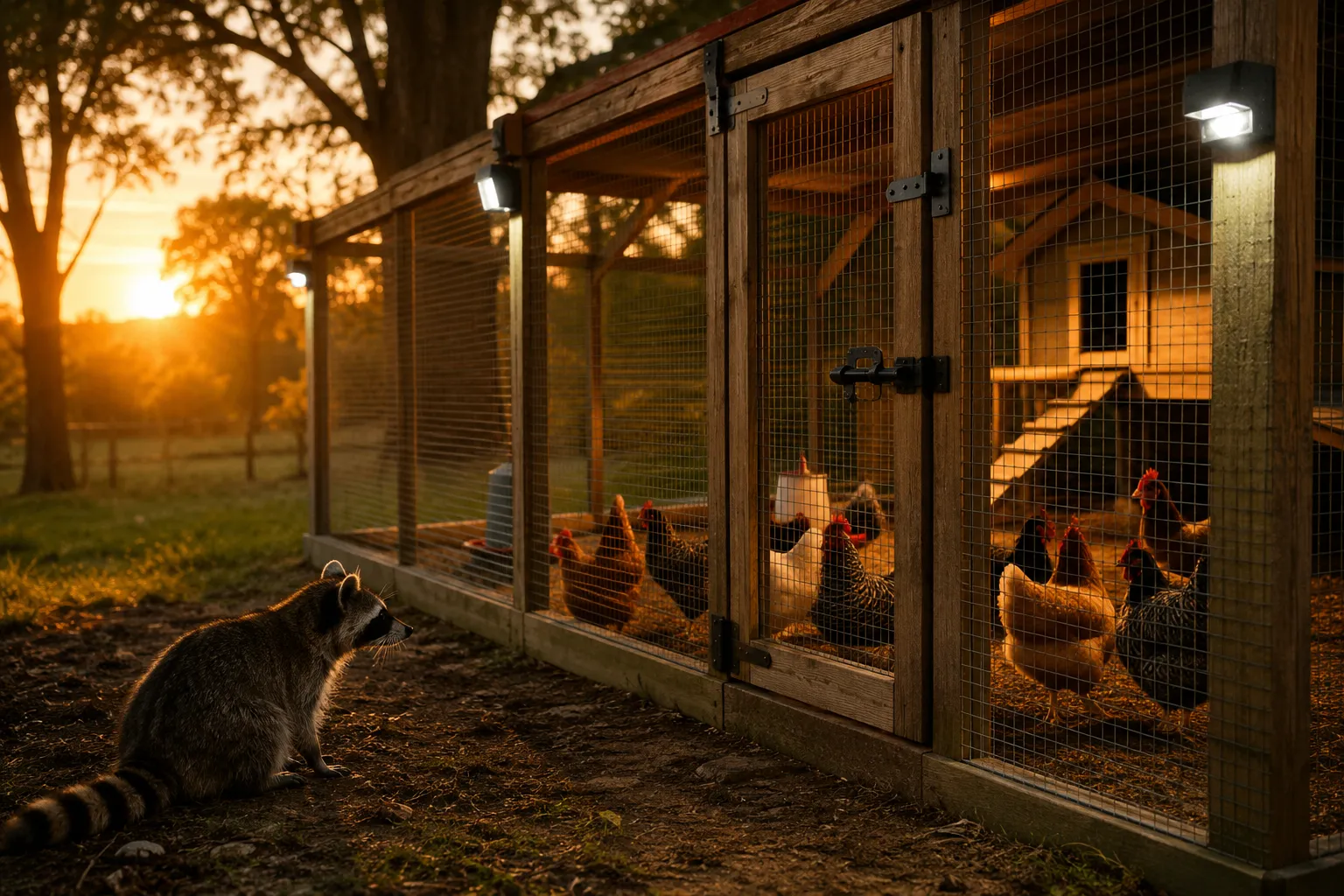
Quick Answer: Protecting chickens from raccoons requires securing your coop with hardware cloth (not chicken wire), installing raccoon-proof latches with carabiners or padlocks, burying fencing at least 12 inches deep, and eliminating gaps larger than 2 inches. Raccoons are intelligent, dexterous predators that hunt at night and can open simple latches, so multiple layers of defense are essential for keeping your flock safe.
Key Takeaways
- Hardware cloth with ½-inch or ¼-inch mesh is essential, chicken wire cannot stop raccoons from reaching through or tearing it open
- Raccoons can open simple hook-and-eye latches, sliding bolts, and basic door handles, use carabiners, padlocks, or complex two-step latches instead
- Bury fencing 12-18 inches deep and extend it outward to prevent raccoons from digging under your coop
- Seal all gaps larger than 2 inches, raccoons can squeeze through surprisingly small openings to access chickens
- Raccoons often kill multiple chickens in one attack and typically return to the same location after a successful hunt
- Motion-activated lights and electric fencing add extra deterrent layers but should supplement, not replace, physical barriers
- Budget-friendly protection is possible using salvaged materials, DIY hardware cloth installation, and strategic reinforcement of vulnerable entry points
- Check local regulations before trapping or removing raccoons, laws vary significantly by state and municipality
What Are Signs That a Raccoon Attacked My Chickens?
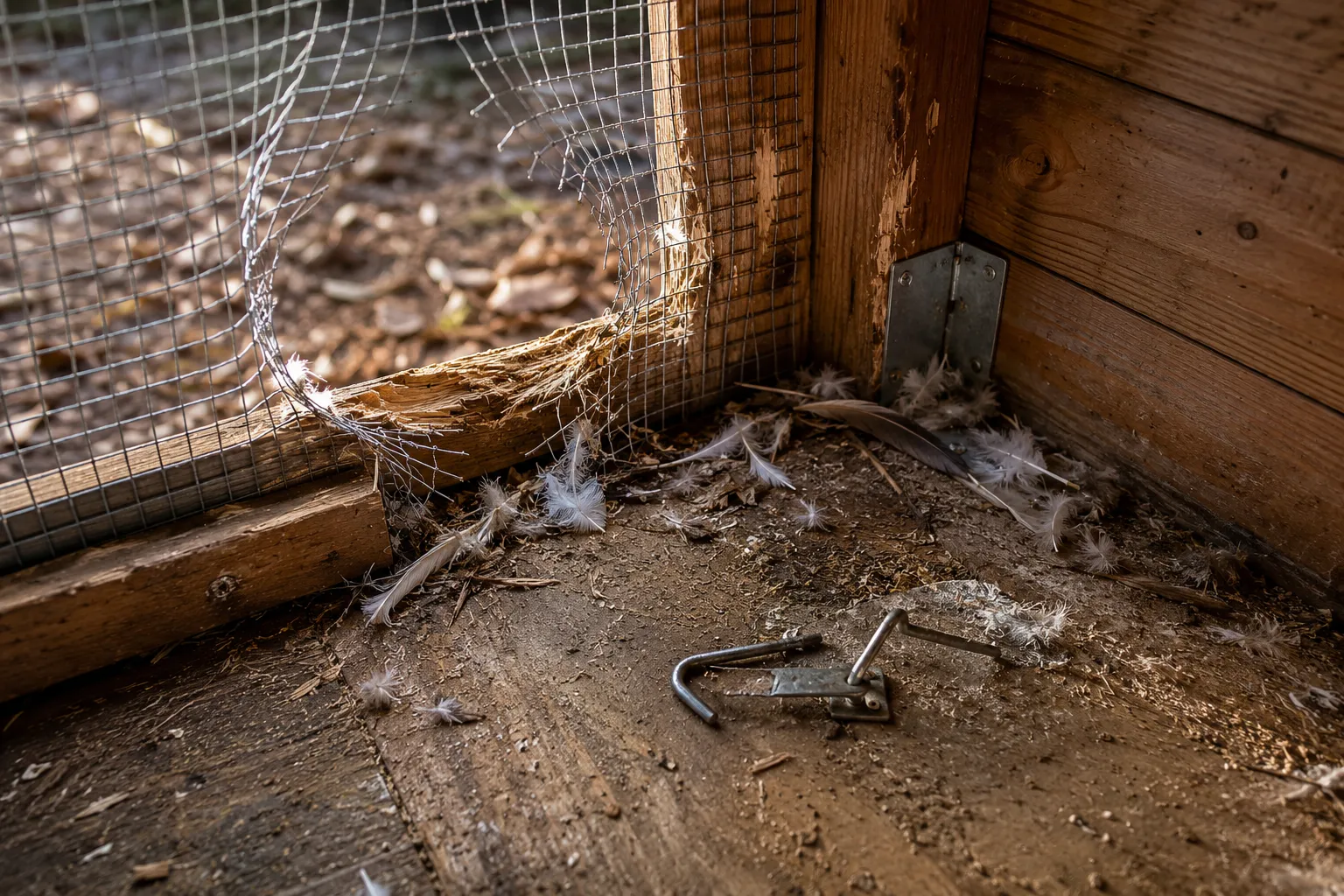
Raccoon attacks leave distinctive evidence that differs from other predators. Chickens killed by raccoons typically have injuries to their heads, necks, and breasts, with the chest often torn open to access internal organs. Raccoons usually kill one or two birds per visit but may kill more in a feeding frenzy, leaving partially eaten carcasses behind.
Look for these specific signs of raccoon activity:
- Claw marks on wooden surfaces, raccoons leave parallel scratch marks from their five-toed paws
- Torn or bent wire mesh, raccoons have strong hands and will pull at weak spots in fencing
- Scattered feathers near coop walls or wire, indicates the raccoon reached through gaps to grab chickens
- Missing heads or upper bodies, raccoons often consume these parts first
- Tracks showing five distinct toes, front paws look almost like small human hands
- Droppings near the coop, raccoon scat is tubular, 2-3 inches long, and often contains undigested food
Common mistake: Many people assume a daytime attack rules out raccoons, but nursing mother raccoons sometimes hunt during daylight hours when they need extra food. However, 95% of raccoon predation occurs at night.
If you find chickens with legs or wings pulled through wire mesh but bodies still inside the coop, that’s a classic raccoon signature. They reach through openings and grab whatever they can access.
How Do Raccoons Get Into Chicken Coops at Night?
Raccoons exploit weak points in coop construction using their intelligence, dexterity, and persistence. They commonly enter through unsecured doors, gaps in siding, ventilation openings, rotted wood, and by digging under fencing. Their nimble front paws can manipulate latches, pull up loose boards, and tear through chicken wire with surprising ease.
Primary entry methods include:
- Opening latches and doors, raccoons can lift hook-and-eye closures, slide simple bolts, and turn some door handles
- Digging under walls and fencing, they excavate 6-12 inches down to tunnel beneath barriers
- Climbing and entering through roof vents, raccoons are excellent climbers and will access elevated openings
- Tearing through chicken wire, their strength allows them to rip or bend thin wire mesh
- Squeezing through gaps, they can compress their bodies to fit through openings as small as 3-4 inches
- Pulling apart weak construction joints, corners, door frames, and window edges are vulnerable spots
Edge case to consider: Raccoons will test your coop’s defenses methodically. If they find one entry point blocked, they’ll search for another. After a successful kill, they memorize the location and return repeatedly, so immediate repairs after any breach are critical.
Raccoons also work in groups occasionally. A mother with juveniles may bring her young to a food source, resulting in multiple raccoons attacking simultaneously and causing more damage than a single predator.
Best Locks for Chicken Coop Doors to Keep Raccoons Out
Simple latches fail against raccoons because their front paws function almost like hands, with individual digit control. The most effective locks require two separate motions or opposing forces that raccoons cannot coordinate: carabiners, combination padlocks, barrel bolts with padlocks, and double-action latches that require squeezing and lifting simultaneously.
Raccoon-proof locking options ranked by effectiveness:
| Lock Type | Effectiveness | Cost Range | Installation Difficulty |
|---|---|---|---|
| Carabiner clips (spring-loaded) | Excellent | $3-8 each | Very easy |
| Combination padlock | Excellent | $8-15 | Easy |
| Barrel bolt + padlock | Excellent | $10-20 | Moderate |
| Two-step squeeze latches | Very good | $12-25 | Easy |
| Slide bolts at top and bottom | Good (if both used) | $6-12 | Easy |
| Hook-and-eye latches | FAILS | $2-5 | Easy |
| Simple sliding bolts | FAILS | $3-8 | Easy |
Choose carabiners if: You want the cheapest effective solution and don’t mind the industrial look. Spring-loaded carabiners from climbing or hardware stores work perfectly and cost just a few dollars.
Choose combination padlocks if: You have multiple people accessing the coop and don’t want to manage keys. Make sure everyone knows the combination.
Choose barrel bolts with padlocks if: Your door frame allows for recessed installation and you want maximum security with a traditional appearance.
Common mistake: Installing a great lock on the main door but leaving pop doors (chicken-sized openings) secured with only a simple latch. Raccoons will find and exploit the weakest entry point, so every access point needs equal protection.
For automatic coop doors, ensure the mechanism has enough closing force to resist a raccoon pushing against it, and that the door itself has no gaps when closed.
Hardware Cloth vs Chicken Wire for Raccoon Protection
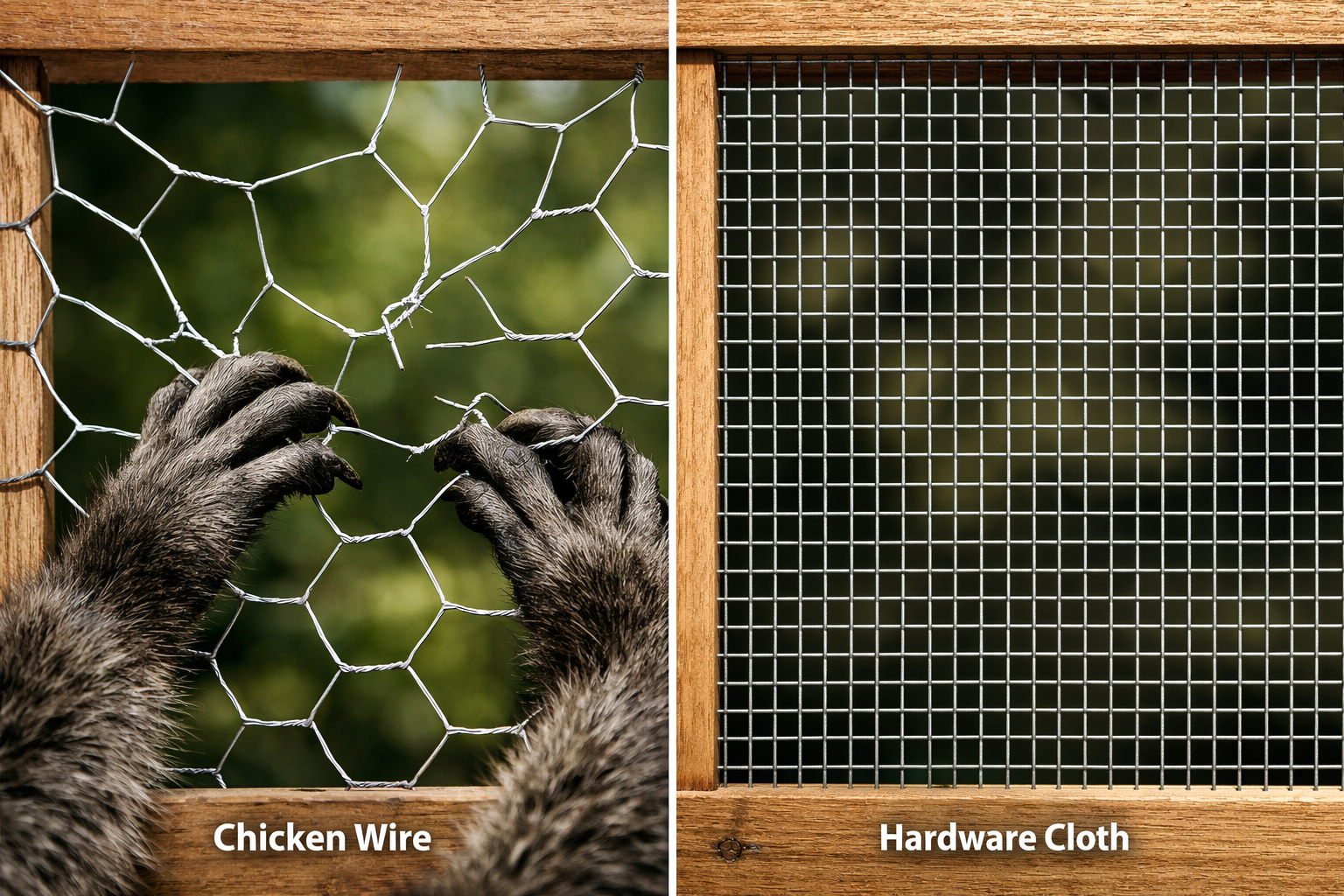
Hardware cloth is essential for raccoon protection, while chicken wire is inadequate and dangerous. Hardware cloth is welded wire mesh made from thicker gauge wire (typically 23-gauge or heavier) with small, square openings of ½-inch or ¼-inch. Chicken wire is thin, twisted hexagonal wire with 1-inch openings that raccoons easily tear, bend, or reach through.
Critical differences:
Hardware Cloth (½-inch or ¼-inch mesh):
- Welded at intersections, creating a rigid grid
- Prevents raccoons from reaching through to grab chickens
- Resists tearing and bending from predator attacks
- Costs $1.50-3.00 per square foot
- Heavier and requires more support when installing
- Lasts 10-20+ years with galvanized coating
Chicken Wire (1-inch hexagonal mesh):
- Twisted wire that unravels when cut or stressed
- Raccoons easily reach through to grab chickens by legs, wings, or necks
- Tears under moderate force from predators
- Costs $0.30-0.80 per square foot
- Lightweight and easy to install
- Designed only to keep chickens contained, not predators out
The brutal reality: Chickens killed through chicken wire die terrified and in pain as raccoons pull them against the mesh and tear off accessible body parts. This is one of the most common and preventable causes of flock loss.
Where to use hardware cloth:
- All windows and ventilation openings
- Run walls and ceiling (if not solid roofed)
- Any opening in the coop structure
- Buried as an apron around the perimeter
- Over existing chicken wire for budget retrofits
Budget tip: If you cannot afford to replace all chicken wire immediately, prioritize the bottom 3 feet of all walls (where raccoons reach through most often) and all door/window openings. You can add hardware cloth in sections as budget allows.
How Much Does Electric Fencing Cost for Chicken Coops?
Electric fencing for chicken coops typically costs $150-400 for a complete system covering a standard backyard setup. A basic solar-powered electric fence charger runs $80-150, polywire or polytape costs $20-40 per 200 feet, and insulators and posts add another $50-100. Operating costs are minimal, with solar units requiring no electricity and battery-powered units using about $10-20 annually in batteries.
Complete electric fence budget breakdown:
Fence charger (energizer): $80-200
- Solar-powered: $120-200 (best for remote coops)
- Battery-powered: $80-150 (requires periodic battery replacement)
- AC-powered: $60-120 (cheapest but needs electrical outlet)
Wire/tape: $20-60
- Polywire (200 ft): $20-30
- Polytape (200 ft, more visible): $30-50
Posts and insulators: $50-100
- Fiberglass or plastic posts: $2-4 each (need 8-15)
- Insulators: $0.50-2 each (need 15-30)
Ground rod and connectors: $20-40
Total first-time setup: $170-400 depending on perimeter size and charger type.
Choose electric fencing if: You have a large run area where hardware cloth would be prohibitively expensive, you’re dealing with persistent predator pressure, or you want an additional deterrent layer beyond physical barriers.
Don’t rely solely on electric fencing because: Raccoons can sometimes tolerate brief shocks, vegetation can ground out the fence reducing effectiveness, and power failures leave your flock vulnerable. Electric fencing works best as a supplement to solid physical barriers, not a replacement.
Run electric wire 4-6 inches off the ground and again at 12 inches to create two shock zones. Raccoons approaching on all fours will touch their nose to the lower wire, receiving a memorable deterrent shock.
Will Motion-Activated Lights Keep Raccoons Away From Chickens?
Motion-activated lights provide moderate deterrent value but should never be your primary defense. Raccoons initially startle at sudden bright lights, but they quickly habituate to them, especially when food (your chickens) is the reward. Lights work best as one layer in a multi-faceted protection strategy, buying you time to hear disturbances and adding psychological pressure to predators.
Effectiveness factors:
- First-time deterrent: 60-70% effective at discouraging initial approach
- After habituation (2-3 weeks): 20-30% effective as raccoons learn lights pose no real threat
- Combined with other deterrents: Significantly more effective when paired with physical barriers and noise
Best practices for motion lights:
- Position lights to illuminate all coop approaches, raccoons avoid well-lit areas when easier targets exist nearby
- Use bright LED lights (800+ lumens), dim lights provide insufficient deterrent
- Adjust sensitivity to avoid constant triggering, too many false alarms from wind or small animals reduce effectiveness
- Pair with motion-activated alarms or radios, sound plus light creates stronger deterrent than light alone
- Rotate light positions monthly, prevents complete habituation to predictable patterns
Reality check: A hungry raccoon will tolerate bright lights to access an easy meal. Lights may discourage casual exploration but won’t stop a determined predator that has already identified your coop as a food source.
Budget alternative: Solar-powered motion lights cost $15-30 each and require no wiring, making them an affordable supplemental defense. Place 2-3 units around your coop for overlapping coverage.
The real value of motion lights is alerting you to nighttime activity. If you hear your chickens alarming and see lights triggering, you can intervene before a predator gains entry.
Do Raccoons Eat Chickens or Just Kill Them?
Raccoons both eat chickens and kill more than they consume. They typically eat the head, neck, crop, and breast meat first, often leaving the rest of the carcass behind. In a phenomenon called “surplus killing,” raccoons sometimes kill multiple chickens in one visit when prey is abundant and easily accessible, consuming only small portions of each bird.
Typical raccoon feeding pattern:
- First priority: Head and brain (high fat and nutrient content)
- Second priority: Breast meat and internal organs (heart, liver)
- Often left behind: Legs, wings, lower body, feathers
- Eggs: Raccoons also raid nests, breaking and eating eggs when available
Why surplus killing happens:
Raccoons evolved to maximize food acquisition when opportunity presents itself. In the wild, prey doesn’t come in convenient packages, so killing multiple animals when possible is an adaptive survival strategy. Unfortunately, confined chickens trigger this instinct because they cannot escape, leading to devastating flock losses.
What to expect after an attack:
- 1-3 chickens killed and partially eaten in most attacks
- 5-10+ chickens killed in surplus killing events (more common with young or inexperienced raccoons)
- Remaining carcasses left in or near the coop
- Return visits on subsequent nights if the entry point remains accessible
Important distinction: Unlike foxes (which often carry away entire chickens) or weasels (which kill by biting the back of the neck), raccoons typically kill and feed on-site, leaving clear evidence of their presence.
Can Raccoons Open Latches and Simple Locks on Coops?
Yes, raccoons can open most simple latches, hooks, sliding bolts, and even some lever-style door handles. Their front paws have remarkable dexterity, with five separate digits that can grip, pull, lift, and manipulate objects. Research shows raccoons can solve complex puzzles and remember solutions for up to three years, making them one of the most challenging predators to exclude.
Latches raccoons commonly defeat:
- ✗ Hook-and-eye latches (lifted easily)
- ✗ Simple sliding bolts (pushed or pulled open)
- ✗ Bungee cords (stretched and unhooked)
- ✗ Twist-tie wire (unwound with persistence)
- ✗ Single-action snap closures (pressed or pulled)
- ✗ Lightweight magnetic catches (pulled apart)
- ✗ Lever door handles (pushed down)
Latches that successfully stop raccoons:
- ✓ Carabiner clips (cannot coordinate the spring-loaded gate)
- ✓ Padlocks (lack the strength and dexterity for keys or combinations)
- ✓ Two-step latches requiring simultaneous squeeze and lift
- ✓ Barrel bolts with padlocks
- ✓ Complex puzzle latches requiring 3+ separate motions
The intelligence factor: Raccoons learn through trial and error. If a latch requires only one motion (lift, slide, or pull), they’ll eventually figure it out. Effective locks require either opposing forces (squeeze while lifting) or tools (keys) that raccoons cannot use.
Real-world test: If you can open your coop latch with one hand while holding a flashlight in the other, a raccoon can probably open it too. The gold standard is requiring two hands performing different actions simultaneously.
Edge case: Some raccoons are more persistent problem-solvers than others. If you have a particularly clever individual in your area, you may need to upgrade to padlocks even if simpler two-step latches work against most raccoons.
How to Raccoon-Proof a Chicken Run on a Budget
Raccoon-proofing on a budget requires strategic material choices and focusing protection on the most vulnerable areas first. You can secure a basic chicken run for $100-200 by using hardware cloth only where raccoons can reach through, burying a wire apron instead of deep fencing, and sourcing materials from farm stores or online bulk suppliers rather than retail hardware stores.
Budget-friendly protection steps:
Cover the bottom 3 feet of all run walls with ½-inch hardware cloth ($50-80 for 25-foot roll)
- This is where raccoons reach through most often
- Leave existing chicken wire above 3 feet if budget is tight
Create a buried wire apron instead of deep fencing ($30-50)
- Lay hardware cloth or welded wire flat on the ground extending 18 inches outward from run perimeter
- Secure with landscape staples or rocks
- Raccoons dig down at the fence line and hit the barrier
Reinforce doors and openings with scrap wood and hardware cloth ($10-20)
- Cover gaps with hardware cloth scraps
- Add 2×4 framing to strengthen weak spots
- Use free pallets for additional structural support
Install carabiner clips on all doors ($10-15)
- Cheapest effective lock option
- One per door, plus one for any pop doors
Add a single strand of electric wire at nose height ($80-120 if needed)
- Optional but highly effective deterrent
- Solar charger eliminates operating costs
Money-saving sourcing tips:
- Buy hardware cloth in bulk online, 50-100 foot rolls cost 30-40% less per foot than small rolls at retail stores
- Check farm supply stores, often cheaper than big-box hardware stores for fencing materials
- Use T-posts instead of wooden posts, $3-5 each versus $8-15 for treated wood posts
- Salvage materials, free pallets, reclaimed lumber, and used T-posts from farm auctions
- Join local chicken groups, members often have leftover materials from their own projects
Prioritization strategy if funds are very limited:
- First $50: Hardware cloth for bottom 3 feet of walls where chickens roost
- Next $30: Carabiner locks for all doors and buried wire apron
- Next $50: Hardware cloth for remaining vulnerable openings
- Next $70: Complete hardware cloth coverage or electric fence addition
Common budget mistake: Buying chicken wire because it’s cheaper. This is false economy, you’ll lose chickens worth far more than the cost difference, plus the emotional toll. Save up for proper materials rather than installing inadequate protection.
Are Guardian Dogs or Guinea Fowl Better for Protecting Chickens From Raccoons?
Livestock guardian dogs (LGDs) provide superior protection against raccoons compared to guinea fowl, but they require significant investment, training, and commitment. Guardian dogs actively patrol, confront predators, and can physically prevent attacks, while guinea fowl primarily serve as alarm systems that alert you to danger but cannot stop a determined raccoon.
Livestock Guardian Dogs:
Pros:
- Actively patrol and mark territory, deterring raccoons from approaching
- Physically capable of fighting off or killing raccoons
- Work 24/7 without human intervention
- Protect against multiple predator types (raccoons, foxes, coyotes, hawks)
- Bond with flock and genuinely guard them
Cons:
- High initial cost ($500-2,000+ for trained LGD)
- Require secure fencing to prevent roaming
- Need proper training and socialization (6-12 months)
- Food costs $50-100+ monthly for large breeds
- Veterinary care expenses
- Not suitable for small urban/suburban yards
- May bark excessively, disturbing neighbors
Best LGD breeds for chicken protection: Great Pyrenees, Anatolian Shepherd, Maremma, Akbash
Guinea Fowl:
Pros:
- Loud alarm calls alert you to predator presence
- Low cost ($5-15 per bird)
- Self-sufficient foragers requiring minimal feed
- Eat ticks and insects, providing pest control
- No special training required
Cons:
- Cannot physically stop raccoons from attacking
- Noisy at all hours (not just during threats)
- May harass chickens or steal their food
- Vulnerable to the same predators as chickens
- Fly well and may roost in trees or leave property
- Alarm calls don’t distinguish between real threats and minor disturbances
Choose an LGD if: You have acreage, budget for ongoing care, and face persistent predator pressure from multiple species. LGDs work best on properties of 1+ acres where they can patrol effectively.
Choose guinea fowl if: You want an early warning system, have tolerant neighbors, and will respond to alarms by checking on your flock. Guinea fowl supplement but don’t replace physical security measures.
Reality check: Neither option eliminates the need for secure coops with proper hardware cloth, raccoon-proof latches, and buried fencing. Both serve as additional deterrent layers, not primary defenses. A raccoon can kill chickens in minutes while your dog is patrolling another area or before you respond to guinea fowl alarms.
Common Mistakes People Make When Securing Chicken Coops From Predators
The most critical mistake is assuming chicken wire provides adequate protection. This single error accounts for more chicken losses than any other security failure. Beyond that, people commonly underestimate raccoon intelligence, leave gaps in their defenses, and fail to maintain security measures over time.
Top security mistakes and how to avoid them:
1. Using chicken wire instead of hardware cloth
- Why it fails: Raccoons tear through or reach through 1-inch openings
- Fix: Replace with ½-inch or ¼-inch hardware cloth on all openings
2. Installing great locks on main doors but simple latches on pop doors
- Why it fails: Raccoons find and exploit the weakest entry point
- Fix: Use identical security on every access point, no matter how small
3. Leaving gaps larger than 2 inches anywhere in the structure
- Why it fails: Raccoons squeeze through surprisingly small openings
- Fix: Inspect every seam, corner, and joint; seal with hardware cloth or wood
4. Failing to bury fencing or create a dig barrier
- Why it fails: Raccoons dig under fences in 15-30 minutes
- Fix: Bury fencing 12-18 inches deep or lay wire apron extending 18 inches outward
5. Assuming predators only attack at night
- Why it fails: Nursing mother raccoons sometimes hunt during daylight
- Fix: Maintain security 24/7, not just overnight
6. Not inspecting and maintaining security measures regularly
- Why it fails: Wood rots, wire rusts, latches loosen, and gaps develop over time
- Fix: Monthly security inspections, immediate repairs of any damage
7. Leaving feed accessible outside the secure coop
- Why it fails: Feed attracts raccoons to the area, increasing attack likelihood
- Fix: Store all feed in metal containers inside secure buildings
8. Thinking motion lights or noise alone will stop attacks
- Why it fails: Hungry raccoons tolerate deterrents when food is the reward
- Fix: Use lights and sound as supplements to physical barriers, not replacements
9. Not securing the coop roof or assuming raccoons won’t climb
- Why it fails: Raccoons are excellent climbers and will access roof openings
- Fix: Cover all ventilation with hardware cloth; ensure roof has no gaps
10. Delaying repairs after discovering a weak point
- Why it fails: Raccoons return to successful hunting locations repeatedly
- Fix: Make emergency repairs immediately, even temporary ones, until permanent fixes are complete
The compounding effect: Multiple small security gaps create major vulnerability. A raccoon that can’t dig under your fence will test your door latches. If those hold, it will look for gaps in your walls. Comprehensive security means eliminating all weak points, not just the most obvious ones.
Will a Raccoon Come Back After Killing Chickens Once?
Yes, raccoons almost always return after a successful kill, often within 24-48 hours. Raccoons have excellent spatial memory and remember productive food sources for months or even years. Once a raccoon identifies your coop as an easy meal, it will return repeatedly until the entry point is secured or the raccoon is removed.
Return behavior patterns:
- First return: Usually the next night (70-80% probability)
- Continued visits: Every 1-3 nights until food source is exhausted or access is blocked
- Teaching behavior: Mother raccoons bring juveniles to successful hunting sites, multiplying your problem
- Seasonal patterns: More persistent returns during spring/summer when feeding young, and fall when building fat reserves for winter
Why raccoons return reliably:
Raccoons are opportunistic omnivores that optimize their foraging efficiency. Finding a location with abundant, easy-to-access protein is a jackpot in raccoon terms. They mentally map productive food sources and incorporate them into regular patrol routes.
What to do immediately after an attack:
- Make emergency repairs that same night, even temporary barriers are better than nothing
- Remove any remaining carcasses, the scent attracts return visits
- Clean blood and feathers thoroughly, reduces scent markers
- Upgrade all locks and seal all gaps, the raccoon knows exactly how it entered
- Consider setting a live trap, check local regulations first
- Expect return attempts for 1-2 weeks, monitor closely during this period
The multiplication problem: If you don’t secure the entry point immediately, the successful raccoon may bring family members or other raccoons may notice the activity and investigate. One breach can lead to multiple predators targeting your coop.
Long-term memory: Even after you secure your coop, raccoons may test it periodically for months. They remember the location and will check if circumstances have changed (storms damaging repairs, seasonal wood warping creating new gaps, etc.).
How Small of a Gap Can a Raccoon Squeeze Through to Get to Chickens?
Raccoons can squeeze through openings as small as 3-4 inches in diameter, though they prefer larger gaps of 5-6 inches or more. Their bodies are surprisingly compressible because they lack a rigid collarbone, allowing them to flatten their chest and contort through spaces that appear too small for their size.
Size guidelines for secure construction:
- Seal all gaps larger than 2 inches, this provides a safety margin below raccoon capability
- Use ½-inch or ¼-inch hardware cloth, prevents reaching through even if they can’t enter
- Pay special attention to corners and joints, these naturally create gaps as wood ages and shifts
- Check where different materials meet, wood-to-metal and wood-to-wire transitions often leave spaces
Common gap locations raccoons exploit:
- Door frames and thresholds, warped wood creates gaps at top and bottom
- Window edges, especially older windows with rotted frames
- Ventilation openings, often sized for airflow without considering predator access
- Roof eaves and soffits, gaps where roof meets walls
- Floor-to-wall joints, particularly in raised coops
- Corners where walls meet, construction joints naturally leave small spaces
- Around pipes or wires, utility penetrations rarely sealed properly
Testing your coop security:
Run your hand along every seam, corner, and joint from inside the coop. If you can fit three fingers through a gap, a raccoon can likely squeeze through. If you can fit your whole hand through, a raccoon will enter easily.
The reach-through danger: Even gaps too small for entry allow raccoons to reach inside and grab chickens. Their arms extend 10-12 inches, so chickens roosting within a foot of any opening are vulnerable. This is why hardware cloth (which prevents reaching through) is essential even when gaps are too small for full body entry.
Seasonal consideration: Gaps that seem secure in summer may expand in winter as wood contracts, or shrink in humid seasons as wood swells. Inspect your coop quarterly and after extreme weather events.
Is It Legal to Trap or Shoot Raccoons That Are Killing My Chickens?
Legality varies significantly by state, county, and municipality, so you must check local regulations before taking any action. Most jurisdictions allow property owners to protect livestock from active predation, but the specific methods permitted (trapping, shooting, relocating, or hiring professionals) and required permits differ widely.
General legal framework (verify locally):
Trapping:
- Live trapping: Usually legal with restrictions on trap type, check frequency, and animal handling
- Lethal trapping: Often requires special permits or trapper certification
- Relocation: Illegal in many states due to disease transmission concerns and poor survival rates
- Trap check requirements: Most states require checking traps every 12-24 hours
Shooting:
- On your property: Generally legal if you can do so safely and during predation or immediate threat
- Firearm restrictions: Must comply with local discharge ordinances (often prohibited in city limits)
- Hunting seasons: Some states require hunting licenses even for nuisance animals
- Nighttime shooting: Additional restrictions often apply
Hiring professionals:
- Licensed trappers: Legal in all states; professionals know local regulations
- Wildlife control operators: Certified for humane removal
- Cost: $150-400 for assessment and removal of 1-3 animals
State-by-state variation examples:
- California: Relocation prohibited; must release on property or euthanize
- Texas: Property owners may trap/shoot raccoons damaging property without permit
- New York: Requires nuisance wildlife control permit for most removal methods
- Florida: Allows lethal removal during active predation; relocation requires permit
Before taking action:
- Contact your state wildlife agency, they provide specific guidance for your location
- Check municipal ordinances, cities often have stricter rules than state law
- Document the predation, photos of damage help if legality is questioned
- Consider hiring professionals, they handle legal compliance and disposal
Ethical considerations:
Even where legal, lethal removal should be humane and used only when prevention has failed. Raccoons are intelligent, sentient animals doing what comes naturally. Securing your coop properly is more ethical and effective than ongoing predator removal, since new raccoons will move into vacant territories.
The prevention-first approach: Focus 90% of your effort on making your coop impenetrable rather than removing individual raccoons. One raccoon removed creates territory for another to claim. A properly secured coop protects your flock indefinitely regardless of how many raccoons live nearby.
Frequently Asked Questions
What time of night do raccoons usually attack chicken coops? Raccoons typically attack between dusk and midnight, with peak activity 1-3 hours after sunset. They may also hunt in the pre-dawn hours between 4-6 AM. Attacks are most common during new moon periods when darkness provides better cover.
Can raccoons kill chickens through chain link fencing? Yes, raccoons can reach through chain link fencing (which typically has 2-inch openings) and grab chickens by legs, wings, or necks. They pull the chicken against the fence and tear off accessible body parts. Cover chain link with hardware cloth to prevent this.
How many chickens will a raccoon kill in one night? Raccoons typically kill 1-3 chickens per visit but may kill 5-15 or more in surplus killing events, especially when chickens are confined and cannot escape. They usually eat only portions of 1-2 birds even when killing many.
Do raccoons attack during the day or only at night? Raccoons are primarily nocturnal and conduct 95% of attacks at night. However, nursing mothers with high caloric needs sometimes hunt during daylight hours, particularly in early morning or late afternoon. Daytime raccoon sightings may also indicate rabies or distemper.
Will a rooster protect hens from raccoon attacks? No, roosters cannot effectively protect hens from raccoons. While roosters may sound alarms and attempt to defend the flock, they are no match for a raccoon’s size, strength, and predatory skills. Physical barriers are essential; roosters alone provide inadequate protection.
How high should chicken coop fencing be to keep raccoons out? Fencing should be at least 4-5 feet tall, but height alone doesn’t stop raccoons since they’re excellent climbers. More important is using hardware cloth instead of chicken wire, burying or creating an apron barrier at ground level, and securing the top if the run isn’t fully roofed.
Can raccoons open combination locks or just simple latches? Raccoons cannot open combination locks or key locks because they lack the dexterity for the precise sequential movements required. They can only open single-motion latches like hooks, slides, and simple bolts. Combination locks provide excellent security.
What smells deter raccoons from chicken coops? No scent provides reliable deterrence. Raccoons tolerate ammonia, predator urine, cayenne pepper, and commercial repellents when food is the reward. Some people report temporary success with these methods, but raccoons quickly habituate. Physical barriers are the only dependable protection.
Should I leave lights on in my chicken coop all night to deter raccoons? Constant lighting provides minimal deterrent value and disrupts chicken sleep cycles, reducing egg production and causing stress. Motion-activated lights are more effective as they startle approaching predators while allowing chickens to rest in darkness.
How much does it cost to fully raccoon-proof a chicken coop? Complete raccoon-proofing costs $200-600 for a standard backyard coop (8×10 feet), including hardware cloth for all openings, buried fencing or apron barriers, raccoon-proof locks, and reinforcement materials. Larger coops or runs cost proportionally more based on square footage.
Do electric fences hurt chickens or just raccoons? Electric fences positioned 4-6 inches off the ground do not hurt chickens because chickens don’t typically walk into them. Chickens that do touch the wire receive a brief, harmless shock. The fence primarily deters ground predators like raccoons that approach nose-first.
Will raccoons dig under a concrete foundation to reach chickens? No, raccoons cannot dig through concrete. Coops built on concrete slabs or with concrete foundations extending 12+ inches below ground are secure from digging predators. However, ensure no gaps exist where walls meet the foundation.
Conclusion
Protecting chickens from raccoons requires multiple layers of defense, with physical barriers forming the foundation of any effective strategy. Hardware cloth with ½-inch or smaller mesh, raccoon-proof locks requiring two-step operation or keys, and buried fencing or wire aprons prevent the vast majority of attacks. Simple deterrents like motion lights and noise provide supplemental value but cannot replace solid construction and proper materials.
The investment in raccoon-proofing pays for itself quickly when compared to the cost of lost chickens, both financially and emotionally. A properly secured coop protects your flock for years, while inadequate measures lead to repeated losses and ongoing stress.
Take these actions today:
- Inspect your coop thoroughly, identify every gap larger than 2 inches and every simple latch
- Replace chicken wire with hardware cloth, start with the bottom 3 feet of walls if budget is limited
- Upgrade all latches to carabiners or padlocks, this single change prevents most break-ins
- Create a dig barrier, bury fencing 12-18 inches deep or install a wire apron
- Establish a monthly inspection routine, catch and repair small problems before they become entry points
Remember that raccoons are intelligent, persistent predators that will test your defenses repeatedly. The time and money you invest in proper security measures now will save you from the heartbreak of finding your flock decimated by a preventable attack. Your chickens depend on you to create a safe environment where they can thrive without fear of nighttime predators.