
Quick Answer: Introducing new chickens to your flock requires a 30-day quarantine period, followed by a gradual visual introduction through fencing, and finally supervised physical integration. The process typically takes 2-4 weeks after quarantine and works best when you introduce multiple birds at once rather than a single chicken, giving newcomers allies and reducing targeted aggression from the established pecking order.
Key Takeaways
- Quarantine all new chickens for 30 days in a separate coop at least 30 feet from your existing flock to prevent disease transmission
- Visual introduction through fencing for 1-2 weeks allows birds to see and hear each other without physical contact
- Introduce at night by placing new birds on the roost after dark when chickens are calmer and less territorial
- Multiple birds integrate better than single chickens because they provide mutual support and dilute aggression
- Expect 2-4 weeks for full acceptance, with some pecking and chasing as the pecking order reestablishes
- Provide 4 square feet per bird inside the coop and 10 square feet per bird in the run to minimize fighting
- Never introduce chicks under 16 weeks directly to adult chickens without protection, as size differences invite serious injury
- Watch for blood-drawing pecking and separate immediately if aggression escalates beyond normal dominance displays
- Roosters can complicate introductions by becoming territorial, but multiple hens introduced together usually succeed
- Create multiple feeding and watering stations to prevent resource guarding during the integration period
What Is the Quarantine Period for New Chickens Before Introducing Them?
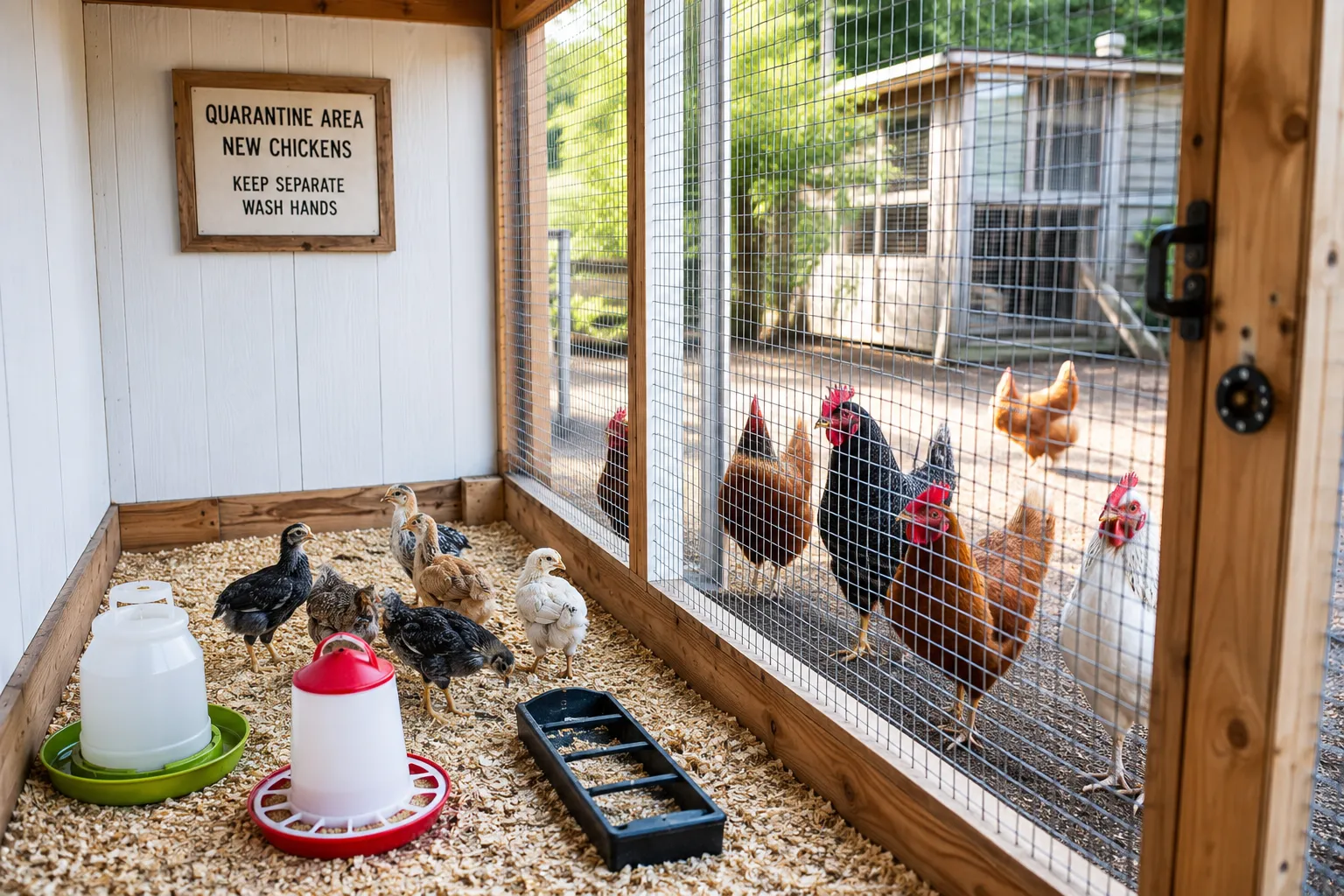
New chickens must be quarantined for a minimum of 30 days in a completely separate coop or enclosure at least 30 feet away from your existing flock. This quarantine period allows you to observe the newcomers for signs of illness, parasites, or disease that could spread to your healthy birds.
During quarantine, watch for these warning signs:
- Respiratory symptoms (sneezing, coughing, nasal discharge, wheezing)
- Lethargy or hunched posture
- Diarrhea or abnormal droppings
- Eye discharge or swelling
- Mites, lice, or other external parasites
- Loss of appetite or weight loss
- Limping or lameness
Change your clothes and shoes between handling quarantined birds and your existing flock. Always care for your established flock first, then tend to the new birds to avoid cross-contamination.
If any health issues appear during quarantine, extend the isolation period until the birds have been symptom-free for at least two weeks. This precaution protects your entire investment in your flock and prevents devastating disease outbreaks that can wipe out years of careful breeding and care.
Common mistake: Skipping quarantine because new birds “look healthy.” Many serious poultry diseases have incubation periods of 1-3 weeks, and carriers can appear perfectly normal while shedding pathogens.
How Long Does It Take for Chickens to Accept New Flock Members?
Chickens typically take 2-4 weeks to fully accept new flock members after the initial introduction, though the timeline varies based on flock size, available space, and individual bird personalities. The integration is complete when new birds can eat, drink, and roost alongside established members without constant harassment.
The acceptance process follows predictable stages:
Week 1: Intense pecking order establishment with frequent chasing, pecking, and vocal displays. New birds stay on the periphery and may hide or avoid the flock.
Week 2-3: Aggression decreases as hierarchy stabilizes. New birds begin integrating into daily routines but still face occasional challenges from established members.
Week 4+: New birds are accepted as flock members. Minor pecking order disputes occur but are brief and non-injurious.
Factors that speed acceptance:
- Larger flock size (6+ birds) dilutes aggression across more individuals
- Ample space reduces territorial behavior
- Similar age and size between new and existing birds
- Introducing multiple new birds simultaneously
- Providing distractions like treats, fresh greens, or new enrichment items
Factors that slow acceptance:
- Small flocks (2-3 birds) concentrate aggression on newcomers
- Cramped quarters increase stress and fighting
- Significant size differences between birds
- Introducing a single bird to an established group
- Presence of an aggressive rooster or dominant hen
Be patient and resist the urge to separate birds at the first sign of conflict. Some pecking and chasing is normal and necessary for establishing social order. Only intervene if you see blood, persistent attacks on a single bird, or if a chicken is being prevented from accessing food and water.
Should I Introduce Chickens at Night or During the Day?
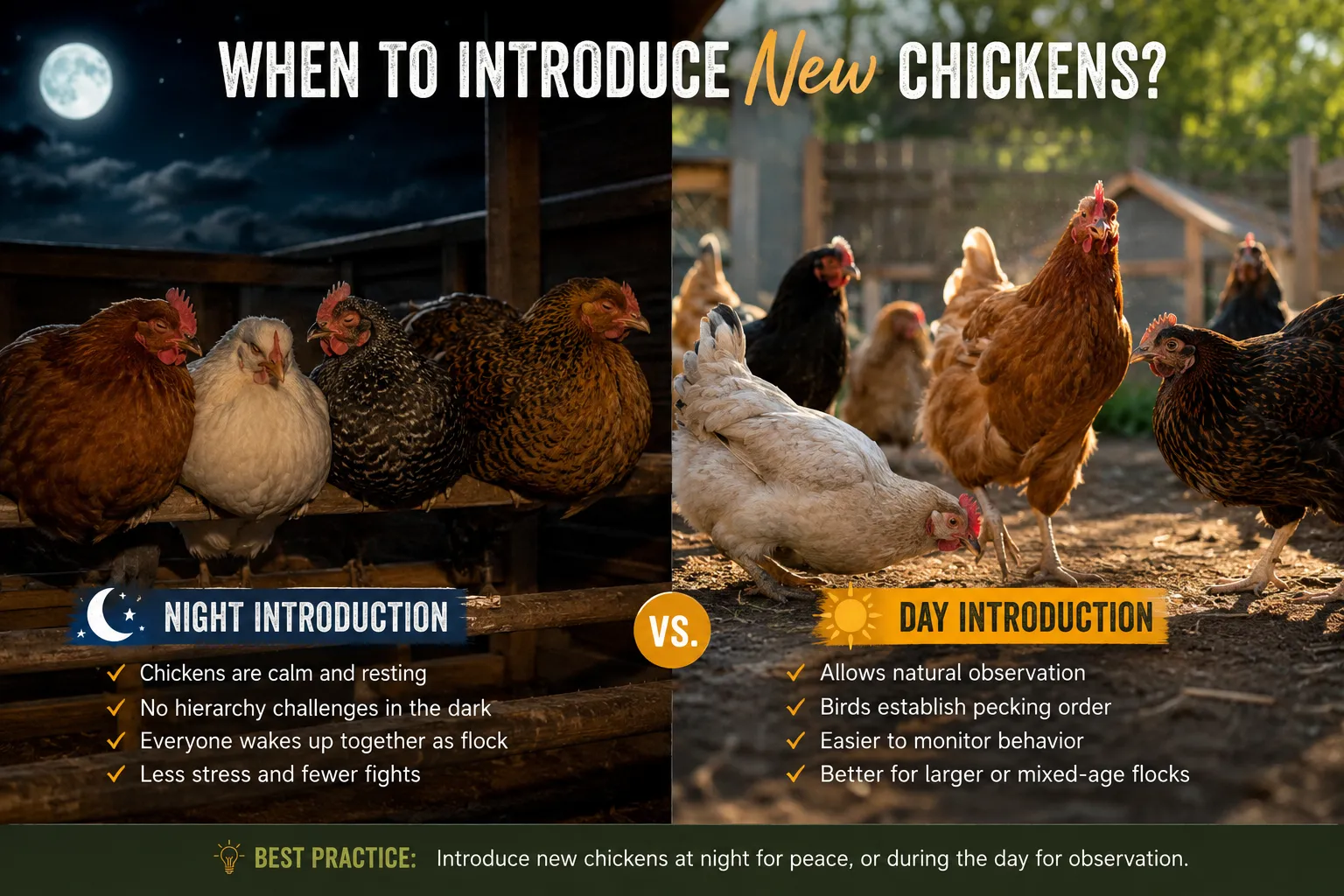
Introduce new chickens at night by placing them on the roost after your existing flock has settled down for sleep. Nighttime introductions work because chickens are calmer and less territorial in darkness, and they often wake up accepting the newcomers as part of the flock without the aggressive confrontations that occur during daylight introductions.
The nighttime introduction method:
- Wait until 30-60 minutes after sunset when your flock is fully roosted and settled
- Use a flashlight with red light (less disruptive to chickens) or a dim light
- Gently place new birds on the roost next to (not directly between) established members
- Position newcomers near the end of the roost, not in prime middle spots
- Leave the coop quietly and check on them the next morning
Why nighttime works better:
- Chickens have poor night vision and are less reactive in darkness
- The flock’s territorial instincts are suppressed during roosting time
- Birds wake up with the newcomers already “part of” the roost group
- Reduces the initial shock and aggressive displays that mark daytime introductions
Daytime introduction alternative: If you prefer daytime integration or your chickens don’t roost predictably, introduce new birds in the late afternoon (2-3 hours before sunset) in a large run or yard with plenty of space and hiding spots. This gives birds time to establish initial contact but limits the duration of conflict before roosting time naturally separates them.
Choose daytime if: You want to closely supervise the first interactions, your coop is too small to safely add birds in darkness, or you’re introducing very young birds that need monitoring.
The nighttime method succeeds in about 80% of introductions with minimal conflict, making it the preferred approach for most backyard chicken keepers.
What Are Signs That Chickens Are Rejecting New Birds?
Normal pecking order establishment includes chasing, pecking, and vocal warnings, but rejection becomes serious when you see blood-drawing attacks, a bird being completely prevented from eating or drinking, or a newcomer showing signs of injury or extreme stress. Dangerous rejection requires immediate intervention to prevent serious injury or death.
Normal integration behaviors (don’t intervene):
- Brief pecking and chasing that stops when the subordinate bird moves away
- Chest bumping and wing spreading (dominance displays)
- Vocal squawking and posturing
- New birds eating and drinking when dominant birds aren’t nearby
- Newcomers roosting separately but in the same coop
- Minor feather pulling without blood
Dangerous rejection signs (intervene immediately):
- Blood on the head, comb, or back from repeated pecking
- Persistent attacks where multiple birds gang up on one newcomer
- Preventing access to resources so the new bird cannot eat or drink for hours
- Cornering or trapping a bird with no escape route
- Scalping or severe feather loss exposing raw skin
- Lethargy, hunched posture, or hiding that persists for more than 24 hours
- Limping or wing drooping from physical injuries
What to do when rejection occurs:
- Separate the injured or targeted bird immediately to a safe recovery area where it can still see the flock
- Treat any wounds with antiseptic spray and monitor for infection
- Reassess your integration method – you may have rushed the process or have insufficient space
- Try the “pen within a pen” method where new birds live in a protected enclosure inside the run for another week
- Remove the most aggressive bully temporarily if one bird is causing most problems
- Add more hiding spots, perches, and resources to reduce competition
Common mistake: Confusing normal dominance behavior with dangerous rejection. Some noise, chasing, and minor pecking is expected and necessary. Only intervene when safety is compromised.
If rejection persists after multiple attempts with proper spacing and gradual introduction, you may have an exceptionally aggressive flock or incompatible birds. Some chickens simply don’t integrate well, and permanent separation may be necessary.
Can I Put Baby Chicks in With Adult Chickens?
Never place chicks younger than 16 weeks directly with adult chickens without physical protection, as the size difference invites serious injury or death from pecking, trampling, or aggressive attacks. Adult hens can kill chicks they perceive as intruders, and even curious pecking from a full-sized bird can fatally injure a small chick.
Safe age for integration: Wait until chicks are 16-20 weeks old and at least two-thirds the size of your smallest adult bird. At this age, they’re large enough to defend themselves and fast enough to escape aggressive encounters.
The “grow-out pen” method (safest approach):
- Raise chicks in a brooder until they’re fully feathered (6-8 weeks)
- Move them to a grow-out pen adjacent to the main coop where flocks can see each other through wire mesh
- Maintain visual contact for 8-10 weeks while chicks mature
- Introduce at 16-20 weeks using the standard nighttime or gradual integration method
Broody hen exception: If a hen hatches and raises chicks herself, she protects them and the flock accepts them from day one. This is the only scenario where very young chicks safely integrate with adults, because the mother hen enforces boundaries and the flock recognizes the chicks as legitimate members.
The “integration cage” method for younger birds (12-16 weeks):
If you must integrate slightly younger birds, use a protected cage or pen inside the run where chicks can interact through wire but adults cannot reach them. Maintain this setup for 2-4 weeks until size differences are less pronounced.
Why size matters: Chickens establish pecking order through physical confrontation. A 6-pound hen pecking a 1-pound chick can cause skull fractures, internal injuries, or death. Even without aggressive intent, adult chickens may peck at anything small and moving, triggering a feeding response.
Choose to wait if: Your chicks are under 16 weeks, you have particularly aggressive adults, or you have a rooster (roosters are often more aggressive toward young birds than hens are).
How to Introduce Chickens Without a Separate Coop or Pen
If you lack a separate coop or pen, create a temporary divided space using wire fencing, dog crates, or large rabbit hutches positioned inside or adjacent to your existing coop for the visual introduction phase. This “pen within a pen” method allows birds to see, hear, and smell each other for 1-2 weeks before physical contact while using your existing infrastructure.
Budget-friendly temporary separation options:
- Wire fencing panels ($30-50) to divide your run into two sections
- Large dog crate ($50-100) placed inside the run for new birds
- Rabbit hutch or small chicken tractor ($80-150) positioned next to the run
- Temporary chicken wire enclosure ($20-40 in materials) built inside the run
- Repurposed pallets and hardware cloth (often free) to create a divider
The compressed integration timeline:
When you can’t maintain a full 30-day quarantine in a completely separate location, use this modified approach:
- Quarantine new birds at a friend’s property or in a garage/shed for the full 30 days if possible
- Create your temporary divided space in the week before integration
- Move new birds into the divided section for 7-10 days of visual contact
- Supervise first physical contact in a neutral space (free-range yard) before combining in the coop
- Provide multiple resources (two feeders, two waterers, multiple roosts) to reduce competition
Free-range introduction method:
If your chickens free-range and you have adequate yard space (at least 100 square feet per bird), introduce new birds in the open yard rather than the confined coop:
- Let your established flock out to free-range first
- Release new birds 15-20 minutes later in a different area of the yard
- Supervise as they gradually encounter each other in open space
- Allow several days of supervised free-range interaction before combining them in the coop at night
This works because: Open space provides escape routes and reduces territorial behavior compared to confined coop introductions.
Common mistake: Skipping the visual introduction phase entirely and putting new birds directly into the coop. This almost always results in severe aggression because the flock has no time to adjust to the newcomers’ presence.
Even without ideal infrastructure, successful integration is possible with creativity and patience. The key is maintaining some form of protected contact period before full integration.
Do Roosters Make It Harder to Introduce New Hens?
Roosters can complicate introductions because they’re more territorial than hens and may aggressively defend their flock against newcomers, but they also sometimes welcome new hens quickly as additions to their breeding group. The outcome depends on the rooster’s temperament, the hen-to-rooster ratio, and whether you’re introducing pullets or mature hens.
When roosters help integration:
- Mature, confident roosters often accept new hens within days and may even protect them from aggressive established hens
- Undersexed roosters (fewer than 8-10 hens per rooster) typically welcome additional hens
- Calm-temperament breeds like Orpingtons or Cochins are less aggressive during introductions
When roosters create problems:
- Young, insecure roosters (under 18 months) may attack new hens to assert dominance
- Oversexed roosters (more than 10 hens per rooster) may over-breed newcomers, causing stress and feather damage
- Aggressive breeds like some game fowl lines may attack any newcomer regardless of sex
- Multiple roosters increase territorial behavior and fighting during integration
Managing rooster complications:
- Temporarily separate the rooster during the first 2-3 days of physical integration if he’s attacking newcomers
- Introduce multiple hens at once so the rooster’s attention is divided
- Watch for over-breeding and use hen saddles to protect newcomers’ backs from mating damage
- Provide extra space as roosters need more territory than all-hen flocks
- Consider the ratio – maintain at least 8-10 hens per rooster to prevent over-breeding
Introducing new roosters: Adding a new rooster to a flock with an established rooster is extremely difficult and often results in serious fighting. If you must add a rooster, introduce him with several hens as a “package deal” or remove the existing rooster first.
Best practice: If your rooster has a good temperament and your hen-to-rooster ratio is appropriate (8-10+ hens per rooster), proceed with standard integration methods. If your rooster is young, aggressive, or you have multiple roosters, expect complications and be prepared to separate birds if needed.
What to Do If Older Chickens Are Pecking New Ones Badly
Separate the injured bird immediately to a recovery area where it can heal while still maintaining visual contact with the flock, then reassess your integration approach by adding more space, resources, and hiding spots before attempting reintroduction. Severe pecking that draws blood requires intervention because chickens are attracted to red and will continue attacking wounded areas.
Immediate response steps:
- Remove the injured bird to a safe, clean space with food, water, and bedding
- Clean wounds with saline solution or diluted betadine
- Apply antiseptic spray (Vetericyn or BluKote) to prevent infection and cover red areas
- Isolate for 3-7 days until wounds heal and new feather growth begins
- Identify the aggressor(s) by watching flock dynamics
Treating the injured bird:
- Minor pecking wounds: Clean and spray with antiseptic, monitor for 24 hours
- Blood-drawing wounds: Separate immediately, apply BluKote to hide red color
- Scalping or severe feather loss: Separate for 1-2 weeks, apply antibiotic ointment
- Deep wounds or lethargy: Consult a veterinarian as infection risk is high
Preventing repeat attacks:
Before reintroducing the recovered bird, address these common causes of excessive aggression:
- Insufficient space: Add at least 25% more room or reduce flock size
- Resource competition: Install a second feeder and waterer in different locations
- Boredom: Add enrichment like hanging cabbage, scratch areas, or perches
- Lack of hiding spots: Create visual barriers with pallets, branches, or coop furniture
- Protein deficiency: Increase protein to 18-20% as low protein triggers feather picking
The “bully separation” technique:
If one or two birds are causing most of the aggression:
- Remove the bully (not the victim) from the flock for 5-7 days
- Allow the victim to integrate with the remaining, calmer birds
- Reintroduce the bully as the “newcomer” – this often resets the pecking order
When to give up on integration:
If severe aggression continues after multiple attempts with proper spacing and gradual introduction, you may need to:
- Permanently separate incompatible birds into two flocks
- Rehome the most aggressive individuals
- Keep the newcomer as a separate “flock of one” with visual contact only
Common mistake: Returning an injured bird to the flock before wounds are fully healed. Visible wounds and scabs attract renewed attacks.
Is It Better to Introduce One Chicken or Multiple at Once?
Introduce multiple chickens at once (at least 2-3 birds) rather than a single chicken because newcomers provide mutual support, dilute aggression across several targets, and have allies when establishing their place in the pecking order. Single birds face concentrated harassment and often struggle to integrate successfully.
Why multiple birds succeed:
- Shared defense: New birds can support each other when challenged
- Divided attention: Established flock members can’t focus aggression on one target
- Social confidence: Birds are less stressed when they have companions
- Faster integration: Multiple birds establish a sub-group that integrates as a unit
- Reduced bullying: The flock’s aggression is distributed across several birds rather than concentrated on one
Single bird challenges:
- Faces constant harassment from every flock member
- No allies or support during conflicts
- Higher stress levels and risk of injury
- Longer integration period (often 4-6 weeks instead of 2-4)
- May never fully integrate into the social structure
When single-bird introduction works:
- Very large flocks (12+ birds) where aggression is naturally diluted
- Exceptionally calm, established flocks with stable pecking orders
- Similar size and age between the newcomer and existing birds
- Ample space (15+ square feet per bird in the run)
Optimal introduction group sizes:
- Small flocks (3-5 existing birds): Add 2-3 new birds
- Medium flocks (6-10 existing birds): Add 3-5 new birds
- Large flocks (11+ existing birds): Add 4-6 new birds
The “buddy system” approach:
If you must add a single bird, pair it with one existing bird that’s low in the pecking order:
- Separate the lowest-ranking established bird and the newcomer together for 3-5 days
- Allow them to bond in a neutral space
- Reintroduce both birds together to the main flock
- The established bird provides social cover for the newcomer
Common mistake: Buying a single chicken to “try out” chicken keeping or replace a lost bird. Always plan to add at least two birds to ensure successful integration and maintain flock social structure.
If you already have a single bird that needs integration and can’t acquire more, expect a longer, more challenging process and be prepared to provide extra supervision and intervention.
How Much Space Do I Need Per Chicken to Avoid Fighting?
Provide a minimum of 4 square feet per chicken inside the coop and 10 square feet per chicken in the outdoor run to minimize fighting during integration, though more space (6-8 square feet indoors, 15-20 square feet outdoors) significantly improves success rates and reduces aggression. Overcrowding is the leading cause of integration failure and ongoing flock aggression.
Minimum space requirements:
| Location | Minimum per Bird | Recommended per Bird | Ideal per Bird |
|---|---|---|---|
| Inside coop | 4 sq ft | 6 sq ft | 8+ sq ft |
| Outdoor run | 10 sq ft | 15 sq ft | 20+ sq ft |
| Roost space | 8-10 linear inches | 12 inches | 14+ inches |
| Feeder space | 2-3 linear inches | 4 inches | 6+ inches |
Why space matters during integration:
- Escape routes: Subordinate birds need room to retreat from aggression
- Resource distribution: Multiple feeding and watering stations reduce competition
- Stress reduction: Crowding increases cortisol levels and aggressive behavior
- Pecking order establishment: Birds need space to work out hierarchy without constant conflict
- Individual territories: Chickens establish personal space bubbles that require physical room
Space calculation example:
For a flock of 6 existing chickens plus 3 new birds (9 total):
- Minimum coop: 9 birds × 4 sq ft = 36 sq ft
- Recommended coop: 9 birds × 6 sq ft = 54 sq ft
- Minimum run: 9 birds × 10 sq ft = 90 sq ft
- Recommended run: 9 birds × 15 sq ft = 135 sq ft
Vertical space counts too:
Add these features to maximize usable space:
- Multiple roost levels at different heights (12-18 inches apart)
- Elevated platforms for subordinate birds to escape
- Hanging feeders and waterers to free up floor space
- Outdoor perches at various heights in the run
When space is limited:
If you can’t expand your coop or run:
- Reduce flock size before adding new birds
- Maximize free-range time to provide additional space
- Add vertical elements to increase usable square footage
- Introduce fewer new birds than you originally planned
- Extend the integration timeline to allow slower adjustment
Common mistake: Calculating space based on minimum requirements and then wondering why integration fails. Always aim for recommended or ideal space, especially during the stressful integration period.
Free-range consideration: If your chickens free-range for most of the day, you can use minimum coop space requirements, but maintain recommended run space for times when they’re confined.
Can I Introduce Chickens of Different Breeds Together?
Yes, you can successfully introduce chickens of different breeds together, and breed diversity often improves flock dynamics by preventing the formation of aggressive breed-based cliques. However, avoid pairing very large breeds with bantams or introducing aggressive breeds to docile flocks, as significant size and temperament differences can cause integration problems.
Breed compatibility factors:
Size differences:
- Compatible: Standard breeds together (5-8 pounds) or bantams together (1-3 pounds)
- Challenging: Standards with large fowl (8-12 pounds) – monitor closely
- Avoid: Standards with bantams – size difference invites injury
Temperament matching:
- Docile breeds: Orpingtons, Cochins, Brahmas, Silkies, Australorps
- Moderate breeds: Plymouth Rocks, Wyandottes, Rhode Island Reds, Sussex
- Assertive breeds: Leghorns, Hamburgs, some Mediterranean breeds
- Aggressive breeds: Some game fowl, Old English Game, Malay
Best practice: Match temperament levels. Introduce docile breeds to docile flocks, assertive breeds to assertive flocks.
Successful mixed-breed combinations:
- Orpingtons + Australorps + Cochins (all docile, similar size)
- Plymouth Rocks + Wyandottes + Rhode Island Reds (moderate temperament, similar size)
- Leghorns + Hamburgs + Andalusians (active, flighty, similar temperament)
Problematic combinations:
- Silkies + Rhode Island Reds (size and temperament mismatch)
- Bantams + Jersey Giants (extreme size difference)
- Game fowl + Orpingtons (aggression vs. docility)
Visual differences don’t matter:
Chickens don’t discriminate based on feather color, comb type, or appearance. A black Australorp integrates just as easily with a white Leghorn as with another black bird. Behavior and size matter; appearance doesn’t.
The “breed buffer” advantage:
Mixed-breed flocks often have fewer integration problems because:
- No breed-based cliques form
- Pecking order is based on individual personality, not breed identity
- Genetic diversity often produces calmer, more adaptable birds
- Visual variety makes it harder for birds to single out newcomers
Introducing rare or expensive breeds:
If you’re adding valuable birds to a mixed flock:
- Choose similar-sized companions for your rare breed
- Introduce during the grow-out phase (16-20 weeks) when birds are still establishing personality
- Provide extra supervision during the first week
- Consider temperament carefully – don’t add docile rare breeds to aggressive flocks
Common mistake: Assuming all chickens of the same breed will get along better than mixed breeds. Individual personality matters far more than breed identity in flock dynamics.
What Age Is Best to Introduce New Chickens to Existing Flock?
The best age to introduce new chickens is 16-20 weeks old when they’re nearly full-sized but still young enough to be subordinate to established adults, allowing them to integrate into the pecking order without serious injury risk. Birds younger than 16 weeks are too small and vulnerable, while birds older than one year may be too set in their ways to adapt easily to a new flock.
Age-based integration success rates:
16-20 weeks (pullets) – BEST:
- Large enough to defend themselves
- Still subordinate by age, reducing conflict
- Adaptable and not yet set in social patterns
- Similar size to adults minimizes injury risk
- Will begin laying within 4-8 weeks of integration
12-16 weeks – CHALLENGING:
- Require protected integration (pen within pen)
- Size difference still significant
- Need extra supervision
- Extend integration timeline by 1-2 weeks
20-30 weeks (point-of-lay) – GOOD:
- Fully grown and capable of self-defense
- May challenge mid-ranking established birds
- Integration usually successful but takes longer
- Stress may delay onset of laying
30+ weeks to 1 year – MODERATE:
- Established personalities may clash with flock dynamics
- More aggressive pecking order battles
- Takes 4-6 weeks for full integration
- Works best with calm, stable flocks
1+ years (mature hens) – DIFFICULT:
- Set in their ways and resistant to change
- May never fully integrate into flock social structure
- Higher risk of serious fighting
- Best introduced in groups of 3+ for mutual support
Age matching considerations:
Similar ages (within 8 weeks):
- Easiest integration
- Similar size and energy levels
- Establish pecking order quickly
Mixed ages (new birds younger):
- Younger birds naturally defer to older birds
- Less conflict but longer integration
- Older birds may bully younger ones initially
Mixed ages (new birds older):
- Can disrupt established pecking order
- More aggressive confrontations
- May work if new birds are calm breeds
Chick integration timeline:
If you’re raising chicks to add to your flock:
- Weeks 0-6: Brooder phase, no contact with flock
- Weeks 6-12: Move to grow-out pen with visual contact through fencing
- Weeks 12-16: Supervised free-range time with flock
- Weeks 16-20: Full integration using nighttime introduction method
Common mistake: Buying “started pullets” (22-24 weeks) that are about to lay and expecting immediate integration. The stress of integration often delays laying by 2-4 weeks, negating the advantage of buying older birds.
Retirement flock exception: If you’re integrating older hens (2+ years) into a retirement or pet flock where egg production doesn’t matter, age matters less than temperament and space availability.
Common Mistakes When Introducing New Chickens That Cause Injuries
The most dangerous mistakes are rushing the integration process without quarantine or visual introduction phases, introducing a single bird to an established flock, and providing insufficient space for subordinate birds to escape aggression. These errors account for most serious injuries and failed integrations.
Critical mistakes that cause injuries:
1. Skipping quarantine (30 days minimum):
- Risk: Disease transmission to entire flock
- Consequence: Potential loss of all birds, not just newcomers
- Prevention: Always quarantine for 30 days minimum, 45 days if any symptoms appear
2. No visual introduction period:
- Risk: Sudden physical contact triggers extreme territorial aggression
- Consequence: Severe pecking, scalping, and injuries requiring separation
- Prevention: Maintain 1-2 weeks of visual contact through fencing before physical integration
3. Introducing a single bird:
- Risk: Concentrated aggression with no allies or support
- Consequence: Persistent bullying, stress, and potential death
- Prevention: Always introduce at least 2-3 birds simultaneously
4. Insufficient space:
- Risk: No escape routes for subordinate birds
- Consequence: Cornering, trampling, and severe pecking injuries
- Prevention: Provide 10-15 square feet per bird in run, 4-6 square feet in coop
5. Introducing during feeding time:
- Risk: Resource guarding triggers immediate aggression
- Consequence: Violent attacks over food and water
- Prevention: Introduce at night or during free-range time, never at feeding time
6. Extreme size differences:
- Risk: Large birds can kill small birds with normal pecking
- Consequence: Skull fractures, internal injuries, death
- Prevention: Wait until new birds are at least 2/3 the size of smallest existing bird
7. Returning injured birds too soon:
- Risk: Visible wounds attract renewed attacks
- Consequence: Escalating injuries and potential cannibalism
- Prevention: Wait until wounds are fully healed and new feathers cover bare spots
8. Single resource locations:
- Risk: Dominant birds guard food and water
- Consequence: New birds can’t eat or drink, leading to starvation and dehydration
- Prevention: Provide 2-3 feeding and watering stations in different locations
9. No hiding spots or visual barriers:
- Risk: Subordinate birds have nowhere to escape
- Consequence: Constant stress and repeated attacks
- Prevention: Add pallets, branches, crates, or coop furniture for hiding
10. Intervening too early:
- Risk: Preventing natural pecking order establishment
- Consequence: Prolonged integration as hierarchy never stabilizes
- Prevention: Only intervene for blood-drawing attacks or resource denial
Warning signs you’re making these mistakes:
- Blood on any bird within first 24 hours
- A bird hiding and refusing to eat for more than 6 hours
- Multiple birds attacking one newcomer simultaneously
- Limping, wing drooping, or lethargy in new birds
- Constant loud distress calls from newcomers
Recovery protocol after mistakes:
If you’ve made one of these mistakes and injuries have occurred:
- Separate injured birds immediately
- Treat wounds and allow 1-2 weeks healing time
- Reset the integration process from the beginning
- Address the specific mistake (add space, add birds, create visual barriers)
- Proceed with proper gradual introduction steps
Common mistake: Thinking “my flock is friendly” and skipping precautions. Even the calmest flock will defend territory against newcomers. Always follow proper integration protocols regardless of your flock’s normal temperament.
Do I Need to Introduce New Chickens If I Only Have Two Birds?
Yes, you still need to follow proper introduction protocols even with just two existing birds because small flocks often display more concentrated aggression toward newcomers than large flocks, and the limited social structure makes integration more challenging. However, the process is often faster because adding 2-3 new birds to a flock of 2 creates a nearly new social group where everyone must reestablish hierarchy.
Small flock integration dynamics:
Advantages of small flock integration:
- Adding 2-3 birds to 2 existing birds creates a “reset” where all birds renegotiate pecking order
- Less complex social hierarchy to navigate
- Easier to supervise all interactions
- Faster to identify and address problems
Challenges of small flock integration:
- Aggression is concentrated on fewer targets
- No “buffer” birds to dilute conflict
- Established pair may have strong bond and reject outsiders
- Limited space in small coops designed for 2-3 birds
Modified integration for small flocks:
Step 1: Quarantine (30 days):
- Non-negotiable even for small flocks
- Disease risk is the same regardless of flock size
Step 2: Visual introduction (1-2 weeks):
- Use a dog crate or temporary fence to divide your coop/run
- Allow your pair to see and hear the newcomers
- Watch for curiosity rather than constant aggression
Step 3: Supervised free-range introduction:
- If your birds free-range, introduce in open space first
- Supervise for 2-3 days before combining in coop
- Provide multiple escape routes
Step 4: Nighttime coop introduction:
- Place new birds on roost after dark
- Check first thing in morning for conflicts
- Be prepared to separate if needed
How many to add to a flock of two:
- Add 2-3 birds: Creates a small flock of 4-5 with balanced dynamics
- Avoid adding just 1: Creates odd numbers and concentrated bullying
- Consider adding 3-4: If space allows, larger groups integrate more smoothly
The “bonded pair” challenge:
If your two existing birds are a strongly bonded pair (often a rooster and favorite hen, or two hens raised together):
- They may unite against newcomers
- Integration takes 3-4 weeks instead of 2-3
- Consider separating the pair for 2-3 days during initial integration
- Reintroduce the pair one at a time to prevent unified attacks
Space requirements for small flock expansion:
Before adding birds to your flock of two:
- Current space: 2 birds need minimum 8 sq ft coop, 20 sq ft run
- Expanded to 4-5 birds: Need minimum 20-25 sq ft coop, 50-75 sq ft run
- Verify you have adequate space before purchasing new birds
When small flock integration is easiest:
- Both existing birds are under 1 year old
- You’re adding birds of similar age (within 8 weeks)
- Your coop and run exceed minimum space requirements
- Your existing pair is calm-tempered breeds
Common mistake: Thinking “it’s just two chickens, they’ll be fine” and skipping quarantine or visual introduction. Small flocks can be just as aggressive as large ones, and you have fewer birds to dilute conflict.
Alternative approach: If your two existing birds are very old (3+ years) or you’re having integration difficulties, consider retiring them as a separate pair and starting a new flock of 4-6 younger birds in a different coop.
Conclusion
Successfully introducing new chickens to your flock requires patience, planning, and attention to detail, but following the proven steps of quarantine, visual introduction, and gradual physical integration will result in a harmonious, expanded flock. The 30-day quarantine period protects your investment in your existing birds, the 1-2 week visual introduction phase allows birds to adjust to newcomers without physical risk, and the nighttime introduction method minimizes aggressive confrontations.
Your integration action plan:
- Quarantine new birds for 30 days in a separate location at least 30 feet from your existing flock
- Set up visual introduction using fencing or crates for 1-2 weeks of protected contact
- Introduce multiple birds (2-3 minimum) rather than a single chicken
- Wait until newcomers are 16-20 weeks old and at least two-thirds the size of your smallest existing bird
- Use the nighttime introduction method by placing new birds on the roost after dark
- Provide adequate space (10-15 square feet per bird in the run, 4-6 square feet in the coop)
- Install multiple feeding and watering stations to prevent resource guarding
- Add hiding spots and visual barriers so subordinate birds can escape aggression
- Expect 2-4 weeks for full integration with some normal pecking and chasing
- Intervene only for blood-drawing attacks or if birds are prevented from accessing food and water
Remember that some conflict is normal and necessary for establishing pecking order. Resist the urge to separate birds at the first sign of chasing or pecking. Only intervene when safety is compromised by blood, persistent attacks, or resource denial.
The effort invested in proper integration pays dividends in flock harmony, egg production, and the health of all your birds. A well-integrated flock is calmer, more productive, and more enjoyable to keep than one with ongoing social conflicts.
Next steps: Before purchasing new birds, verify you have adequate space for your expanded flock, set up your quarantine area, and plan your visual introduction setup. Proper preparation before bringing new birds home is the foundation of successful integration.
Frequently Asked Questions
How long should I quarantine new chickens before introducing them to my flock?
Quarantine new chickens for a minimum of 30 days in a completely separate coop at least 30 feet away from your existing flock. This allows time to observe for signs of illness, parasites, or disease that could spread to your healthy birds. Extend quarantine to 45 days if any symptoms appear during the observation period.
Can I introduce new chickens during winter or cold weather?
Yes, you can introduce chickens during winter, but the process is more challenging because birds spend more time confined in the coop with less outdoor space to escape aggression. Provide extra indoor space, multiple roosts at different heights, and consider using a heat lamp to create separate warm zones. Integration may take 1-2 weeks longer in winter than in mild weather.
What should I do if my rooster is attacking new hens?
Temporarily separate the rooster for 3-5 days while the new hens integrate with your existing hens, then reintroduce him as the “newcomer.” This often resets his territorial behavior. Alternatively, introduce multiple hens at once so his attention is divided, and ensure your hen-to-rooster ratio is at least 8-10 hens per rooster to prevent over-breeding stress.
How do I know when integration is complete?
Integration is complete when new birds can eat, drink, and roost alongside established members without constant harassment, typically after 2-4 weeks. You’ll still see occasional pecking order reminders, but these should be brief and non-injurious. New birds will participate in normal flock activities like dust bathing and foraging rather than hiding or staying isolated.
Can I introduce chickens from a hatchery directly to my flock?
Never introduce hatchery chickens directly to your flock without quarantine. Even birds from reputable hatcheries can carry diseases or parasites. Always quarantine for 30 days, watch for symptoms, and treat for common parasites before beginning the visual introduction phase. This protects your entire flock from potential disease outbreaks.
What’s the minimum flock size for successful integration?
Integration is possible with any flock size, but flocks of 6+ birds integrate newcomers more easily than small flocks of 2-4 birds because aggression is diluted across more individuals. If you have a small flock, add 2-3 birds at once to create a larger group where everyone must reestablish pecking order, reducing concentrated aggression on newcomers.
Should I separate chickens that are fighting during integration?
Only separate birds if you see blood-drawing attacks, persistent ganging up on one bird, or if a chicken is being prevented from accessing food and water for more than 6 hours. Normal pecking order establishment includes chasing, pecking, and vocal displays that look aggressive but are necessary for establishing hierarchy. Separating too early prevents natural social order from forming.
How do I introduce new chickens if I free-range my flock?
Free-range integration is often easier because open space provides escape routes and reduces territorial behavior. After quarantine and visual introduction, release your established flock to free-range first, then release new birds 15-20 minutes later in a different area of the yard. Supervise as they gradually encounter each other, then combine them in the coop at night after several days of supervised free-range interaction.
Can I introduce chickens of very different sizes together?
Avoid introducing birds with extreme size differences, such as bantams with standard breeds or chicks with adults. Wait until new birds are at least two-thirds the size of your smallest existing bird, typically 16-20 weeks old. Significant size differences invite serious injury because larger birds can cause skull fractures or internal injuries with normal pecking behavior.
What if my new chickens won’t go into the coop at night?
New chickens often don’t know where to roost for the first few nights. Manually place them on the roost after dark for 3-5 consecutive nights until they learn the routine. Use a dim light or red flashlight to avoid startling the flock. Most birds learn the pattern within a week and will enter the coop on their own at dusk.
Do I need to introduce chickens differently if I have a small urban coop?
Small urban coops require extra attention to space requirements during integration. If your coop meets only minimum space standards for your current flock, you may not have adequate room to add birds without triggering aggression. Consider reducing your existing flock size before adding new birds, or expand your coop to provide 6-8 square feet per bird indoors and 15-20 square feet per bird in the run.
How many times can I try integration before giving up?
If integration fails after 2-3 attempts with proper quarantine, visual introduction, adequate space, and gradual physical contact, you may have incompatible birds or an exceptionally aggressive flock. At this point, consider permanent separation into two flocks, rehoming the most aggressive individuals, or keeping newcomers as a separate group with visual contact only. Some chickens simply don’t integrate well despite best efforts.


