

Quick Answer
Most U.S. cities allow backyard chickens with restrictions on flock size, coop placement, and rooster bans, but the rules vary dramatically by municipality. To find out if backyard chickens are legal in your city, check your local municipal code online, call your city’s planning or zoning department, or contact your local animal control office. Many cities require permits, limit the number of hens to 4-6, and mandate minimum setback distances from property lines and neighboring homes.
Key Takeaways
- City ordinances vary widely: What’s legal in one city may be prohibited in the next, even within the same county.
- Most cities ban roosters: Hens are typically allowed in residential zones, but roosters are prohibited due to noise concerns.
- Permits are common: Many municipalities require a permit or license before you can keep chickens, with annual renewal fees ranging from $0 to $100.
- Flock size limits exist: Cities typically cap backyard flocks at 4-6 hens, though some allow more on larger lots.
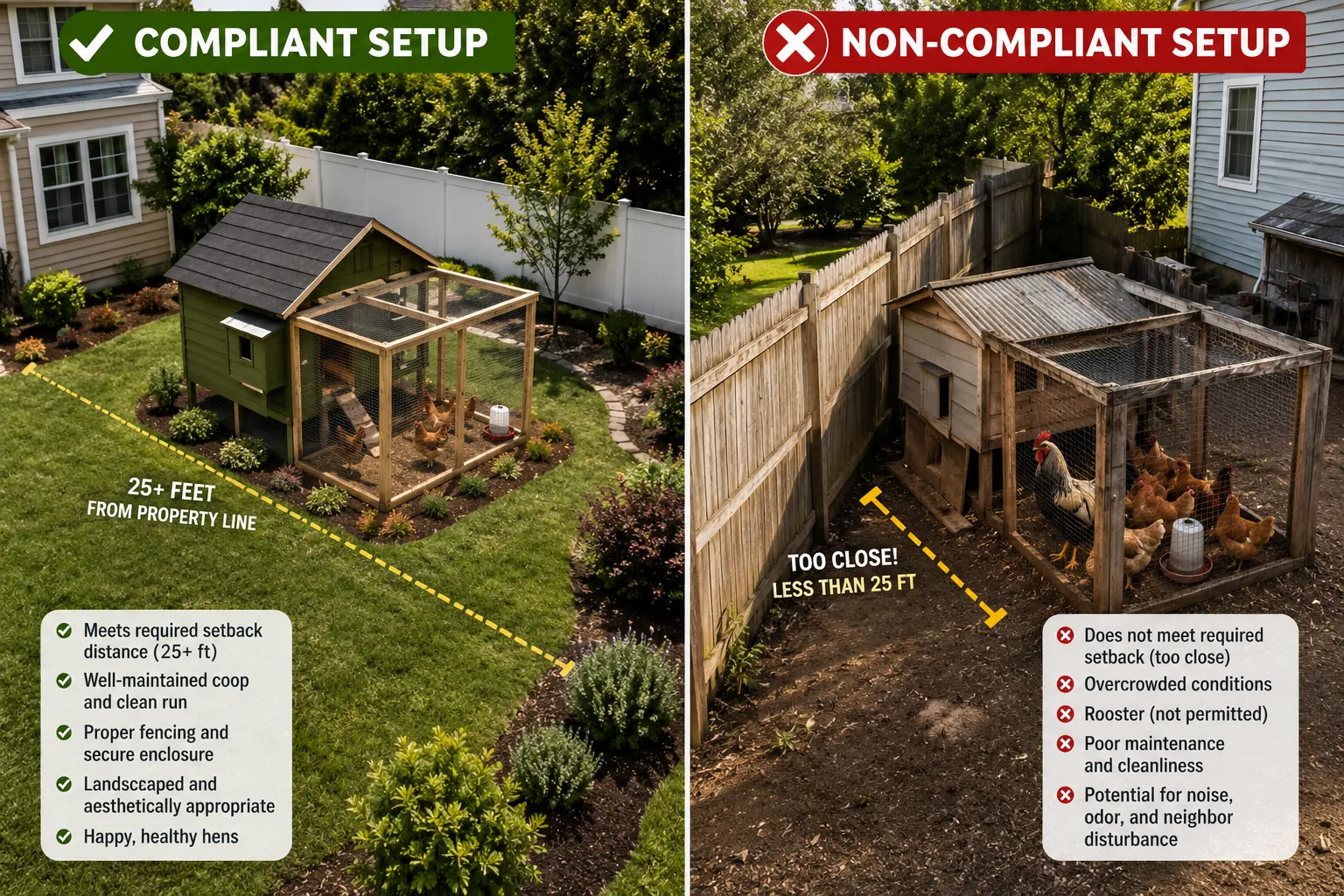
- Setback requirements matter: Coops usually must be 10-25 feet from property lines and neighboring structures.
- HOA rules can be stricter: Homeowners association regulations may prohibit chickens even when city law allows them.
- Violations carry penalties: Keeping illegal chickens can result in fines, forced removal, and neighbor complaints.
- Ordinances can change: Community advocacy has successfully legalized backens in hundreds of cities since 2010.
What Are Backyard Chicken Laws and Zoning Ordinances?
Backyard chicken laws are local regulations that govern whether residents can keep poultry on residential property, and under what conditions. These rules are typically found in municipal codes under zoning ordinances, animal control regulations, or health and safety statutes.
Zoning ordinances divide cities into districts (residential, commercial, agricultural, etc.) and specify what activities are permitted in each zone. Most urban and suburban areas are zoned residential, where agricultural activities like raising livestock are traditionally restricted. However, many cities have amended their codes to allow small-scale chicken keeping as an exception.
Common elements in chicken ordinances include:
- Permitted zones: Which residential districts allow chickens (single-family, multi-family, etc.)
- Flock size limits: Maximum number of birds allowed per property or per square foot of lot
- Rooster restrictions: Whether male birds are prohibited due to noise
- Coop requirements: Standards for structure size, materials, cleanliness, and ventilation
- Setback distances: How far coops must be from property lines, dwellings, and public rights-of-way
- Permit requirements: Whether you need approval before keeping chickens
- Slaughter and sales prohibitions: Many cities ban on-site butchering and commercial egg sales
Why these laws exist: Cities regulate backyard chickens to balance residents’ desire for urban farming with concerns about noise, odor, disease, predators, and neighborhood aesthetics. Well-written ordinances protect both chicken keepers and their neighbors.
How Do I Find My City’s Chicken Ordinance Online?
Finding your local chicken ordinance typically takes 10-15 minutes of online research. Start by searching “[your city name] municipal code chickens” or “[your city name] backyard chicken ordinance” in your web browser.
Step-by-step search process:
- Visit your city’s official website: Look for sections labeled “Municipal Code,” “City Ordinances,” “Code of Ordinances,” or “City Charter”
- Use the search function: Once in the code library, search for terms like “chickens,” “poultry,” “fowl,” “hens,” or “livestock”
- Check multiple sections: Chicken rules may appear under zoning, animal control, health codes, or nuisance ordinances
- Look for recent amendments: Many cities updated their codes between 2010-2025, so check the revision date
- Download or print the relevant sections: Save a copy for your records and permit applications
If the municipal code isn’t online: Smaller cities may not have digitized codes. In this case, call city hall and ask to speak with the planning department, zoning administrator, or city clerk. They can tell you whether chickens are allowed and email or mail you the relevant ordinance text.
Helpful resources:
- Municode.com and American Legal Publishing host codes for thousands of U.S. cities
- BackYardChickens.com maintains a user-updated database of city ordinances (verify information independently)
- County extension offices often have summaries of local livestock regulations
Common mistake: Don’t assume your city’s rules match those of neighboring cities. Regulations can differ drastically even between adjacent municipalities.
How Many Chickens Am I Allowed to Have in City Limits?
Most cities that permit backyard chickens limit residential flocks to 4-6 hens, though the exact number depends on lot size and local ordinances. Some progressive cities allow more birds on larger properties, while restrictive municipalities may cap flocks at 3 hens or fewer.
Typical flock size formulas:
- Fixed limit: “Maximum of 6 hens per residential lot” (most common)
- Density-based: “One hen per 800 square feet of lot area” or “One hen per 1,000 square feet”
- Tiered by lot size: “4 hens on lots under 6,000 sq ft; 8 hens on lots 6,000-10,000 sq ft; 12 hens on lots over 10,000 sq ft”
Why cities limit flock size: Smaller flocks produce less noise, odor, and waste, reducing the likelihood of neighbor complaints. Limits also prevent residents from operating commercial egg operations in residential zones.
Choose your flock size based on:
- Egg consumption: Three hens typically produce 12-18 eggs per week, enough for a family of four
- Space requirements: Each hen needs 2-4 square feet of coop space and 8-10 square feet of outdoor run space
- Maintenance time: Larger flocks require more daily care, cleaning, and feed costs
- Legal buffer: Stay below the maximum to avoid violations if a hen count is disputed
Edge case: If your property straddles two zoning districts or is in an unincorporated area, different rules may apply. Check with your county planning department if you’re unsure which jurisdiction governs your address.
Do I Need a Permit to Keep Chickens in My Backyard?
Whether you need a permit depends entirely on your city’s ordinance. Roughly 60-70% of cities that allow backyard chickens require some form of permit or license, while others allow chickens “by right” with no application process.
Common permit types:
- Annual chicken permit: Requires application, inspection, and yearly renewal (fees typically $0-$100)
- One-time registration: Simple notification to the city that you’re keeping chickens, no renewal
- Conditional use permit: More complex approval process, often requiring neighbor notification and public hearing
- No permit required: Chickens allowed as long as you follow coop and flock size rules
What the permit process typically involves:
- Application submission: Complete a form with your name, address, property details, and planned flock size
- Site plan: Some cities require a diagram showing coop location and distances from property lines
- Neighbor notification: A few cities require signatures from adjacent property owners (rare but exists)
- Inspection: City staff may inspect your coop for compliance before issuing the permit
- Fee payment: Permit fees range from free to $100 annually
- Renewal: Annual permits must be renewed, often with a follow-up inspection
Benefits of getting a permit (even if optional): Having official approval protects you if a neighbor complains and provides documentation that your setup meets code requirements.
Common mistake: Starting your flock before checking permit requirements. Some cities impose higher fines for keeping chickens without a required permit versus minor code violations.

Are Roosters Allowed in Residential Areas or Just Hens?
Roosters are banned in the vast majority of cities that allow backyard chickens, typically 90-95% of municipalities. Cities prohibit roosters primarily due to noise concerns, as roosters crow loudly and frequently throughout the day, not just at dawn.
Why cities ban roosters:
- Noise complaints: Roosters can crow at 90 decibels, comparable to a lawnmower, and may crow 12-15 times per hour
- Aggressive behavior: Roosters can be territorial and may pose a safety risk, especially around children
- Unnecessary for eggs: Hens lay eggs without a rooster present; roosters are only needed for fertilization
- Neighbor relations: Rooster noise is the number one complaint that leads to chicken bans being proposed
Rare exceptions where roosters may be allowed:
- Agricultural zones: Properties zoned for farming or on large rural lots (typically 1+ acre)
- Conditional permits: Some cities allow roosters with special approval and neighbor consent
- Grandfather clauses: Existing roosters may be allowed to remain if the ban was enacted after you acquired the bird
What happens if you accidentally get a rooster: Hatcheries and feed stores sometimes mis-sex chicks, and you may not realize you have a rooster until it starts crowing at 4-6 months old. If roosters are banned in your city, you’ll need to rehome the bird to a farm, sanctuary, or rural property. Many chicken keepers maintain relationships with rural friends specifically for this scenario.
Choose hens if: You live in any standard residential neighborhood. Hens are quieter (soft clucking and occasional “egg songs”), equally productive for eggs, and far less likely to trigger complaints or code violations.
What Happens If I Keep Chickens Illegally in My City?
Keeping chickens in violation of local ordinances can result in fines ranging from $50 to $500 per day, mandatory removal of the birds, and strained relationships with neighbors. The severity of consequences depends on how you were discovered and your city’s enforcement approach.
Common enforcement scenarios:
Neighbor complaint: This is the most frequent trigger. If a neighbor reports noise, odor, or visible chickens, animal control or code enforcement will investigate. You’ll typically receive a warning letter giving you 7-30 days to remove the birds or come into compliance.
Routine inspection: Some cities conduct random inspections or discover violations during other property inspections (building permits, rental inspections, etc.).
Social media exposure: Posting photos of your illegal flock online has led to enforcement actions in multiple cities.
Typical penalty progression:
- First violation: Written warning with 14-30 day compliance deadline
- Second violation: Fine of $50-$250 and order to remove birds immediately
- Continued violation: Daily fines of $100-$500 until birds are removed
- Court action: Cities may pursue civil penalties or misdemeanor charges for persistent violations
Additional consequences:
- Forced rehoming: You may have to surrender your birds to animal control or find them new homes quickly
- Property liens: Unpaid fines can result in liens against your property
- Difficulty selling your home: Code violations must be disclosed to buyers in many states
- Neighbor conflicts: Legal disputes can permanently damage relationships with adjacent property owners
What to do if you receive a violation notice:
- Respond promptly: Contact the enforcement officer to understand your options
- Request a variance: Some cities allow you to apply for an exception or conditional permit
- Advocate for change: If many residents want chickens, organize to amend the ordinance (see section below)
- Comply or appeal: Either remove the birds or formally appeal the violation through your city’s process
Risk assessment: Keeping illegal chickens is a gamble. Some people do it for years without issue, while others are reported within weeks. The risk increases if your coop is visible from the street, your chickens are noisy, or you have contentious neighbor relationships.
How to Get a Chicken Keeping Ordinance Changed in My Town
Changing a city ordinance to allow backyard chickens typically takes 6-18 months and requires organized community effort, but hundreds of cities have successfully legalized chickens through resident advocacy since 2010.
Step-by-step advocacy process:
1. Research and build your case (1-2 months)
- Collect ordinances from similar-sized cities that allow chickens
- Gather data on health, safety, and noise concerns (studies show well-maintained coops pose minimal risk)
- Document the benefits: local food security, education, waste reduction, sustainability
- Survey your community to demonstrate support
2. Form a coalition (1-2 months)
- Connect with other interested residents through social media, neighborhood groups, and local food organizations
- Recruit a diverse group (families, retirees, young professionals) to show broad appeal
- Assign roles: spokesperson, researcher, social media coordinator, meeting organizer
3. Engage city officials (2-4 months)
- Request a meeting with your city council member or mayor
- Present your research and proposed ordinance language
- Address concerns proactively (noise, property values, enforcement costs)
- Ask for their support in bringing the issue to council
4. Draft model ordinance language (1 month)
- Work with city staff or an attorney to create specific, enforceable language
- Include reasonable restrictions: hen-only, flock limits, setbacks, permit requirements
- Make it easy for the city to say yes by addressing enforcement and compliance
5. Attend and speak at city council meetings (2-6 months)
- Sign up for public comment at multiple meetings
- Bring supporters to show community interest
- Share personal stories about why chickens matter to you
- Respond professionally to opposition concerns
6. Navigate the approval process (3-6 months)
- Ordinances typically require multiple readings and a public hearing
- Be prepared for amendments and compromises
- Stay engaged through the entire process
Common obstacles and solutions:
- “Property values will decline”: Share studies showing no impact on home values in cities with chicken ordinances
- “It will attract predators”: Explain proper coop security and that pet food and garbage already attract wildlife
- “We don’t have staff to enforce it”: Propose complaint-based enforcement rather than proactive inspections
- “It’s not appropriate for our city”: Emphasize that chickens are allowed in cities of all sizes, from small towns to major metros
Success factors: Cities are most likely to approve chicken ordinances when advocates are organized, professional, willing to compromise on reasonable restrictions, and able to demonstrate broad community support.
Do HOA Rules Override City Chicken Laws?
Yes, homeowners association (HOA) rules can and often do prohibit chickens even when city ordinances allow them. HOA covenants, conditions, and restrictions (CC&Rs) are private contracts that can impose stricter limitations than municipal law.
How HOA and city rules interact:
- City law sets the floor: Cities can prohibit chickens, making them illegal everywhere within city limits
- HOAs can be more restrictive: If the city allows chickens, your HOA can still ban them through CC&Rs
- HOAs cannot be more permissive: If the city bans chickens, your HOA cannot override that prohibition
Check your HOA rules before getting chickens:
- Review your CC&Rs: Look for sections on livestock, poultry, farm animals, or nuisances
- Check architectural guidelines: Some HOAs require approval for any outdoor structures, including coops
- Read recent amendments: HOAs may have updated rules in response to the backyard chicken trend
- Attend HOA meetings: Ask the board directly about their chicken policy
What HOA chicken restrictions typically include:
- Outright bans: “No livestock or poultry of any kind shall be kept on any lot”
- Approval requirements: Chickens allowed only with architectural committee approval
- Additional restrictions: Stricter setbacks, coop appearance standards, or flock limits than city law
Options if your HOA prohibits chickens:
Request a variance: Submit a formal request to the HOA board explaining your plan and how you’ll prevent impacts on neighbors. Include photos of attractive coop designs and testimonials from other HOA communities that allow chickens.
Propose a rule change: Gather support from other homeowners and petition the board to amend the CC&Rs. This typically requires a vote of the membership, with approval thresholds ranging from simple majority to 75% depending on your HOA’s governing documents.
Negotiate restrictions: Offer to accept stricter rules than city law requires (smaller flock, greater setbacks, annual inspections) in exchange for permission.
Legal challenge: In rare cases, you may be able to argue that a blanket chicken ban is unreasonable or that the HOA is selectively enforcing rules. This requires an attorney and is expensive.
Common mistake: Assuming that because your city allows chickens, your HOA must too. Always check both sets of rules before investing in a coop and birds.
What Cities Allow Backyard Chickens Without Permits?
Many cities allow backyard chickens “by right,” meaning no permit or registration is required as long as you follow basic rules about flock size, coop placement, and hen-only restrictions. These cities treat chickens similarly to dogs or cats, allowed but regulated.
Examples of permit-free chicken cities include:
- Portland, Oregon: Up to 3 hens allowed without permit; 4-10 hens require permit
- Austin, Texas: Up to 10 hens allowed without permit on single-family lots
- Minneapolis, Minnesota: Chickens allowed without permit, must follow setback and coop rules
- Albuquerque, New Mexico: Up to 15 hens allowed without permit
- Boise, Idaho: Chickens allowed in most residential zones without permit
Why some cities skip permits: Permit programs create administrative costs for application processing, inspections, and enforcement. Cities with limited staff may choose to allow chickens without permits and rely on complaint-based enforcement of nuisance rules instead.
What “no permit required” typically means:
- Chickens are allowed by default: You don’t need approval before getting birds
- Rules still apply: You must follow flock limits, setbacks, and other code requirements
- Enforcement is reactive: The city responds to complaints rather than proactively monitoring compliance
- No inspection: Your coop won’t be inspected unless a neighbor complains
Advantages of permit-free systems:
- Lower barrier to entry for new chicken keepers
- No application fees or renewal costs
- Faster start, no waiting for approval
- Less government oversight and paperwork
Disadvantages:
- No official documentation that your setup is compliant
- Less protection if a neighbor complains
- May be harder to get city guidance on proper coop placement
- Some cities have vague rules that are difficult to interpret without staff input
How to verify your city’s permit status: Even if you’ve heard your city doesn’t require permits, confirm by reading the actual ordinance or calling the planning department. Informal sources may be outdated or incorrect.
How Far Do Chicken Coops Need to Be From Property Lines?
Most cities require chicken coops to be 10-25 feet from property lines, with additional setback requirements from neighboring dwellings, public streets, and other structures. These setback distances are designed to minimize noise, odor, and visual impacts on adjacent properties.
Common setback requirements:
From property lines:
- Minimum: 5-10 feet (rare, usually in rural areas)
- Typical: 10-15 feet from side and rear property lines
- Strict: 20-25 feet from all property lines
From neighboring homes:
- Typical: 25-50 feet from any dwelling on an adjacent lot
- Very strict: 100 feet from neighboring residences (uncommon)
From your own home:
- Typical: 10-20 feet from your primary dwelling
- Rationale: Prevents odor and pest issues from affecting your living space
From public rights-of-way:
- Typical: 15-25 feet from front property line or street
- Rationale: Keeps coops out of sight from the street and maintains neighborhood aesthetics
Measuring setbacks correctly:
- Measure from the coop structure, not the chicken run or fence
- Measure to the property line, not to your neighbor’s house or fence (which may not be on the line)
- Include roof overhangs in your measurements
- Check for easements: Utility easements may create additional setback requirements
What if your lot is too small for required setbacks?
- Request a variance: Apply for an exception based on lot size or configuration
- Use a mobile coop: Some cities allow reduced setbacks for portable coops that can be moved
- Advocate for rule changes: Work with your city to create density-based setbacks that account for small urban lots
Edge case, corner lots: Properties on corner lots may have two “front” yards, which can significantly limit where you can place a coop. Check whether your city defines front setbacks based on street frontage or primary entrance.
Best practice: Even if your city allows coops closer to property lines, placing them farther away reduces the chance of neighbor complaints and gives you a buffer if measurements are disputed.
Can My Neighbors Complain About My Backyard Chickens?
Yes, neighbors can complain about your chickens to city code enforcement, animal control, or health departments at any time, even if your setup is fully legal and compliant. How the city responds depends on whether you’re violating specific ordinances or creating a legally defined nuisance.
Common neighbor complaints:
Noise: Hens clucking, especially “egg songs” after laying, or illegal roosters crowing. Cities may investigate if noise exceeds decibel limits or occurs during restricted hours (typically before 7 AM or after 10 PM).
Odor: Smell from manure, wet bedding, or decomposing feed. Most cities have nuisance ordinances prohibiting odors that substantially interfere with neighbors’ use of their property.
Pests: Complaints about rats, mice, flies, or other pests attracted to chicken feed or waste. Proper feed storage and coop maintenance prevent most pest issues.
Visual impact: Unsightly coops, runs, or free-ranging chickens. Some cities have standards for coop appearance and maintenance.
Property line disputes: Neighbors may claim your coop is too close to the property line or that chickens are entering their yard.
How cities handle complaints:
- Investigation: Code enforcement or animal control visits your property to assess the complaint
- Violation notice: If you’re breaking specific rules (too many chickens, rooster, setback violation), you’ll receive a written notice
- Nuisance determination: If you’re technically compliant but creating odor, noise, or pest problems, the city may still require corrective action
- Compliance deadline: You’ll typically have 7-30 days to fix violations
- Follow-up inspection: The city verifies that you’ve corrected the issue
- Penalties: Continued violations result in fines or forced removal of birds
Protecting yourself from complaints:
- Maintain a clean coop: Remove waste weekly, keep bedding dry, and ensure good ventilation
- Store feed properly: Use metal containers with tight lids to prevent rodents
- Follow all ordinance requirements: Stay within flock limits, maintain setbacks, and keep hens only
- Be a good neighbor: Inform adjacent property owners before getting chickens and address concerns proactively
- Share eggs: Giving neighbors fresh eggs can turn potential complainers into supporters
- Keep chickens contained: Don’t let birds roam into neighbors’ yards or gardens
What if a complaint is unfounded? If you’re fully compliant and not creating a nuisance, the city will typically close the complaint after investigation. Document your compliance with photos, measurements, and maintenance records in case of future disputes.
Mediation option: Some cities offer neighbor mediation services to resolve disputes without formal enforcement action. This can preserve relationships while addressing legitimate concerns.
Are Backyard Chickens Worth It If I Have to Follow Strict Rules?
Backyard chickens can absolutely be worth it even with strict regulations, provided you’re willing to invest in proper infrastructure and maintenance. The decision depends on your priorities, available space, time commitment, and how much you value fresh eggs and the chicken-keeping experience.
Benefits that persist despite regulations:
Fresh, high-quality eggs: Home-raised eggs from well-fed hens have richer yolks, better flavor, and higher nutrient content than store-bought eggs. A flock of 4 hens produces 12-20 eggs per week, enough for most families with surplus to share.
Educational value: Children learn responsibility, animal husbandry, and food systems by caring for chickens. Many families cite education as their primary motivation.
Waste reduction: Chickens consume kitchen scraps (vegetable peelings, fruit, grains) and produce nitrogen-rich manure for gardens, creating a closed-loop system.
Entertainment and companionship: Chickens have distinct personalities, and many keepers find watching their flock relaxing and entertaining. Some breeds are friendly and enjoy human interaction.
Food security: Having your own egg supply provides independence from supply chain disruptions and price fluctuations.
Costs to consider with strict regulations:
- Permit fees: $0-$100 annually in cities that require permits
- Compliant coop: Meeting setback and construction standards may require a $500-$2,000 coop investment
- Ongoing maintenance: Feed costs $15-$30 per month for a small flock; bedding adds $10-$20 monthly
- Time commitment: Daily care takes 15-30 minutes; weekly cleaning takes 1-2 hours
- Veterinary care: Chicken vets are rare and expensive; budget for potential health issues
When strict rules make chickens NOT worth it:
- Your lot is too small to meet setback requirements without major compromise
- Permit costs exceed $100 annually and you have a small flock
- You travel frequently and can’t arrange reliable chicken care
- Your HOA prohibits chickens or requires expensive architectural approval
- You have difficult neighbors likely to complain about any minor issue
- Local predator pressure is extreme and would require expensive fortifications
When chickens are worth it despite rules:
- You have adequate space and can easily meet setback requirements
- You’re committed to excellent coop maintenance and neighbor relations
- Fresh eggs and the chicken-keeping experience are high priorities
- You have time for daily care and enjoy hands-on animal husbandry
- Your family wants the educational and entertainment value
- You’re willing to invest in quality infrastructure upfront
Break-even analysis: If you’re purely focused on egg economics, store-bought eggs are usually cheaper when you factor in coop costs, feed, and time. But most chicken keepers value the experience, quality, and self-sufficiency beyond simple cost comparison.
Start small: If you’re unsure, begin with the minimum flock size allowed (typically 3-4 hens) and a modest but compliant coop. You can always expand later if you find the experience rewarding.
What to Do If My City Code Is Unclear About Chickens
When your city’s ordinance is vague or silent on backyard chickens, contact your planning or zoning department directly for an official interpretation before investing in a coop and birds. Getting written clarification protects you from future enforcement actions based on different interpretations.
Common sources of confusion:
Ambiguous language: Ordinances may prohibit “livestock” without defining whether chickens qualify, or allow “customary household pets” without specifying if chickens are included.
Conflicting sections: Zoning code may allow chickens while animal control code prohibits them, or different chapters may have inconsistent requirements.
Outdated codes: Ordinances written decades ago may not address modern backyard chicken keeping, leaving their legality unclear.
Undefined terms: Words like “farm animals,” “poultry,” “fowl,” and “domestic animals” may not be clearly defined in the code.
Steps to get clarity:
1. Request an official interpretation (1-2 weeks)
- Call or email your city’s planning/zoning department
- Explain that you want to keep backyard chickens and the code is unclear
- Ask for a written interpretation of whether chickens are allowed
- Request specific guidance on any applicable rules (flock size, setbacks, permits)
2. Attend a planning commission meeting (2-4 weeks)
- If staff can’t provide clarity, request that the planning commission issue an interpretation
- Present your question formally and ask for a written decision
- This creates an official record of the city’s position
3. Request a code amendment (3-12 months)
- If the code is truly silent, work with city staff to draft clear chicken regulations
- This is an opportunity to shape reasonable rules for your community
- Follow the advocacy process outlined in the earlier section
4. Consult an attorney (if significant investment is at stake)
- If you’re planning major coop construction and the city won’t provide clarity, a local land-use attorney can review the code and advise on legal risk
- This is expensive ($200-$500 for consultation) but may be worthwhile for large projects
What NOT to do:
- Don’t assume silence means permission: “It doesn’t say I can’t” is not a defense if the city later determines chickens violate general livestock or nuisance provisions
- Don’t rely on informal advice: Verbal guidance from a city employee without authority to interpret code isn’t binding
- Don’t point to neighbors: “My neighbor has chickens” doesn’t mean they’re legal or that the city won’t enforce against you
Document everything: Keep copies of all correspondence with city officials, including emails, letters, and notes from phone calls. If the city later claims chickens aren’t allowed, you can show you sought guidance and relied on their interpretation.
Edge case, unincorporated areas: If you live outside city limits, county regulations apply instead. County codes are often more permissive for agricultural activities, but you still need to verify the rules.
Frequently Asked Questions
Can I keep chickens in my backyard if I rent?
You need permission from both your landlord and your city. Even if city law allows chickens, your lease may prohibit them or require landlord approval. Get written permission from your landlord before investing in a coop, and clarify who owns the chickens and coop when you move out.
How do I find out if my HOA allows chickens?
Review your HOA’s CC&Rs (covenants, conditions, and restrictions), which you received when you purchased your home or can request from the HOA board. Look for sections on livestock, poultry, or animals. If unclear, ask the HOA board directly in writing and request a written response.
What’s the difference between a chicken permit and a zoning variance?
A chicken permit is routine approval to keep chickens under existing rules. A zoning variance is a special exception to rules you can’t meet (like setback requirements on a small lot). Variances require a formal application, public hearing, and findings that your situation is unique and the variance won’t harm neighbors.
Can I keep chickens if my city code doesn’t mention them at all?
Maybe, but get official clarification first. Silence doesn’t automatically mean permission. Contact your planning department for an interpretation. Some cities allow chickens under general “household pet” provisions, while others consider them prohibited livestock.
Do I need a permit for a chicken coop structure?
Many cities require building permits for structures over a certain size (typically 100-200 square feet) or permanent foundations. Small, portable coops often don’t require building permits, but check with your building department. Chicken permits and building permits are separate requirements.
What happens to my chickens if I move?
You can take them to your new home if local laws allow, rehome them to another chicken keeper, or surrender them to a farm animal sanctuary. Plan ahead, chickens can live 5-10 years, and moving with them requires finding chicken-friendly housing.
Can I sell eggs from my backyard chickens?
Most cities prohibit commercial egg sales from residential properties. Some allow casual sales to neighbors or at farmers markets with proper permits and health department approval. Check both city ordinances and state egg-handling regulations before selling eggs.
Are there cities that completely ban backyard chickens?
Yes, some cities maintain complete bans, though they’re increasingly rare. Cities that prohibit chickens are often in dense urban areas, upscale suburbs with strict zoning, or communities that have had enforcement problems. Bans can be changed through advocacy.
How close can my chicken coop be to my neighbor’s house?
This varies by city, but typical requirements range from 25-50 feet from neighboring dwellings. Some cities measure from property lines instead (10-25 feet). Check your specific ordinance, as this is one of the most commonly enforced requirements.
Can I keep chickens if I have a small urban lot?
It depends on your city’s setback requirements and minimum lot size rules. Some cities allow chickens on any residential lot, while others require minimum lot sizes of 5,000-10,000 square feet. Measure your lot and compare it to setback requirements to determine if a compliant coop will fit.
What should I do if my neighbor threatens to report my legal chickens?
First, ensure you’re fully compliant with all ordinances and permit requirements. Then, try to address your neighbor’s specific concerns (noise, odor, appearance) through better maintenance or coop modifications. If you’re compliant, their complaint will be unfounded, but maintaining good relations prevents escalation.
Do I need to register my chickens like I register my dog?
Some cities require chicken registration or permits that function similarly to dog licenses. Others have no registration requirement. Check your local ordinance, registration typically costs $0-$100 annually and may require renewal.
Conclusion
Understanding whether backyard chickens are legal in your city requires researching local ordinances, checking HOA rules, and verifying permit requirements before you invest in a coop and flock. While regulations vary dramatically between municipalities, most cities that allow chickens impose reasonable restrictions on flock size, rooster bans, and coop placement that protect both chicken keepers and their neighbors.
Take these action steps now:
- Search your city’s municipal code for chicken, poultry, and livestock regulations
- Review your HOA’s CC&Rs if you live in a planned community
- Contact your planning department for clarification if the code is unclear
- Measure your property to ensure you can meet setback requirements
- Apply for required permits before purchasing chickens
- Design a compliant coop that exceeds minimum standards to prevent complaints
- Inform your neighbors and address concerns proactively
Even if your city has strict regulations, backyard chickens can provide fresh eggs, educational value, and rewarding experiences for years to come. The key is doing your homework upfront, building a compliant setup, and maintaining excellent coop conditions that keep both your flock and your neighbors happy. If chickens aren’t currently allowed in your city, consider joining or starting an advocacy effort, hundreds of communities have successfully legalized backyard chickens through organized resident campaigns.


