
Quick Answer
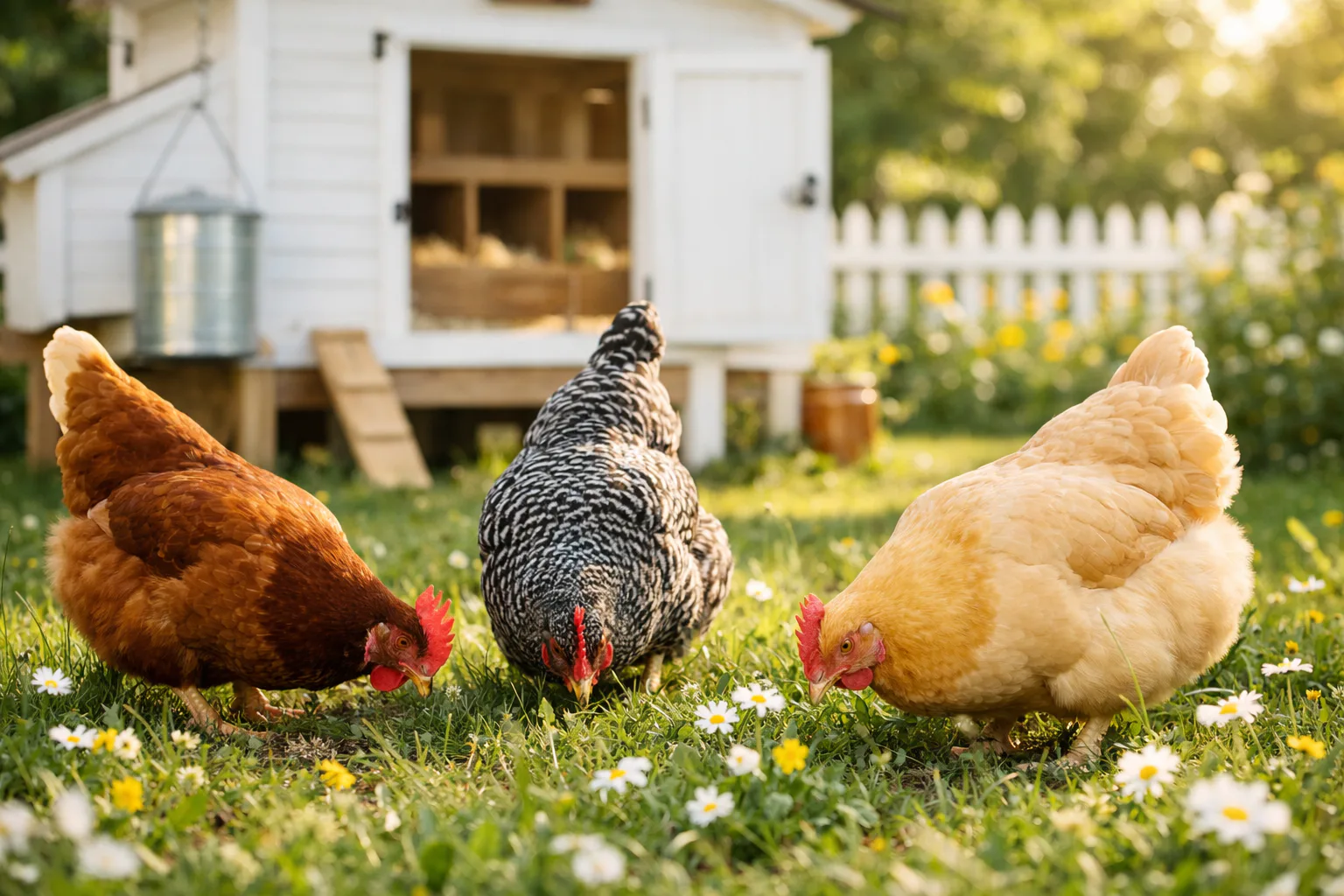
The best chicken breeds for beginners are docile, hardy, low-maintenance birds that lay consistently and tolerate handling well. Rhode Island Reds, Plymouth Rocks, Buff Orpingtons, Australorps, and Sussex chickens top the list because they adapt to various climates, forgive beginner mistakes, and produce 200-280 eggs per year. These breeds are friendly, disease-resistant, and thrive in standard backyard setups without special equipment.
Key Takeaways
- Rhode Island Reds, Plymouth Rocks, and Buff Orpingtons are the most forgiving breeds for first-time chicken keepers
- Beginner-friendly chickens cost $3-$8 per chick or $15-$30 per started pullet depending on breed and source
- Start with 3-6 chickens to balance egg production, social dynamics, and manageable workload
- Avoid high-maintenance breeds like Silkies, Polish, and game birds until you gain experience
- Standard-sized chickens are easier for beginners than bantams, which require more precise care
- Most beginner breeds need only basic coops and equipment,no specialized housing required
- Mixing different beginner breeds in one flock works well and adds visual variety
- You don’t need a rooster for egg production; hens lay unfertilized eggs without male birds
What Makes a Chicken Breed Good for Beginners?
A beginner-friendly chicken breed combines docile temperament, hardiness, and consistent egg production with tolerance for handling mistakes. These birds forgive irregular feeding schedules, adapt to basic housing, resist common diseases, and remain calm when approached by inexperienced handlers.
Key characteristics that define beginner-suitable breeds:
- Calm, friendly disposition: Birds that don’t panic when you enter the coop or try to catch them
- Cold and heat tolerance: Breeds that handle temperature swings without special climate control
- Reliable egg layers: 200+ eggs per year without complicated nutrition requirements
- Forgiving nature: Chickens that bounce back from minor care mistakes like delayed feeding or occasional overcrowding
- Dual-purpose utility: Breeds that provide both eggs and meat if you choose to process older hens
- Low maintenance: Birds that don’t require frequent grooming, special diets, or constant health monitoring
Common mistake: New keepers often choose breeds based on appearance alone, selecting exotic or ornamental birds that need experienced care. Prioritize temperament and hardiness over looks for your first flock.
What Are the Best Chicken Breeds for Beginners?
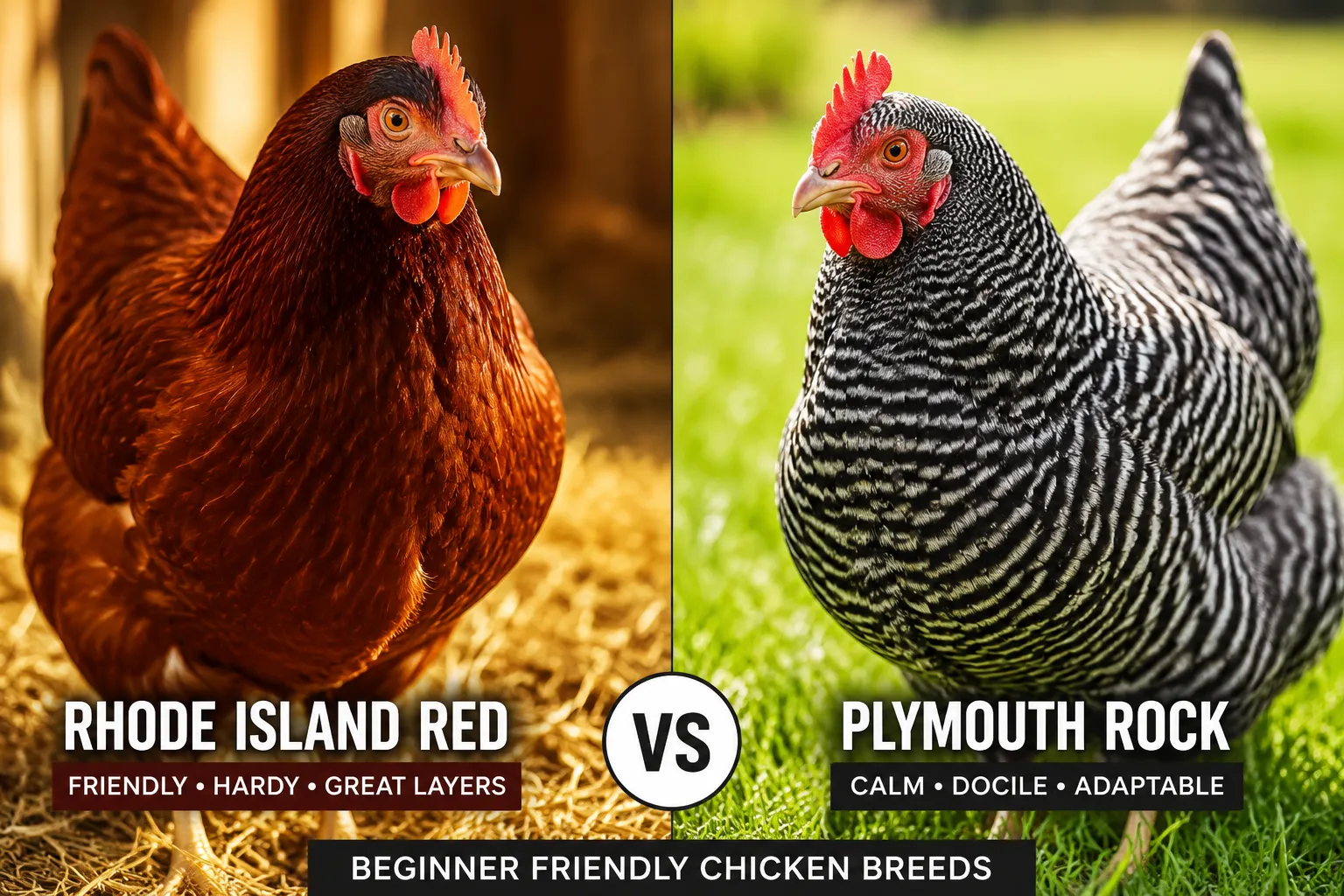
The top five beginner breeds have proven track records across diverse climates and management styles. Each offers a slightly different balance of traits, but all excel at forgiving new keeper mistakes.
Rhode Island Red
The most popular beginner breed for good reason. Rhode Island Reds lay 250-280 large brown eggs annually, tolerate confinement or free-ranging equally well, and handle cold winters without frostbite issues. They’re assertive but not aggressive, making them confident foragers that establish clear pecking order without excessive fighting.
Choose Rhode Island Reds if: You want maximum egg production, live in cold climates, or need birds that thrive with minimal supervision.
Plymouth Rock (Barred Rock)
Barred Rocks are the friendliest of the high-production breeds. They lay 200-250 large brown eggs per year, enjoy human interaction, and remain calm during handling. Their distinctive black-and-white striped feathers make flock monitoring easy. They’re slightly less cold-hardy than Rhode Island Reds but more sociable with children.
Choose Plymouth Rocks if: You have kids who want to interact with chickens, value gentle temperament over maximum production, or want visually striking birds.
Buff Orpington
The golden retrievers of the chicken world. Buff Orpingtons are large, fluffy, golden-colored birds that lay 180-200 light brown eggs annually. They go broody more often than other beginner breeds, making them excellent mothers if you want to hatch chicks naturally. Their docile nature makes them ideal for families and urban settings where noise complaints matter.
Choose Buff Orpingtons if: You prioritize temperament over production, want potential broody hens for natural hatching, or need quiet birds for close neighbors.
Australorp
The world-record egg layer (364 eggs in 365 days, set in 1922). Modern Australorps lay 250-280 large brown eggs per year with exceptional feed efficiency. They’re jet-black with a green sheen, handle heat better than most cold-hardy breeds, and remain productive longer than other high-output chickens.
Choose Australorps if: You want maximum eggs per feed dollar, live in hot climates, or need long-term layers that produce into their fourth year.
Sussex (Light or Speckled)
Sussex chickens are curious, friendly foragers that lay 200-250 light brown or cream eggs annually. They adapt to confinement but excel as free-range birds, significantly reducing feed costs. Their inquisitive nature makes them entertaining to watch but can lead to garden destruction if not properly fenced.
Choose Sussex if: You plan to free-range your flock, want birds that actively control pests, or enjoy interactive chickens that follow you around the yard.
Rhode Island Red vs Plymouth Rock for First-Time Chicken Owners
Both breeds are excellent starter chickens, but they suit different keeper priorities. Rhode Island Reds produce 30-50 more eggs per year and handle neglect better, making them ideal for busy owners who want maximum production with minimal interaction. Plymouth Rocks are gentler and more kid-friendly, better for families who view chickens as pets that happen to lay eggs.
Temperament difference: Rhode Island Reds are confident and sometimes bossy, establishing dominance quickly. Plymouth Rocks are more submissive and integrate easily into mixed flocks. If you’re mixing breeds, Plymouth Rocks make better flock mates for other docile breeds.
Climate consideration: Rhode Island Reds have smaller combs that resist frostbite in extreme cold. Plymouth Rocks have larger combs that may need petroleum jelly protection below 10°F (-12°C).
Decision rule: Choose Rhode Island Reds if egg production is your primary goal. Choose Plymouth Rocks if you want friendly birds for a family environment or plan to mix multiple breeds.
How Much Do Starter Chickens Cost?
Day-old chicks cost $3-$8 each depending on breed, hatchery, and order size. Started pullets (16-20 weeks old, ready to lay) cost $15-$30 each. Point-of-lay hens (22-24 weeks, actively laying) cost $25-$40 each from local breeders.
Price breakdown by source:
- Mail-order hatcheries: $3-$5 per chick (minimum orders of 15-25 birds to maintain shipping warmth)
- Local feed stores: $4-$8 per chick (no minimum, available spring through early summer)
- Backyard breeders: $5-$10 per chick, $20-$30 per started pullet (often healthier, locally adapted birds)
- Specialty/heritage breeders: $8-$15 per chick (show-quality or rare color varieties)
Hidden costs: Add $50-$100 for brooding equipment if starting with chicks (heat lamp, brooder box, chick feeder and waterer). Started pullets skip this expense but cost more upfront.
Common mistake: Buying only 2-3 chicks to save money. Chickens are social birds that suffer stress alone, and mortality rates for small groups are higher. The per-bird cost drops significantly when ordering 5-6 birds, and you’ll have backup if one dies.
Easiest Chicken Breeds That Lay Lots of Eggs
Australorps and Rhode Island Reds combine the highest egg production (250-280 eggs/year) with the lowest maintenance requirements. Both breeds lay consistently through their first three years, require only basic layer feed, and continue producing through mild winters without supplemental lighting.
Production comparison (average annual eggs for beginner-friendly breeds):
- Australorp: 250-280 large brown eggs
- Rhode Island Red: 250-280 large brown eggs
- Plymouth Rock: 200-250 large brown eggs
- Sussex: 200-250 cream/light brown eggs
- Buff Orpington: 180-200 light brown eggs
- Easter Egger: 200-250 blue/green eggs (not a true breed, but beginner-friendly)
Egg production factors: All these numbers assume proper nutrition (16% protein layer feed), adequate daylight (14+ hours), and hens under 3 years old. Production drops 15-20% annually after the second year.
Choose Australorps or Rhode Island Reds if: Egg quantity matters more than egg color variety, and you want birds that pay for their feed costs quickly.
Are Silkie Chickens Good for Beginners or Too Hard to Care For?
Silkies are NOT recommended for beginners despite their adorable appearance and friendly temperament. Their fluffy, hair-like feathers require constant maintenance, they can’t tolerate wet conditions, they’re poor layers (80-120 small eggs per year), and their feather structure prevents them from roosting properly.
Why Silkies are challenging:
- Feather maintenance: Their unique plumage soaks up water and mud, leading to hypothermia and parasites if not dried and cleaned regularly
- Vision problems: Head feathers often block their vision, requiring frequent trimming
- Predator vulnerability: They can’t fly to escape danger and their poor eyesight makes them easy targets
- Special housing needs: Require covered runs to stay dry and low roosts or floor space since they can’t jump
- Low production: Lay fewer, smaller eggs than standard breeds while eating the same amount of feed
When Silkies make sense: After you’ve kept chickens for 1-2 years and want to add ornamental birds or natural incubators (Silkies are excellent broody hens). They’re wonderful second-flock additions but frustrating first birds.
What Chicken Breeds Are Not Recommended for New Owners?
Avoid game birds, high-strung Mediterranean breeds, and ornamental chickens until you’ve successfully kept a beginner flock for at least one year. These breeds require experienced handling, specialized care, or tolerate fewer mistakes.
Breeds to skip as a beginner:
- Leghorns: Flighty, nervous, and difficult to handle despite excellent egg production
- Polish: Head crests block vision, making them vulnerable to predators and prone to panic
- Silkies: Covered above, too high-maintenance for first-time keepers
- Game birds (Old English Game, Modern Game): Aggressive, require experienced handling, often illegal in urban areas
- Hamburgs: Flighty, prefer to roost in trees, difficult to confine
- Malay: Extremely tall, aggressive, need specialized housing
- Sebrights: Delicate bantams prone to health problems
Common thread: These breeds either panic easily, require constant grooming, need non-standard housing, or show aggression that inexperienced handlers can’t manage safely.
Decision rule: If a breed description includes words like “active,” “flighty,” “requires experienced handler,” or “special housing needs,” skip it for your first flock.
Common Mistakes When Choosing Your First Chicken Breed
Choosing based on egg color alone is the most frequent beginner error. Blue and green eggs from Ameraucanas or Easter Eggers are appealing, but these breeds are less consistent layers than brown-egg breeds. Egg color doesn’t affect nutrition or taste, it’s purely aesthetic.
Other common selection mistakes:
Buying only one breed: Single-breed flocks miss the benefits of genetic diversity and behavioral variety. Mixing 2-3 beginner breeds creates more resilient flocks.
Prioritizing rare or exotic breeds: Unusual breeds are often rare because they’re difficult to keep, not because they’re superior. Stick with common breeds that have proven themselves across thousands of backyard flocks.
Ignoring climate compatibility: Choosing cold-hardy breeds in hot climates (or vice versa) creates unnecessary stress. Match breeds to your local weather patterns.
Selecting bantams to save space: Bantams need nearly as much space as standard chickens but lay much smaller eggs. They’re not a space-saving solution.
Buying straight-run chicks: Straight-run (unsexed) chicks are cheaper but give you 50% roosters. Most beginners can’t keep roosters due to noise restrictions. Pay extra for sexed pullets.
Choosing show-quality birds: Exhibition strains are bred for appearance, not production or hardiness. Hatchery-quality birds are healthier and more productive for backyard flocks.
Prevention strategy: Make a list of your priorities (egg production, temperament, climate tolerance, kid-friendliness) and choose breeds that match at least three of your top four criteria.
Do Beginner-Friendly Chickens Need Special Coops or Equipment?
No, beginner breeds thrive in basic coops with 3-4 square feet of indoor space per bird and 8-10 square feet of outdoor run space per bird. Standard equipment includes roosting bars, nesting boxes, feeders, and waterers. No climate control, automatic systems, or specialized housing is required.
Basic coop requirements for beginner breeds:
- Ventilation: Openings near the roof for air circulation without drafts
- Roosting bars: 2-inch diameter bars, 8-12 inches apart, 2-4 feet off the ground
- Nesting boxes: One box per 3-4 hens, 12x12x12 inches, filled with straw or shavings
- Predator protection: Hardware cloth (not chicken wire) on all openings, buried 12 inches deep
- Easy cleaning: Removable dropping boards or deep litter system
Equipment you DON’T need:
- Automatic doors (nice but not necessary)
- Heated waterers (except in extreme cold below 0°F/-18°C)
- Supplemental lighting (hens lay fine with natural daylight)
- Fancy feeders (simple hanging feeders work perfectly)
- Climate control (beginner breeds handle 0-95°F/-18-35°C without help)
Common mistake: Over-building coops with expensive features that don’t improve chicken health or production. A simple, well-ventilated, predator-proof structure beats an elaborate coop with poor ventilation.
Best Cold-Hardy Chicken Breeds for Beginners
Plymouth Rocks, Rhode Island Reds, and Australorps are the top cold-hardy beginner breeds, maintaining egg production through winter and handling temperatures well below 0°F (-18°C) without supplemental heat. Their small-to-medium combs resist frostbite, and their dense feathering provides excellent insulation.
Cold-hardy breed characteristics:
- Small combs and wattles: Less exposed tissue means lower frostbite risk
- Dense feathering: Tight, overlapping feathers trap body heat effectively
- Calm temperament: Stressed birds generate less body heat; docile breeds stay warmer
- Continued laying: Cold-hardy breeds maintain 60-80% production through winter
Winter care for cold-hardy breeds:
- Provide ventilation without drafts,moisture buildup causes more problems than cold
- Use petroleum jelly on combs during extreme cold snaps (below -10°F/-23°C)
- Offer warm water twice daily when temperatures stay below freezing
- Increase feed by 10-15%,birds burn more calories maintaining body temperature
Breeds to avoid in cold climates: Mediterranean breeds (Leghorns, Minorcas, Andalusians) with large combs, and any breed with sparse feathering or exposed skin.
How Many Chickens Should a Beginner Start With?
Start with 4-6 chickens to balance egg production, social dynamics, and manageable workload. This number provides 2-4 eggs daily (enough for a family of four), allows for one or two losses without devastating the flock, and keeps daily chores under 15 minutes.
Why 4-6 is the sweet spot:
- Social structure: Chickens need at least 3 flock mates to establish healthy pecking order without bullying
- Egg production: 4 hens = 20-28 eggs per week during peak production
- Loss buffer: If one or two birds die (10-15% first-year mortality is normal), you still have a functional flock
- Workload: 4-6 birds take 10-15 minutes daily for feeding, watering, and egg collection
- Cost efficiency: Feed and supply costs per bird drop significantly at 4+ birds
Scaling considerations:
- 2-3 chickens: Risky, one loss devastates flock dynamics; barely enough eggs to justify the work
- 7-10 chickens: More eggs than most families need; requires larger coop and more time
- 10+ chickens: Crosses into small-farm territory; not recommended for first-time keepers
Common mistake: Starting with 10+ chickens because “more is better.” Large flocks amplify beginner mistakes, make disease management harder, and produce more eggs than you can use or give away.
Are Bantam Chickens Easier or Harder for Beginners Than Standard Size?
Bantams are harder for beginners despite being smaller. They’re more fragile, lay tiny eggs (3 bantam eggs = 2 standard eggs), are more vulnerable to predators, and often have flighty temperaments that make handling difficult. Standard-sized chickens are more forgiving of beginner mistakes and provide better egg production per feed dollar.
Why bantams challenge new keepers:
- Fragility: Easier to injure during handling; more susceptible to temperature extremes
- Predator vulnerability: Hawks, cats, and even large rats can kill bantams
- Flighty behavior: Many bantam breeds panic easily and are difficult to catch
- Small eggs: You need 50% more bantam hens to match standard egg production
- Specialized care: Some bantams need different roost heights and nesting box sizes
When bantams make sense: After you’ve kept standard chickens successfully, bantams work well for small yards, as ornamental additions, or for showing. Some bantam breeds (Silkie bantams, Cochin bantams) are docile, but they’re still more challenging than standard beginner breeds.
Decision rule: Choose standard-sized chickens for your first flock. Add bantams later if you want variety or have specific space constraints.
Which Chicken Breeds Are Friendliest With Kids?
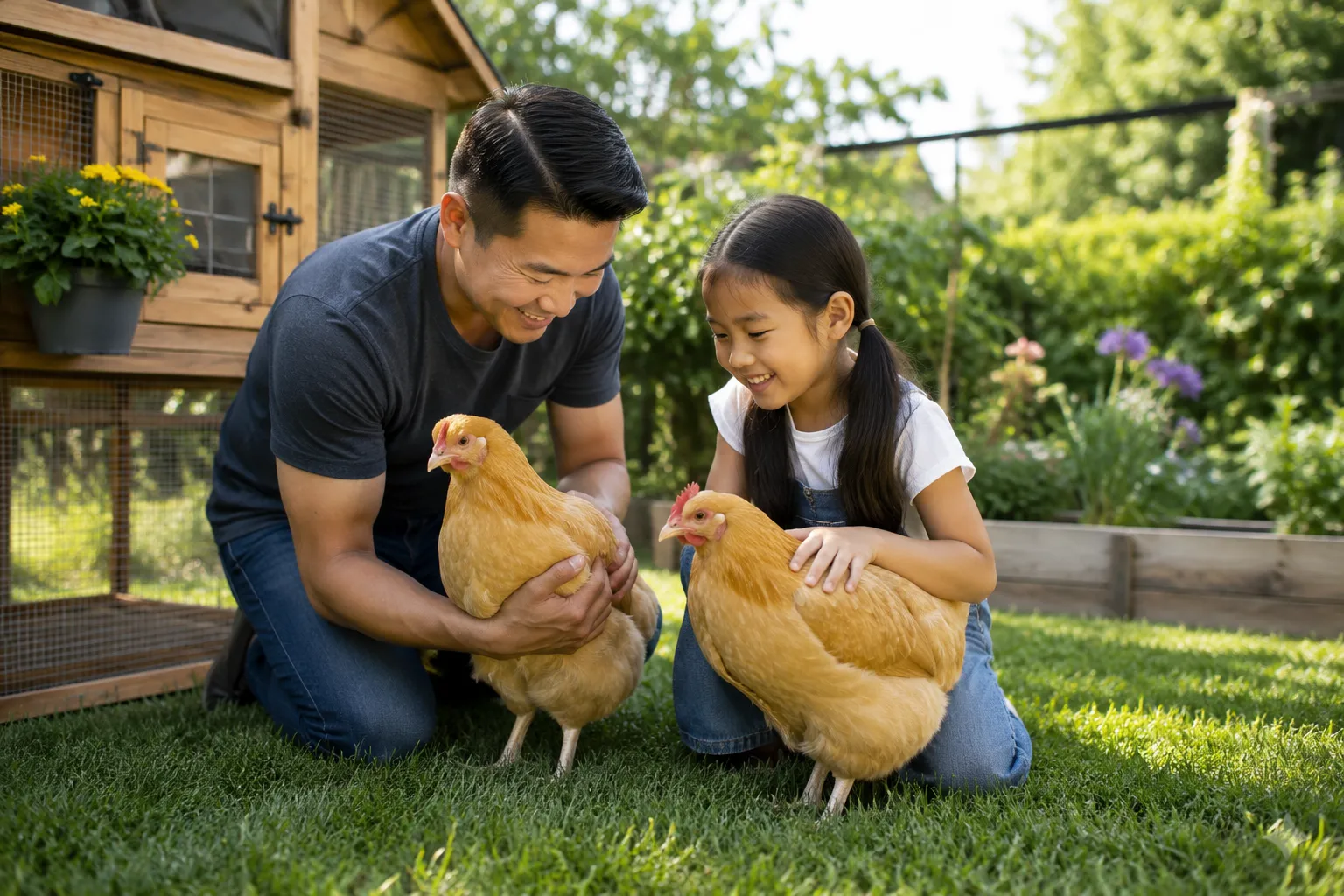
Buff Orpingtons and Plymouth Rocks are the most kid-friendly breeds, tolerating frequent handling, remaining calm when chased, and rarely pecking at small hands. Their large size makes them easy for children to hold securely, and their gentle temperament forgives clumsy handling.
Kid-friendly breed characteristics:
- Docile temperament: Don’t panic or peck when approached by excited children
- Large size: Easier for kids to hold without dropping; less likely to be squeezed too hard
- Slow movement: Calm birds are easier for children to catch and handle
- Tolerance for noise: Don’t startle at children’s voices or sudden movements
Breeds ranked by kid-friendliness:
- Buff Orpington: Extremely gentle, enjoys being held, tolerates petting
- Plymouth Rock: Friendly and calm, good with supervised children
- Sussex: Curious and interactive, but may peck at shiny objects (buttons, jewelry)
- Australorp: Calm but less interested in human interaction than Orpingtons
- Rhode Island Red: Tolerates handling but too assertive for unsupervised young children
Safety rules for kids and chickens:
- Supervise children under 8 during all chicken interactions
- Teach gentle handling, support the bird’s body and feet
- Wash hands immediately after touching chickens (salmonella prevention)
- Never allow children to kiss chickens or put faces near beaks
Do I Need a Rooster If I’m a Beginner Chicken Keeper?
No, you don’t need a rooster for egg production. Hens lay unfertilized eggs without a male bird present. Roosters add noise (often illegal in urban areas), aggression toward handlers, and stress to hens through constant mating attempts. Most beginners should keep hen-only flocks.
What roosters provide:
- Fertilized eggs: Required only if you want to hatch chicks
- Flock protection: Alert hens to predators and sometimes defend against threats
- Social structure: Reduce hen-on-hen aggression by establishing clear hierarchy
Why beginners should skip roosters:
- Noise complaints: Roosters crow 10-15 times daily starting at dawn; illegal in most urban/suburban areas
- Aggression: Many roosters attack handlers, especially during breeding season
- Hen stress: Constant mating can injure hens and reduce egg production
- No egg benefit: Roosters don’t increase egg quantity or quality
When roosters make sense: If you live in a rural area, want to breed chickens, or need flock protection from aerial predators. Even then, wait until your second year of chicken keeping to add a rooster.
Common mistake: Buying straight-run chicks and ending up with multiple roosters. Always buy sexed pullets for your first flock.
What Happens If I Mix Different Beginner Chicken Breeds Together?
Mixing beginner breeds works excellently and often creates more stable flocks than single-breed groups. Different breeds bring varied behaviors and pecking-order positions, reducing bullying and boredom. All the recommended beginner breeds (Rhode Island Reds, Plymouth Rocks, Buff Orpingtons, Australorps, Sussex) integrate well together.
Benefits of mixed-breed flocks:
- Genetic diversity: Reduces disease susceptibility across the entire flock
- Behavioral variety: Different foraging styles and activity levels keep chickens entertained
- Visual interest: Easier to identify individual birds for health monitoring
- Stable pecking order: Breeds with different temperaments create natural hierarchy without excessive fighting
Successful breed combinations:
- Plymouth Rock + Buff Orpington: Two gentle breeds that coexist peacefully
- Rhode Island Red + Australorp: High-production birds with similar energy levels
- Sussex + Plymouth Rock + Buff Orpington: Three friendly breeds with complementary temperaments
- Any beginner breed + Easter Eggers: Adds egg color variety without temperament issues
Breeds to avoid mixing: Don’t combine beginner breeds with aggressive breeds (game birds), flighty breeds (Leghorns), or high-maintenance breeds (Silkies). The temperament mismatch creates stress for all birds.
Integration tips: Introduce all birds simultaneously as chicks or pullets. Adding single birds to established flocks is harder and often results in bullying.
Frequently Asked Questions
What is the easiest chicken breed to raise?
Plymouth Rocks are the easiest overall breed for beginners, combining docile temperament, good egg production (200-250 eggs/year), cold hardiness, and kid-friendly behavior. They forgive beginner mistakes and adapt to confinement or free-ranging equally well.
How long do beginner chicken breeds live?
Most beginner breeds live 5-8 years with proper care, though egg production drops significantly after year 3. Rhode Island Reds and Australorps often remain productive into year 4, while Buff Orpingtons typically retire from laying by year 3.
Can I keep chickens in my backyard if I’ve never done it before?
Yes, if local ordinances allow chickens and you can provide a predator-proof coop with 3-4 square feet per bird indoors and 8-10 square feet per bird in an outdoor run. Beginner breeds require only 10-15 minutes of daily care and basic equipment.
What do beginner chickens eat?
Feed beginner breeds commercial layer feed (16-18% protein) as their primary diet, supplemented with kitchen scraps (vegetables, fruits, grains) and occasional treats. Provide constant access to fresh water and grit (small stones) for digestion.
Do chickens need vaccinations?
Most backyard flocks don’t require vaccinations. Hatcheries often vaccinate chicks against Marek’s disease before shipping. Consult a poultry veterinarian if you live in an area with known disease outbreaks or plan to show your birds.
How soon do beginner breeds start laying eggs?
Most beginner breeds start laying at 18-24 weeks of age. Rhode Island Reds and Australorps often begin at 18-20 weeks, while Buff Orpingtons may wait until 22-24 weeks. Expect small “pullet eggs” for the first month of laying.
Can I let my chickens free-range as a beginner?
Yes, if you have a secure yard and can supervise them initially. Sussex and Plymouth Rocks are excellent free-range breeds for beginners. Start with supervised free-range time and gradually increase as you learn your birds’ behavior and local predator patterns.
What’s the difference between heritage and production breeds?
Heritage breeds are traditional varieties bred for multiple traits (eggs, meat, temperament), while production breeds are optimized for maximum egg output. For beginners, hatchery-quality heritage breeds (Plymouth Rock, Rhode Island Red) offer the best balance of production and hardiness.
How much space do I need for 4-6 beginner chickens?
Provide a coop with 12-24 square feet of indoor space (3-4 sq ft per bird) and a run with 32-60 square feet (8-10 sq ft per bird). A 4×6-foot coop with an 8×8-foot run comfortably houses 5-6 standard-sized chickens.
Do chickens smell bad?
Properly maintained chicken coops don’t smell. Clean droppings weekly, provide good ventilation, and use the deep litter method or dropping boards. Smell indicates poor ventilation, infrequent cleaning, or overcrowding, all preventable with basic management.
Can I keep chickens in winter?
Yes, all recommended beginner breeds handle winter well without supplemental heat. Provide draft-free ventilation, unfrozen water twice daily, and extra feed during extreme cold. Chickens are more cold-tolerant than heat-tolerant.
What predators threaten backyard chickens?
Common predators include raccoons, foxes, hawks, owls, opossums, weasels, and neighborhood dogs. Protect your flock with hardware cloth (not chicken wire) on all coop openings, buried 12 inches deep, and a covered run to prevent aerial attacks.
Conclusion
Choosing the right chicken breeds transforms your first year of chicken keeping from stressful to enjoyable. Rhode Island Reds, Plymouth Rocks, Buff Orpingtons, Australorps, and Sussex chickens offer the perfect combination of hardiness, productivity, and forgiving temperament that new keepers need. These breeds tolerate beginner mistakes, adapt to basic housing, and reward you with consistent egg production while you learn the fundamentals of poultry care.
Your next steps:
- Check local regulations: Verify that your city or HOA allows backyard chickens and note any restrictions on flock size or roosters
- Choose 2-3 beginner breeds: Select 4-6 birds total, mixing breeds for flock diversity and visual interest
- Prepare housing before birds arrive: Build or buy a coop with 3-4 square feet per bird indoors and 8-10 square feet per bird in the run
- Source sexed pullets: Order from reputable hatcheries or local breeders in early spring for best selection
- Start simple: Use basic equipment and standard layer feed for your first year, avoid complicated systems until you’ve mastered the basics
The best chicken breed for beginners is ultimately the one that matches your climate, space, and goals while offering the temperament and hardiness to forgive your inevitable learning curve. Start with proven breeds, keep your setup simple, and enjoy the daily rewards of fresh eggs and entertaining backyard companions.


