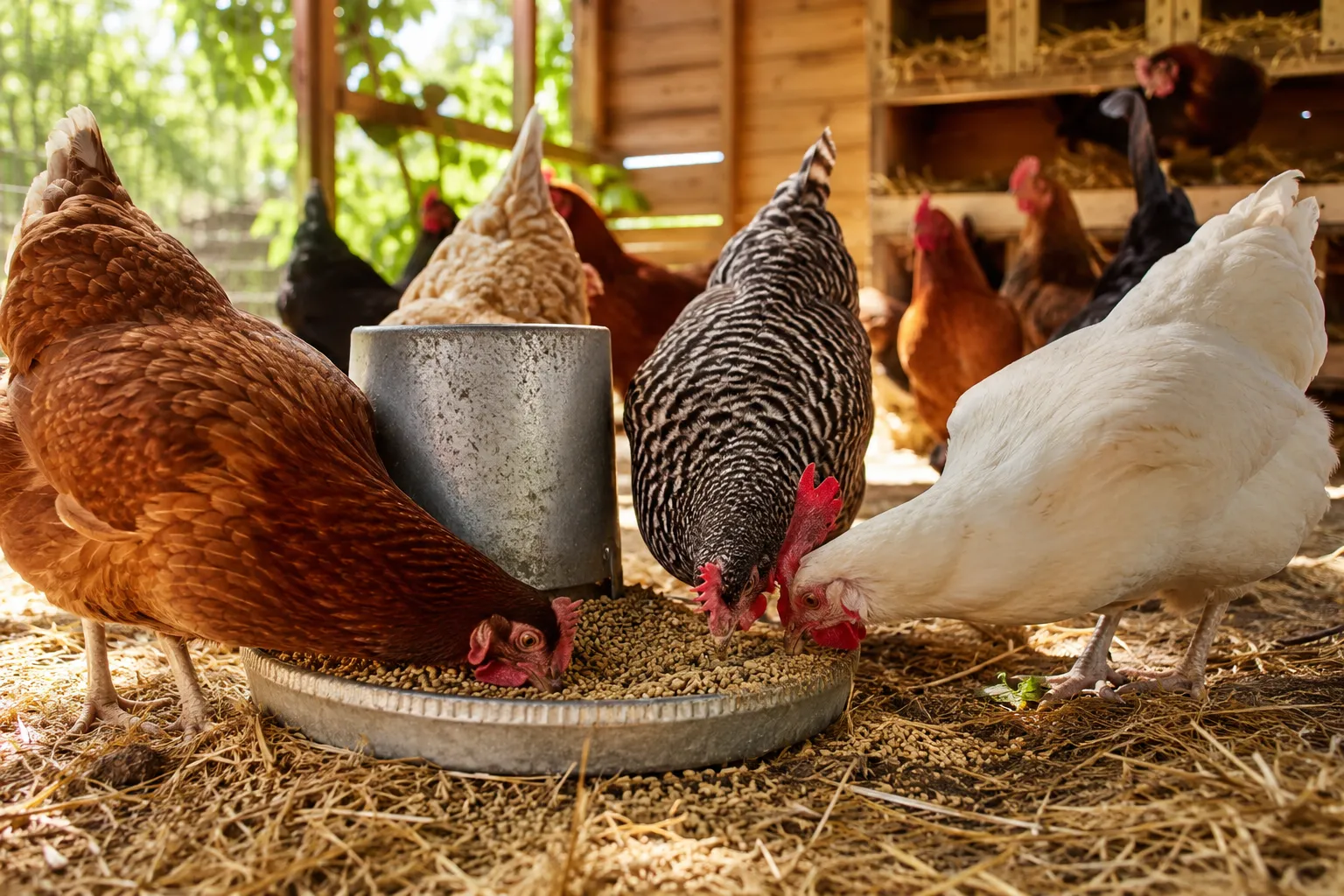
Quick Answer: An adult chicken typically eats between 1/4 to 1/3 pound (approximately 4 to 6 ounces or 113 to 170 grams) of feed per day, depending on the breed, age, season, and whether they have access to forage. Laying hens generally consume more feed than non-layers, and larger breeds eat more than bantams. This daily amount translates to roughly 1.5 to 2.5 pounds per week per chicken.
Key Takeaways
- Adult chickens consume 1/4 to 1/3 pound of feed daily, or about 1.5 to 2.5 pounds per week
- Laying hens eat 20-30% more feed than non-laying chickens due to egg production demands
- Baby chicks need approximately 1 to 2 ounces of starter feed per day during their first weeks
- A 50-pound bag of feed lasts one chicken roughly 150 to 200 days, or about 5 to 6 months
- Chickens eat significantly more in winter (up to 50% more) to maintain body temperature
- Free-ranging can reduce feed costs by 15-30% but doesn’t eliminate the need for supplemental feed
- Bantam chickens eat about half as much as standard breeds, consuming 2 to 3 ounces daily
- Monthly feed costs per chicken range from $3 to $8 depending on feed quality and local prices
- Meat chickens (broilers) consume 2 to 3 times more feed than layers due to rapid growth
- Overfeeding is possible but rare; obesity and health issues can result from unlimited high-calorie treats
What Factors Affect How Much Feed a Chicken Eats Per Day?
Several variables influence daily feed consumption in chickens. Breed size is the primary factor: standard breeds like Rhode Island Reds or Plymouth Rocks eat more than smaller bantams. Age matters significantly because growing chicks and pullets have different nutritional needs than mature birds. Laying hens require extra calories and protein to produce eggs, increasing their intake by 20-30% compared to non-layers.
Key factors that change feed consumption:
- Breed and body size, Large breeds (Jersey Giants, Brahmas) eat 1/3 to 1/2 pound daily, while bantams need only 2 to 3 ounces
- Egg production status, Active layers consume more protein and calcium to support daily egg formation
- Season and temperature, Cold weather increases feed needs for body heat; hot weather decreases appetite
- Activity level, Free-ranging chickens burn more calories and may eat slightly more total food (feed plus forage)
- Feed quality, Nutrient-dense feeds satisfy chickens with smaller portions than low-quality alternatives
- Health status, Sick, molting, or stressed chickens may eat less temporarily
Choose a feeding strategy based on your flock’s specific characteristics rather than relying on a single universal number.
How Much Feed Do Baby Chicks Need Per Day?
Baby chicks consume approximately 1 to 2 ounces of starter feed per day during their first eight weeks of life. Newly hatched chicks start with about 1/2 ounce daily and gradually increase intake as they grow. By week four, most chicks eat 1.5 to 2 ounces daily, and by week eight, they approach juvenile consumption levels of 2.5 to 3 ounces.
Chick feeding guidelines by age:
- Week 1-2: 1/2 to 3/4 ounce per chick daily (approximately 1 tablespoon)
- Week 3-4: 1 to 1.5 ounces per chick daily
- Week 5-8: 1.5 to 2.5 ounces per chick daily
- Week 9-16: 2.5 to 4 ounces per chick daily (transitioning to grower feed)
Always provide chick starter feed with 18-20% protein content and keep feed available at all times. Chicks grow rapidly and need constant access to nutrition. A common mistake is underestimating how quickly chicks empty feeders; check and refill at least twice daily during the first month.
What Is the Difference Between Layer Feed and Grower Feed?
Layer feed contains 16-18% protein and added calcium (3-4%) specifically formulated for hens producing eggs, while grower feed contains 16-18% protein but minimal calcium (around 1%) designed for young chickens aged 8 to 20 weeks who aren’t yet laying. The calcium difference is critical because excess calcium damages the kidneys of non-laying birds, but laying hens need it to form strong eggshells.
Feed type comparison:
| Feed Type | Protein % | Calcium % | Best For | Age Range |
|---|---|---|---|---|
| Starter | 18-20% | 1% | Chicks | 0-8 weeks |
| Grower | 16-18% | 1% | Juveniles | 8-20 weeks |
| Layer | 16-18% | 3-4% | Laying hens | 20+ weeks |
| Finisher | 16-18% | 1% | Meat birds | Final 2-4 weeks |
Switch to layer feed when pullets reach 18 to 20 weeks of age or when they lay their first egg, whichever comes first. If you have a mixed flock with layers and non-layers, feed grower or all-flock feed (with lower calcium) and offer crushed oyster shell in a separate dish so laying hens can self-regulate calcium intake.
Do Chickens Eat More in Winter or Summer?
Chickens eat significantly more in winter, often consuming 25-50% more feed than during warm months. Cold weather forces chickens to burn extra calories maintaining their 106°F body temperature, and they compensate by eating more. In summer, chickens naturally reduce feed intake because they need fewer calories and hot weather suppresses appetite.
Seasonal feeding patterns:
- Winter: 1/3 to 1/2 pound per bird daily (up to 3.5 pounds weekly)
- Spring/Fall: 1/4 to 1/3 pound per bird daily (standard baseline)
- Summer: 1/5 to 1/4 pound per bird daily (reduced intake)
Provide extra feed during cold snaps and consider offering high-energy scratch grains in the evening during winter so chickens have fuel to burn overnight. In summer, feed during the coolest parts of the day (early morning and evening) when chickens are more willing to eat. Never restrict feed access in winter thinking chickens are overeating; they genuinely need the extra calories to survive.
How Much Feed for 6 Chickens Per Week?
Six adult chickens consume approximately 9 to 15 pounds of feed per week, depending on breed size, season, and whether they’re laying. This translates to 1.5 to 2.5 pounds per chicken weekly. During peak laying season in spring and summer, expect consumption at the higher end; in winter, consumption increases due to cold but may decrease slightly if hens stop laying.
Weekly feed calculation for 6 chickens:
- Minimum estimate: 6 chickens × 1.5 pounds = 9 pounds per week
- Average estimate: 6 chickens × 2 pounds = 12 pounds per week
- Maximum estimate: 6 chickens × 2.5 pounds = 15 pounds per week (winter or large breeds)
A 50-pound bag of feed will last a flock of six chickens approximately 3 to 5 weeks under normal conditions. Budget for one 50-pound bag per month for six chickens as a practical guideline. Track your flock’s actual consumption for a few weeks to establish your specific baseline, since individual flocks vary based on the factors mentioned earlier.
How Much Does It Cost to Feed a Chicken Per Month?

Feeding one chicken costs approximately $3 to $8 per month depending on feed quality, local prices, and whether the chicken free-ranges. Standard layer feed typically costs $12 to $20 per 50-pound bag in 2026, and since one chicken eats 7.5 to 10 pounds monthly, the math works out to $1.80 to $4 per chicken for feed alone. Organic or specialty feeds can double or triple this cost.
Monthly feeding cost breakdown:
- Budget feed ($12/50 lb bag): $1.80 to $2.40 per chicken monthly
- Standard feed ($15/50 lb bag): $2.25 to $3.00 per chicken monthly
- Premium feed ($20/50 lb bag): $3.00 to $4.00 per chicken monthly
- Organic feed ($35-45/50 lb bag): $5.25 to $9.00 per chicken monthly
For a flock of six chickens, expect monthly feed costs between $18 and $48 for conventional feed, or $30 to $54 for organic. These estimates assume no free-ranging. Chickens with pasture access can reduce feed consumption by 15-30%, lowering costs proportionally. Add treats, supplements, and grit to your budget for a complete picture; these typically add $5 to $15 monthly for a small flock.
Is It Cheaper to Free Range Chickens or Buy Feed?
Free-ranging reduces feed costs by 15-30% but doesn’t eliminate the need for purchased feed entirely. Chickens that forage obtain protein from insects, greens from plants, and grit naturally, which supplements their diet but rarely provides complete nutrition. You’ll still need to offer layer feed to ensure adequate protein, vitamins, and minerals, especially for laying hens who have high nutritional demands.
Free-range vs. confined feeding comparison:
- Confined chickens: 100% feed reliance, $3-8 per bird monthly
- Free-range chickens: 70-85% feed reliance, $2-6 per bird monthly
- Savings: Approximately $1-2 per bird monthly, or $12-24 annually
Free-ranging works best when chickens have access to diverse pasture with insects, seeds, and greens. A bare dirt yard provides minimal forage value. The quality of your pasture directly affects feed savings. One acre of good pasture can support 50 to 100 chickens with significant feed reduction, while a small backyard might only support 6 to 10 birds with modest savings.
Consider that free-ranging increases predation risk and requires secure fencing. The cost savings may be offset by infrastructure needs and potential losses. Free-ranging is often chosen for chicken health and egg quality rather than purely economic reasons.
How Much Does a 50 Pound Bag of Chicken Feed Last?
A 50-pound bag of chicken feed lasts one chicken approximately 150 to 200 days (5 to 6.5 months), or about 25 to 33 days for a flock of six chickens. The exact duration depends on breed size, season, and whether chickens are laying. Larger flocks go through feed faster, while smaller bantam flocks stretch bags longer.
Feed bag duration by flock size:
- 1 chicken: 5 to 6.5 months per 50-lb bag
- 3 chickens: 7 to 10 weeks per 50-lb bag
- 6 chickens: 3 to 5 weeks per 50-lb bag
- 12 chickens: 1.5 to 2.5 weeks per 50-lb bag
- 25 chickens: Less than 1 week per 50-lb bag
Store feed in airtight containers to prevent moisture, pests, and spoilage. Feed loses nutritional value over time, especially vitamins, so buy quantities your flock will consume within 6 to 8 weeks. Buying in bulk saves money per pound but only makes sense if you can use it before quality degrades. Check the mill date on bags and avoid feed older than 3 months at purchase.
Do Bantam Chickens Eat Less Than Regular Chickens?
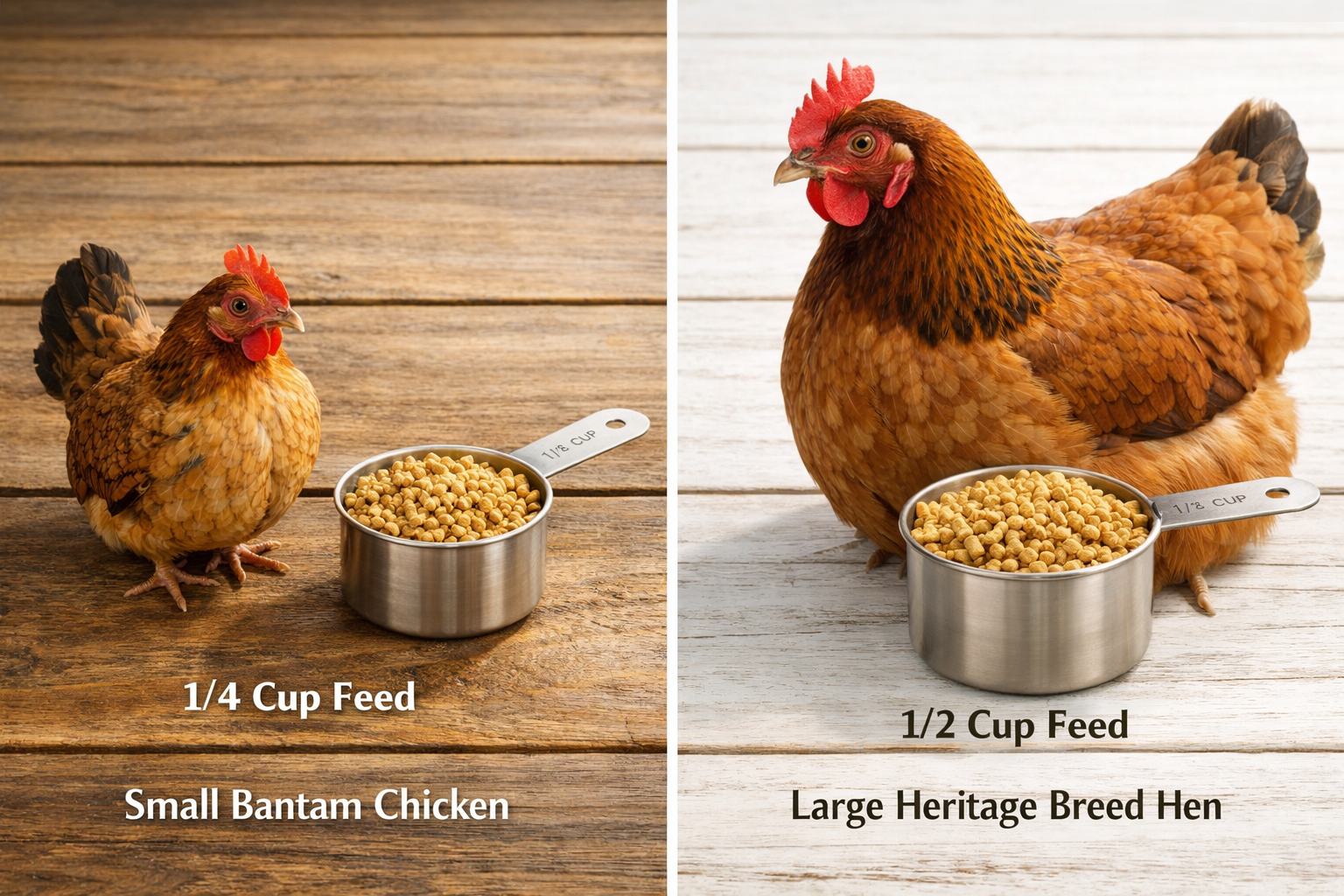
Bantam chickens eat approximately 50-60% less feed than standard-sized chickens, consuming about 2 to 3 ounces (1/8 to 3/16 pound) daily compared to 4 to 6 ounces for standard breeds. A bantam hen weighing 1.5 to 2 pounds needs proportionally less nutrition than a 5 to 7-pound standard hen, making bantams more economical to feed.
Bantam vs. standard feeding comparison:
- Bantam daily intake: 2-3 ounces (approximately 3-4 tablespoons)
- Standard daily intake: 4-6 ounces (approximately 3/4 to 1 cup)
- Monthly feed cost difference: Bantams cost $1.50-3 monthly vs. $3-8 for standards
A flock of six bantams consumes roughly 3 to 4 pounds of feed weekly, compared to 9 to 15 pounds for six standard chickens. This makes bantams ideal for small urban backyards where feed storage and cost are concerns. However, bantam eggs are also smaller (about 50-60% the size of standard eggs), so consider your egg production goals when choosing breeds.
How to Measure Chicken Feed Without a Scale?
Measure chicken feed using volume measurements when a scale isn’t available: one standard 8-ounce measuring cup holds approximately 4 to 5 ounces of layer pellets or crumbles by weight. For one chicken needing 4 to 6 ounces daily, fill a measuring cup about 3/4 to 1 cup full. For six chickens, provide 4.5 to 6 cups of feed daily.
Volume-to-weight conversion guide:
- 1/4 cup pellets ≈ 1 to 1.25 ounces
- 1/2 cup pellets ≈ 2 to 2.5 ounces
- 1 cup pellets ≈ 4 to 5 ounces
- 1 pound pellets ≈ 3 to 3.5 cups
Use a consistent measuring cup and observe your flock’s behavior. If chickens empty feeders hours before the next feeding and act hungry, increase portions. If feed remains at day’s end and chickens ignore it, reduce portions slightly. Most backyard keepers use the “keep feeders 1/2 to 2/3 full” method, refilling once or twice daily and adjusting based on consumption patterns.
A practical approach: fill feeders in the morning and check them at dusk. Ideally, feeders should be nearly empty but not completely bare. This ensures chickens ate their fill without significant waste.
Should I Leave Chicken Feed Out All Day or Schedule Feeding Times?
Leave feed available all day for laying hens and growing chickens, as they self-regulate intake and need constant access to nutrition for egg production and growth. Scheduled feeding (providing specific portions once or twice daily) works for mature non-laying flocks or meat birds on restricted diets, but most backyard flocks thrive with free-choice feeding.
Free-choice feeding (recommended for most flocks):
- Keeps feeders filled throughout the day
- Chickens eat when hungry, typically consuming most feed in morning and evening
- Supports consistent egg production
- Reduces stress and competition in the flock
- Easier management for busy chicken keepers
Scheduled feeding (specific situations):
- Useful for preventing obesity in pet chickens or non-laying flocks
- Helps control feed costs if chickens waste food
- Necessary for show birds on specific conditioning programs
- Can reduce rodent attraction if pests are a serious problem
If rodents are an issue, use treadle feeders that close when chickens aren’t eating, or bring feeders inside at night. Never restrict feed access for laying hens, as this reduces egg production and can cause nutritional deficiencies. Chickens naturally eat less than they need when food is always available, contrary to common fears about overfeeding.
Can You Overfeed Chickens?
Chickens rarely overeat their regular layer feed, but you can cause obesity and health problems by providing excessive high-calorie treats like scratch grains, corn, mealworms, or table scraps. Layer feed is nutritionally balanced, and chickens naturally stop eating when satisfied. Problems arise when treats exceed 10% of daily intake, displacing nutritious feed with empty calories.
Signs of overfeeding or poor diet balance:
- Obesity (difficulty walking, excessive fat deposits)
- Reduced egg production despite adequate feed
- Fatty liver disease (sudden death in overweight hens)
- Feather picking or boredom behaviors
- Soft-shelled or misshapen eggs from nutritional imbalances
Limit treats to 1 to 2 tablespoons per chicken daily, offered in the afternoon after chickens have eaten their fill of layer feed. Scratch grains, bread, and corn are low in protein and calcium, so excessive amounts lead to malnutrition even if chickens appear well-fed. Think of treats like dessert: enjoyable in moderation but harmful as a dietary staple.
If your chickens seem constantly hungry despite adequate feed, check for parasites (worms steal nutrients), ensure feed is fresh (old feed loses palatability), and verify you’re providing enough for your flock size and season.
Why Is My Chicken Eating So Much Food Suddenly?
Sudden increases in feed consumption typically indicate cold weather, the onset of laying, molting recovery, increased activity, or intestinal parasites. A chicken that doubles her feed intake over a few days is responding to a significant metabolic demand. Identify the cause by observing other behaviors and environmental factors.
Common reasons for increased appetite:
- Cold weather: Chickens need 25-50% more calories when temperatures drop below 40°F
- Starting to lay: Pullets beginning egg production increase intake by 20-30%
- Post-molt recovery: Regrowing feathers requires extra protein and calories
- Increased activity: Free-ranging or larger runs increase caloric needs
- Parasites: Worms consume nutrients, causing chickens to eat more while losing weight
- Broodiness ending: Hens resuming normal activity after brooding eat heavily to regain weight
If increased eating accompanies weight loss, lethargy, or pale combs, suspect parasites or illness and consult a veterinarian. Normal increased appetite should result in maintained or improved body condition. Feel your chicken’s breastbone; it should have a slight covering of flesh, not be sharply prominent (underweight) or buried in fat (overweight).
What Happens If Chickens Don’t Get Enough Feed?
Chickens that don’t receive adequate feed experience reduced egg production, weight loss, weakened immune systems, feather loss, and increased aggression as they compete for limited resources. Severe malnutrition leads to organ failure and death. Laying hens are especially vulnerable because egg production demands significant nutritional resources.
Consequences of underfeeding:
- Immediate effects (1-3 days): Reduced or stopped egg laying, increased vocalization, aggressive pecking
- Short-term effects (1-2 weeks): Weight loss, dull feathers, lethargy, weakened immunity
- Long-term effects (weeks to months): Permanent damage to reproductive system, stunted growth in young birds, increased disease susceptibility, cannibalism
Chickens prioritize survival over egg production, so laying stops quickly when feed is insufficient. A hen that stops laying due to malnutrition may not resume normal production even after feed is restored. Growing chicks that experience malnutrition suffer permanent stunting and may never reach normal adult size.
Always ensure feeders are filled and accessible to all flock members. Bullying can prevent subordinate chickens from eating enough even when feed is available. Provide multiple feeding stations for flocks larger than six birds to ensure everyone gets adequate nutrition.
How Much Feed Do Meat Chickens Eat Compared to Layers?
Meat chickens (broilers) consume 2 to 3 times more feed than laying hens, eating 1/2 to 3/4 pound daily during their 8 to 12-week grow-out period compared to 1/4 to 1/3 pound for layers. Broilers are bred for rapid growth, reaching 5 to 7 pounds in just 8 weeks, which requires intensive feeding. A single meat chicken consumes 15 to 20 pounds of feed from hatch to processing.
Meat chicken vs. layer feed consumption:
- Broiler (0-8 weeks): 15-20 pounds total, averaging 1/4 to 3/4 pound daily (increasing with age)
- Layer (annual): 90-110 pounds total, averaging 1/4 to 1/3 pound daily
- Feed conversion ratio: Broilers convert 1.6-2 pounds of feed per pound of body weight; layers are less efficient
Meat chickens require high-protein starter (22-24%) for the first 3 weeks, then grower feed (20%) until processing. Never feed layer feed to meat chickens; the high calcium content causes kidney damage and leg problems in fast-growing birds. Broilers also need restricted feeding or controlled-growth breeds to prevent heart attacks and leg issues from excessive growth rates.
Heritage meat breeds (like Freedom Rangers or Cornish) grow slower, taking 12 to 16 weeks to reach processing weight, but consume less feed daily and have better foraging ability than commercial Cornish Cross broilers.
FAQ
How much feed does a laying hen eat per day?
A laying hen eats approximately 1/4 to 1/3 pound (4 to 6 ounces) of layer feed daily, which is 20-30% more than non-laying hens due to the nutritional demands of egg production. This amount increases in winter and decreases in summer.
Can chickens survive on kitchen scraps alone?
No, chickens cannot survive on kitchen scraps alone. Scraps lack the balanced protein, vitamins, minerals, and calcium needed for health and egg production. Scraps should comprise no more than 10% of a chicken’s diet, with layer feed providing the nutritional foundation.
How do I know if I’m feeding my chickens enough?
Chickens receiving adequate feed maintain steady body weight, produce eggs consistently (if laying), have bright eyes and glossy feathers, and show active, alert behavior. Feeders should be nearly empty by evening but not bare for hours. Feel the breastbone; it should have slight flesh coverage.
What time of day should I feed chickens?
Feed chickens in the early morning and check feeders again in late afternoon. Chickens eat most actively after waking and before roosting. For free-choice feeding, keep feeders filled all day. For scheduled feeding, provide morning and late afternoon meals.
Do roosters eat more than hens?
Roosters eat approximately the same amount as hens of the same breed, consuming 1/4 to 1/3 pound daily. Large breed roosters may eat slightly more due to greater body mass, but the difference is minimal compared to factors like season and activity level.
How much does a chick eat in its first week?
A chick eats approximately 1/2 to 3/4 ounce of starter feed daily during its first week, which is roughly 1 tablespoon. Consumption increases rapidly as chicks grow, doubling by week two and continuing to increase throughout the brooding period.
Should I feed chickens once or twice a day?
Most backyard flocks do best with free-choice feeding (feed always available). If you prefer scheduled feeding, provide feed twice daily (morning and late afternoon) to match chickens’ natural eating patterns. Never feed laying hens only once daily, as this reduces egg production.
What is the best type of feeder to reduce waste?
Treadle feeders and hanging tube feeders reduce waste most effectively. Treadle feeders close when chickens aren’t eating, preventing scratching and spillage. Hanging feeders positioned at back-height prevent chickens from billing out feed. Avoid ground-level open trays.
How long can chickens go without food?
Chickens should never go more than 12 hours without food access during daylight hours. While adult chickens can survive 24 to 48 hours without feed in emergencies, even short periods without food reduce egg production and cause stress. Chicks need constant feed access.
Does free-ranging reduce feed costs significantly?
Free-ranging reduces feed costs by 15-30% depending on pasture quality, season, and flock size. Chickens with access to diverse pasture with insects and greens consume less purchased feed, but you’ll still need to provide layer feed for complete nutrition, especially for laying hens.
How much protein do laying hens need daily?
Laying hens need 16-18% protein in their daily diet, which translates to approximately 16 to 20 grams of protein daily for a hen eating 1/4 pound of feed. Layer feed is formulated to meet this requirement when fed as the primary diet.
Can I mix different types of chicken feed?
You can mix feeds of the same type (two brands of layer feed) without issues, but avoid mixing feeds with different purposes (starter and layer) because calcium and protein levels differ. Transitioning between feed types should happen gradually over 7 to 10 days to prevent digestive upset.
Conclusion
Understanding how much feed a chicken eats per day empowers you to budget accurately, maintain flock health, and optimize egg production. Most adult chickens consume 1/4 to 1/3 pound of feed daily, but this baseline adjusts based on breed size, season, laying status, and whether your flock free-ranges. Baby chicks need 1 to 2 ounces daily with constant access to starter feed, while meat chickens consume significantly more during their rapid growth phase.
Take these actionable steps to optimize your flock’s feeding:
- Calculate your baseline: Multiply your flock size by 1/4 pound, then adjust for breed size and season
- Track consumption: Monitor how quickly your flock empties feeders for 2 weeks to establish your specific pattern
- Adjust seasonally: Increase feed availability by 25-50% during winter; expect reduced consumption in summer
- Choose appropriate feed: Use starter for chicks (0-8 weeks), grower for juveniles (8-20 weeks), and layer for producing hens
- Provide free-choice access: Keep feeders filled throughout the day for laying hens and growing birds
- Limit treats: Restrict treats to 10% of daily intake (1-2 tablespoons per bird) to maintain nutritional balance
- Monitor body condition: Check breastbones monthly and adjust portions if chickens become too thin or overweight
A 50-pound bag of quality layer feed costs $15 to $20 and feeds one chicken for 5 to 6 months, making chickens relatively economical to maintain. Whether you’re raising layers for eggs, growing meat birds, or keeping bantams as pets, providing the right amount of appropriate feed ensures healthy, productive chickens and maximizes your return on investment.