
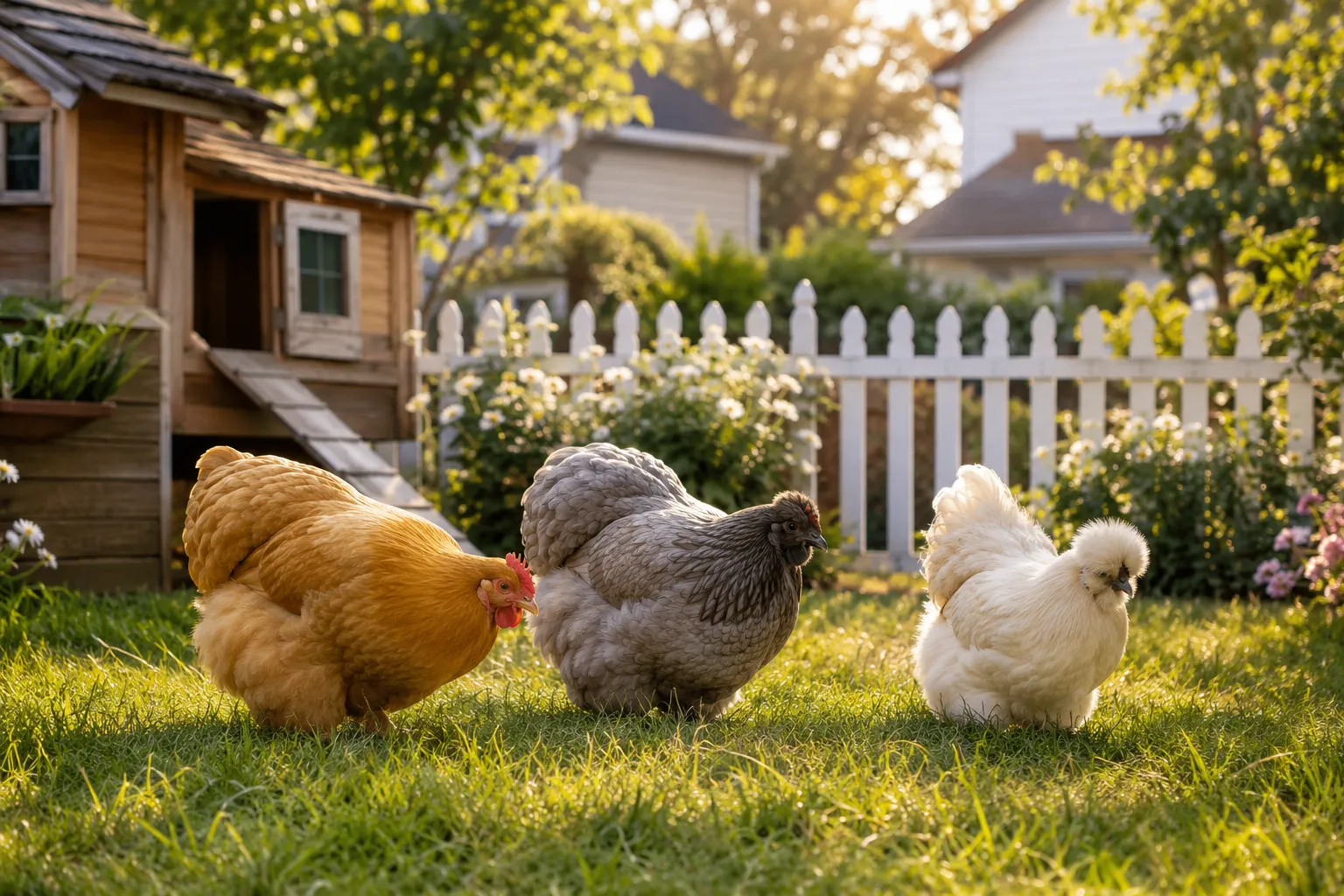
Backyard chicken keeping has grown by more than 400% in urban and suburban areas over the past decade, but noise complaints remain the top reason municipalities deny or revoke permits. The quietest chicken breeds for neighborhoods produce significantly less noise than standard layers, making them ideal for close-quarter living where maintaining good relationships with neighbors is essential. Choosing the right breed can mean the difference between a thriving backyard flock and a visit from code enforcement.
Key Takeaways
- Buff Orpingtons, Cochins, and Silkies are consistently the quietest chicken breeds, producing soft clucks rather than loud squawks
- All hens make some noise, especially during egg-laying (the “egg song”), but quiet breeds vocalize 60-70% less frequently than vocal breeds like Leghorns
- Roosters are 10-15 times louder than hens and are banned in most residential areas; keeping hens only is essential for neighborhood flocks
- Bantam (miniature) chickens are generally quieter than standard-sized birds due to smaller body size and lung capacity
- Quiet breeds that also lay well include Australorps, Wyandottes, and Orpingtons, producing 200-280 eggs per year
- Sudden loud vocalizations from normally quiet chickens usually signal predators, illness, or stress and require immediate investigation
- No chicken is completely silent, but the quietest breeds produce noise levels comparable to normal conversation (50-60 decibels) rather than a lawnmower (90+ decibels)
What Are the Quietest Chicken Breeds for Backyards?
The quietest chicken breeds for backyards are Buff Orpingtons, Cochins, Silkies, Australorps, Wyandottes, and Brahmas. These breeds have calm, docile temperaments that result in less frequent vocalizations and softer clucking sounds compared to high-strung or flighty breeds.
Top quiet breeds and their characteristics:
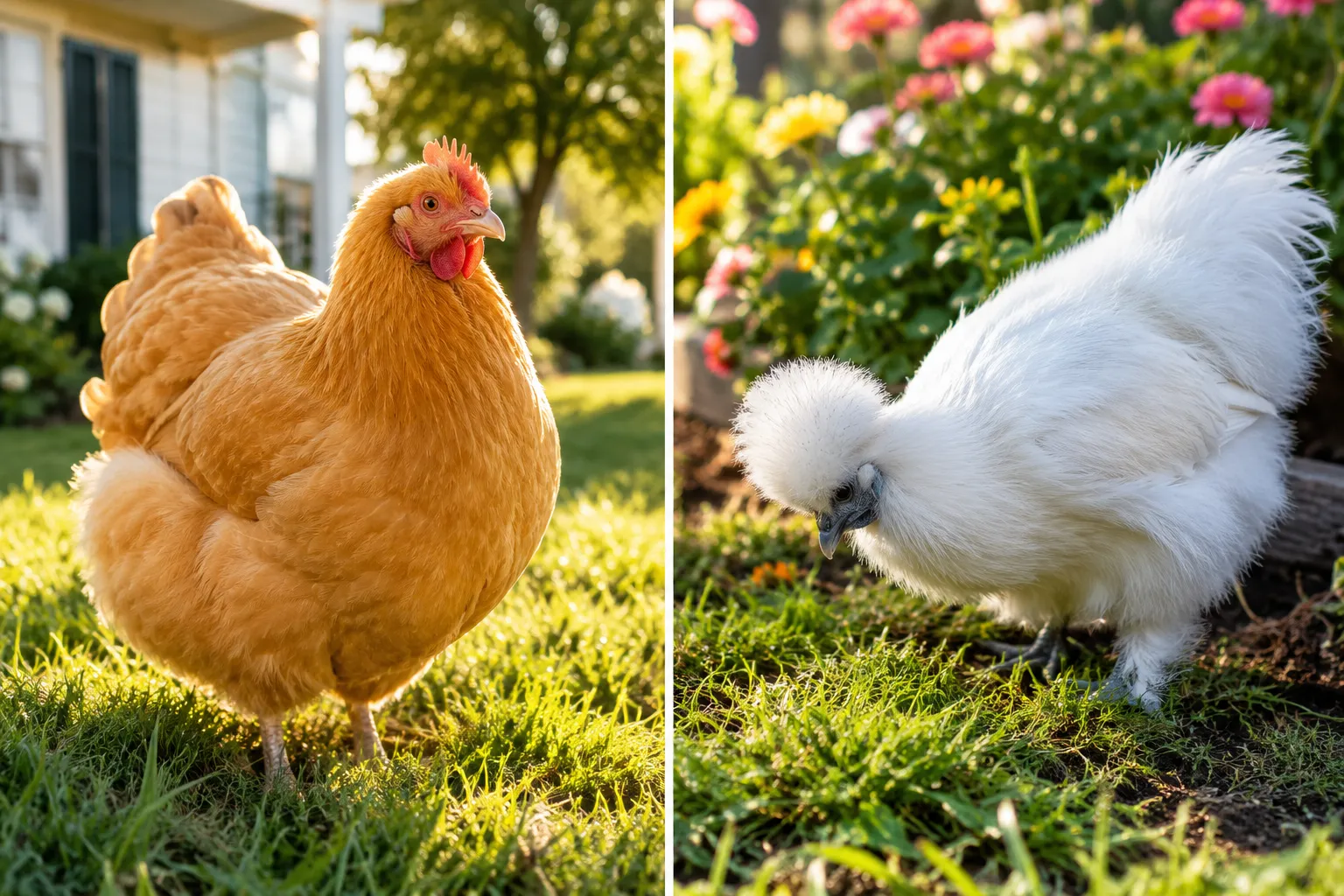
- Buff Orpington: Gentle giants with soft, infrequent clucks; excellent for beginners; dual-purpose for eggs and meat
- Cochin: Fluffy, slow-moving birds with quiet dispositions; feathered feet; go broody frequently
- Silkie: Bantam-sized with hair-like feathers; extremely docile; minimal noise but poor egg layers
- Australorp: Calm black hens; excellent layers (250-300 eggs/year); quiet except during egg-laying
- Wyandotte: Round, friendly birds; moderate layers; handle confinement well
- Brahma: Large but gentle; deep, soft clucks; cold-hardy; good layers in winter
Choose Buff Orpingtons or Australorps if you want both quiet temperament and strong egg production. Choose Silkies or Cochins if noise reduction is your absolute priority and you care less about egg quantity.
Common mistake: Assuming all heritage breeds are quiet. Some heritage breeds like Rhode Island Reds and Leghorns are actually quite vocal and better suited to rural properties.
Do Quiet Chickens Still Make Noise in the Morning?
Yes, quiet chicken breeds still make noise in the morning, but it’s significantly less disruptive than rooster crowing. Hens typically produce soft clucking and murmuring sounds as they wake up, explore their coop, and wait for breakfast, with noise levels around 50-60 decibels (similar to normal conversation).
Morning noise patterns for quiet breeds:
- 5:30-7:00 AM: Soft clucking as hens wake and move around (50-55 decibels)
- 7:00-9:00 AM: Increased activity and feeding sounds (55-65 decibels)
- 9:00 AM-noon: Peak egg-laying period with occasional “egg songs” (65-75 decibels)
The “egg song” is a series of repetitive clucks that hens make after laying an egg. Even quiet breeds perform this behavior, though their version is shorter and softer than vocal breeds. The song typically lasts 1-3 minutes per hen per day.
To minimize morning noise:
- Keep feed and water inside the coop so hens aren’t demanding breakfast loudly
- Use automatic coop doors that open at sunrise rather than earlier
- Provide roosts and nesting boxes that prevent overcrowding and squabbles
- Position the coop at least 25-30 feet from neighbors’ bedroom windows when possible
Edge case: Hens that are startled by predators (raccoons, foxes, hawks) at dawn will alarm-call loudly regardless of breed. Secure coops with hardware cloth and predator-proof latches prevent this issue.
Buff Orpington vs Silkie: Which Is Quieter?
Silkies are slightly quieter than Buff Orpingtons on average, producing softer, less frequent vocalizations due to their smaller size and extremely docile temperament. However, Buff Orpingtons are nearly as quiet and offer significantly better egg production, making them the better choice for most backyard keepers who want both peace and productivity.
Direct comparison:
| Feature | Buff Orpington | Silkie |
|---|---|---|
| Average noise level | 55-65 decibels | 50-60 decibels |
| Vocalization frequency | Low | Very low |
| Egg production | 200-280 eggs/year | 100-120 eggs/year |
| Size | 8-10 lbs (standard) | 2-3 lbs (bantam) |
| Cold hardiness | Excellent | Poor (requires heat) |
| Best for | Productive quiet flock | Maximum noise reduction |
Choose Buff Orpingtons if you want a quiet breed that also provides consistent eggs and can handle cold winters without supplemental heat.
Choose Silkies if you have very close neighbors (houses within 15-20 feet), minimal space, or want chickens primarily as pets rather than for eggs.
Reality check: The noise difference between these two breeds is minimal in practice. Your neighbors are unlikely to notice a difference, but they will notice if you choose a vocal breed like a Leghorn or Ancona.
How Much Do Quiet Chicken Breeds Cost?
Quiet chicken breeds cost between $3-8 per day-old chick, $15-30 per started pullet (8-12 weeks old), and $25-50 per point-of-lay hen (16-20 weeks old) in 2026. Specialty breeds like show-quality Silkies or rare color varieties can cost $50-100+ per bird, but standard hatchery stock of quiet breeds is affordable and widely available.
Price breakdown by breed and age:
Day-old chicks (require brooding setup):
- Buff Orpington: $3-5
- Australorp: $3-4
- Cochin: $4-6
- Silkie: $5-8
- Wyandotte: $4-6
Point-of-lay hens (ready to produce eggs):
- Buff Orpington: $25-35
- Australorp: $25-30
- Cochin: $30-40
- Silkie: $35-50
- Wyandotte: $28-38
Additional first-year costs:
- Coop and run: $300-1,500 (or DIY for $150-400)
- Feeders and waterers: $30-60
- Feed (per hen per year): $50-75
- Bedding: $30-50/year
- Health supplies: $20-40
Money-saving tip: Buy started pullets (8-12 weeks old) instead of day-old chicks. You’ll skip the brooder setup costs and reduce mortality risk, and the price difference is only $10-15 per bird.
Common mistake: Buying the cheapest chicks available without researching breed temperament. Spending an extra $2-3 per chick for a quiet breed saves you from potential neighbor complaints and rehoming costs later.
Why Is My Quiet Breed Chicken Suddenly Loud?
A normally quiet chicken that becomes suddenly loud is usually responding to an immediate threat, experiencing pain or illness, or dealing with flock stress. Predators (including hawks, dogs, and raccoons), egg-laying difficulties, bullying from flock mates, and sudden environmental changes are the most common triggers for increased vocalization in quiet breeds.
Diagnostic checklist for sudden noise:
Immediate threats (loud alarm calls):
- Predator nearby or attempting to enter coop/run
- Hawk or other aerial predator overhead
- Unfamiliar dog or cat in the yard
- Sudden loud noises (construction, fireworks, thunder)
Health issues (distressed clucking or squawking):
- Egg-binding (hen straining to pass an egg)
- Injury from pecking or accident
- Respiratory infection (accompanied by wheezing or sneezing)
- Parasites causing discomfort (mites, lice, worms)
Flock dynamics (persistent loud vocalizations):
- Bullying or pecking order disputes
- Overcrowding in coop or run
- Competition for food, water, or nesting boxes
- Introduction of new birds without proper integration
Action steps:
- Observe immediately to rule out predators or injuries
- Check for egg-binding by gently feeling the hen’s abdomen for a stuck egg
- Isolate the loud hen temporarily to assess whether she’s sick or being bullied
- Review recent changes (new birds, coop modifications, schedule changes)
When to worry: Continuous loud vocalizations lasting more than 30 minutes, especially if accompanied by lethargy, hunched posture, or isolation from the flock, warrant a vet visit.
Are There Completely Silent Chickens?
No, there are no completely silent chickens. All chickens vocalize to some degree as part of their natural communication, including soft clucking while foraging, contact calls to flock mates, and the egg song after laying. However, the quietest breeds produce minimal noise that typically doesn’t carry beyond your property line or disturb neighbors.
Realistic noise expectations:
Even the quietest chicken breeds will:
- Cluck softly while foraging and exploring (40-50 decibels, like a quiet library)
- Make contact calls to stay in touch with flock mates (50-60 decibels)
- Perform a brief egg song after laying (65-75 decibels, like a vacuum cleaner)
- Alarm-call if genuinely threatened (80-90 decibels, but rare)
What you won’t get with quiet breeds:
- Constant loud squawking throughout the day
- Noise that carries several houses away
- Disruptive early-morning crowing (hens don’t crow)
- Aggressive or panicked vocalizations without cause
Comparison to other pets:
- Quiet chickens: 50-65 decibels average
- Barking dog: 80-90 decibels
- Meowing cat: 45-60 decibels
- Parakeet: 65-70 decibels
Choose quiet breeds if your local ordinances allow chickens but you have neighbors within 30-50 feet. The noise level will be comparable to normal backyard activity and shouldn’t cause complaints if you keep hens only (no roosters).
Deal-breaker: If your city ordinance requires that chickens produce “no audible noise beyond property lines,” you may not be able to keep chickens at all, as even the quietest breeds will occasionally be heard during egg-laying.
Best Quiet Chickens for Small Urban Lots
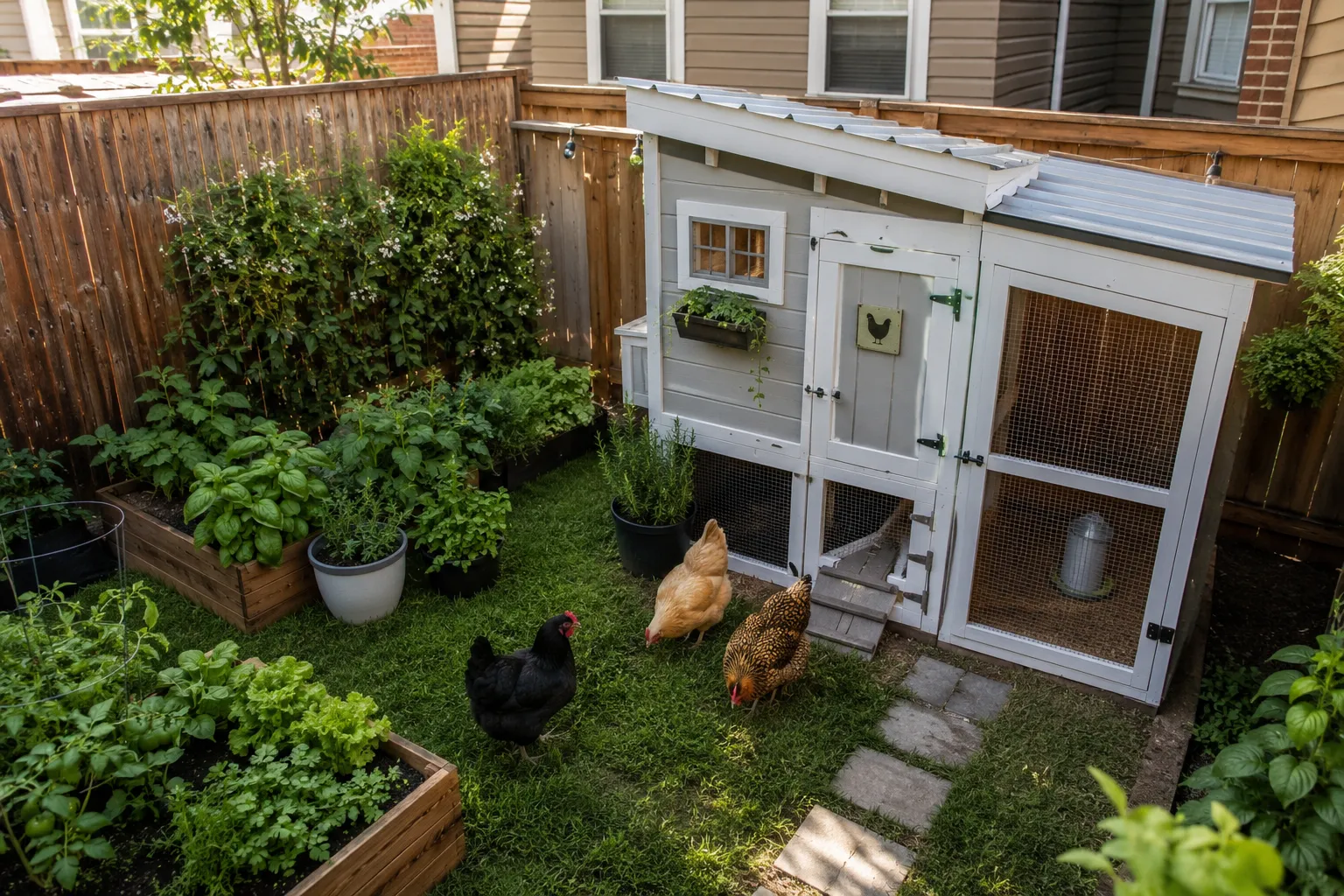
The best quiet chickens for small urban lots are bantam (miniature) versions of naturally quiet breeds, including Silkie bantams, Cochin bantams, and Japanese bantams. These birds combine reduced noise levels with smaller space requirements, making them ideal for properties under 2,000 square feet where neighbors are in close proximity.
Top picks for urban lots:
Silkie Bantams
- Size: 2-3 lbs
- Space needed: 2-3 sq ft per bird in coop, 8-10 sq ft in run
- Noise level: Very low (50-60 decibels)
- Eggs: 100-120 small eggs/year
- Best for: Maximum quiet in minimal space
Cochin Bantams
- Size: 2-3 lbs
- Space needed: 2-3 sq ft per bird in coop, 8-10 sq ft in run
- Noise level: Very low (50-60 decibels)
- Eggs: 120-150 small eggs/year
- Best for: Cold climates with close neighbors
Japanese Bantams
- Size: 1.5-2 lbs
- Space needed: 2 sq ft per bird in coop, 6-8 sq ft in run
- Noise level: Low (55-65 decibels)
- Eggs: 80-100 tiny eggs/year
- Best for: Ornamental flock in very limited space
Australorp Bantams
- Size: 3-4 lbs
- Space needed: 3 sq ft per bird in coop, 10 sq ft in run
- Noise level: Low (55-65 decibels)
- Eggs: 180-200 small eggs/year
- Best for: Urban egg production with quiet temperament
Urban flock formula: For a 400 sq ft backyard, keep 3-4 bantam hens in a 12-16 sq ft coop with a 30-40 sq ft attached run. This provides adequate space while keeping noise minimal.
Zoning compliance tip: Many cities limit backyard chickens to 4-6 hens and require coops to be at least 10-25 feet from property lines. Check your local ordinances before purchasing birds or building infrastructure.
Do Hens Make Less Noise Than Roosters?
Yes, hens make dramatically less noise than roosters. Roosters crow at 80-90 decibels (as loud as a lawnmower) multiple times per day starting before dawn, while hens produce soft clucking at 50-65 decibels (normal conversation level) with occasional louder egg songs. Keeping hens only is essential for neighborhood flocks and is required by most urban chicken ordinances.
Noise comparison:
Roosters:
- Volume: 80-90 decibels at 5 feet
- Frequency: 12-15+ times per day, starting at 4-5 AM
- Duration: 2-5 seconds per crow
- Purpose: Territory marking, flock protection, time-keeping
- Neighbor impact: High; audible several houses away
Hens:
- Volume: 50-65 decibels average, 65-75 during egg song
- Frequency: Intermittent soft clucking; 1-3 minute egg song per day
- Duration: Continuous soft background noise; brief louder periods
- Purpose: Flock communication, egg announcement, alarm calls
- Neighbor impact: Low; rarely audible beyond property line
Why roosters are banned in most neighborhoods:
Roosters crow to establish territory and communicate with the flock, and they cannot be trained to stop. The crowing begins before dawn and continues throughout the day, making them incompatible with residential areas where neighbors value morning quiet.
How to ensure you have hens only:
- Buy sexed chicks from reputable hatcheries (90-95% accuracy)
- Buy started pullets (8+ weeks old) where sex is visually confirmed
- Buy point-of-lay hens (16+ weeks) for 100% certainty
- Watch for rooster signs in young birds: larger combs, pointed saddle feathers, aggressive behavior by 8-12 weeks
Common mistake: Assuming “straight run” (unsexed) chicks will be mostly female. Straight run is 50/50 male/female, and you’ll need to rehome roosters once they start crowing at 4-6 months old.
Quiet Chicken Breeds That Are Also Good Egg Layers
Australorps, Buff Orpingtons, and Wyandottes are the best quiet chicken breeds that also lay well, producing 200-280 eggs per year while maintaining calm, quiet temperaments suitable for neighborhoods. These dual-purpose breeds offer the ideal combination of peaceful behavior and productive egg-laying for backyard keepers who want both tranquility and a steady egg supply.
Top quiet + productive breeds:
Australorp
- Eggs per year: 250-300
- Egg color: Light brown
- Noise level: Low
- Temperament: Calm, friendly
- Best for: Maximum egg production with minimal noise
Buff Orpington
- Eggs per year: 200-280
- Egg color: Light brown
- Noise level: Very low
- Temperament: Extremely docile, friendly
- Best for: Families with children; gentle and quiet
Wyandotte
- Eggs per year: 200-240
- Egg color: Brown
- Noise level: Low
- Temperament: Calm, cold-hardy
- Best for: Cold climates; consistent winter laying
Brahma
- Eggs per year: 180-220
- Egg color: Brown
- Noise level: Low
- Temperament: Gentle giants, very calm
- Best for: Large, quiet birds; good winter layers
Production comparison:
For context, vocal breeds like Leghorns lay 280-320 eggs per year but produce significantly more noise. The 20-40 egg difference per year (less than one egg per week) is rarely worth the neighbor complaints and stress.
Realistic expectations: Even the best layers slow down after 2-3 years. Plan to refresh your flock with new pullets every 2-3 years if consistent egg production is important, or keep older hens as pets once laying decreases.
Will My Neighbors Complain About Quiet Chickens?
Neighbors are unlikely to complain about quiet chicken breeds if you keep hens only (no roosters), maintain a clean coop, follow local ordinances, and communicate proactively. Most chicken-related neighbor complaints stem from rooster crowing, strong odors from poor coop maintenance, or surprise at discovering chickens without prior notice.
Factors that prevent complaints:
Noise management:
- Keep hens only (no roosters)
- Choose naturally quiet breeds
- Position coop 25+ feet from neighbors’ windows when possible
- Use automatic doors to prevent early-morning noise
Odor control:
- Clean coop weekly and deep-clean monthly
- Use proper ventilation to reduce ammonia buildup
- Compost manure away from property lines
- Keep run dry with good drainage
Visual appeal:
- Build or buy an attractive coop that looks intentional
- Keep yard tidy and free of scattered feed
- Use attractive fencing and landscaping around chicken area
- Maintain property overall to show you’re a responsible homeowner
Communication:
- Inform neighbors before getting chickens
- Offer fresh eggs regularly as a goodwill gesture
- Address concerns immediately if raised
- Invite neighbors to meet the chickens (many find them charming)
Legal compliance:
- Follow all local ordinances (number of birds, setbacks, permits)
- Keep documentation of permits if required
- Stay within property lines for free-ranging
Common complaint triggers to avoid:
- Rooster crowing (keep hens only)
- Strong manure smell (clean regularly)
- Chickens escaping into neighbors’ yards (secure fencing)
- Attracting rats or predators (secure feed storage, hardware cloth on coop)
- Visible mess or neglect (maintain tidy appearance)
Success rate: Backyard chicken keepers who follow these guidelines report neighbor complaint rates below 5%, with most complaints easily resolved through communication and minor adjustments.
Common Mistakes When Choosing Chickens for Noise Level
The most common mistake when choosing chickens for noise level is selecting breeds based on appearance or egg color rather than temperament and vocalization patterns. Many backyard keepers choose vocal breeds like Rhode Island Reds or Leghorns because they’re popular or lay well, only to discover they’re too loud for neighborhood settings.
Top mistakes and how to avoid them:
Mistake 1: Choosing breeds for looks alone
- Problem: Beautiful breeds like Leghorns and Anconas are often very vocal
- Solution: Research temperament and noise level before committing to a breed
- Better approach: Choose from proven quiet breeds, then select your favorite color variety
Mistake 2: Buying straight-run (unsexed) chicks
- Problem: 50% will be roosters that must be rehomed once they start crowing
- Solution: Pay extra for sexed chicks or buy started pullets where sex is confirmed
- Cost difference: $1-2 more per sexed chick vs. straight run
Mistake 3: Mixing quiet and vocal breeds
- Problem: Vocal breeds can trigger increased noise from quiet breeds
- Solution: Stick to quiet breeds only for your entire flock
- Exception: If you have acreage and neighbors aren’t close, mixed flocks work fine
Mistake 4: Assuming all heritage breeds are quiet
- Problem: Many heritage breeds were developed for free-range farms where noise didn’t matter
- Solution: Research specific breed temperaments rather than assuming heritage = quiet
- Loud heritage breeds: Rhode Island Red, Leghorn, Ancona, Hamburg
Mistake 5: Overcrowding the coop or run
- Problem: Stress from overcrowding increases vocalization in all breeds
- Solution: Provide 3-4 sq ft per bird in coop, 8-10 sq ft per bird in run minimum
- Better: More space = quieter, calmer birds
Mistake 6: Not checking local ordinances first
- Problem: Some cities ban chickens entirely or have strict noise requirements
- Solution: Verify chickens are legal and understand restrictions before purchasing birds
- Consequence: Forced to rehome flock if discovered in violation
Decision framework: Before choosing a breed, ask yourself: (1) Are chickens legal in my area? (2) How close are my neighbors? (3) Do I prioritize eggs, temperament, or appearance? (4) Can I commit to hens only? Answer these before selecting breeds.
Do Cochins Make Noise at Night?
Cochins and other quiet chicken breeds rarely make noise at night unless disturbed by predators, illness, or environmental disruptions. Healthy chickens sleep quietly from dusk until dawn, producing no vocalizations during normal nighttime hours. Nighttime noise from chickens almost always indicates a problem requiring immediate attention.
Normal nighttime behavior:
Chickens enter a sleep state at dusk and remain quiet and still until dawn. They roost on elevated perches with their flock mates and do not move around, eat, or vocalize during darkness.
Causes of nighttime noise:
Predator disturbance (most common):
- Raccoons, opossums, or rats attempting to enter coop
- Owls or other nocturnal predators nearby
- Dogs or cats prowling around coop
- Response: Loud alarm calls, panicked movement, distressed squawking
Health issues:
- Respiratory infections causing breathing difficulty
- Parasites (mites, lice) causing discomfort
- Egg-binding in hens
- Response: Distressed clucking, restless movement
Environmental problems:
- Insufficient ventilation causing heat stress
- Overcrowding on roosts
- Inadequate roosting space
- Response: Squabbling, restless movement, occasional vocalizations
How to prevent nighttime noise:
- Predator-proof the coop with 1/2-inch hardware cloth on all openings
- Use secure latches that raccoons cannot open (carabiners or complex mechanisms)
- Provide adequate ventilation without drafts
- Ensure sufficient roost space (8-10 inches per bird)
- Treat for parasites regularly (every 3-4 months)
- Lock chickens in coop at night rather than allowing access to run
When to investigate: Any nighttime noise from your coop warrants immediate investigation with a flashlight. Predators can kill multiple birds in minutes, and health issues can deteriorate rapidly overnight.
Are Bantam Chickens Quieter Than Standard Size?
Yes, bantam (miniature) chickens are generally quieter than standard-sized chickens due to their smaller body size, reduced lung capacity, and often calmer temperaments. Bantams produce vocalizations at 5-10 decibels lower than their standard-sized counterparts, making them ideal for urban lots and close-quarter neighborhoods.
Size and noise comparison:
Bantam chickens:
- Weight: 1.5-4 lbs
- Average noise: 50-60 decibels
- Vocalization volume: Softer, less carrying
- Space needed: 2-3 sq ft coop, 6-10 sq ft run
- Best for: Urban lots, close neighbors, limited space
Standard chickens:
- Weight: 5-10 lbs
- Average noise: 55-70 decibels
- Vocalization volume: Louder, carries farther
- Space needed: 3-4 sq ft coop, 8-10 sq ft run
- Best for: Suburban lots, egg production, dual-purpose
Quietest bantam breeds:
- Silkie Bantam: Extremely quiet, fluffy, docile
- Cochin Bantam: Very quiet, feather-footed, calm
- Japanese Bantam: Quiet, tiny, ornamental
- Sebright Bantam: Quiet, active, beautiful lacing
- Belgian d’Uccle Bantam: Quiet, bearded, friendly
Trade-offs with bantams:
Advantages:
- Quieter vocalizations
- Less space required
- Lower feed costs ($30-40/year vs. $50-75)
- Easier to handle and manage
- Better for children
Disadvantages:
- Smaller eggs (3-4 bantam eggs = 2-3 standard eggs)
- Fewer eggs per year (100-180 vs. 200-300)
- More vulnerable to predators (hawks, cats)
- Less cold-hardy in extreme climates
- Can be flighty if not handled regularly
Choose bantams if you have limited space (under 1,000 sq ft backyard), very close neighbors (within 20-30 feet), or want chickens primarily as pets. Choose standard quiet breeds if egg production is important and you have adequate space.
Can You Train Chickens to Be Quieter?
No, you cannot train chickens to be quieter through traditional training methods, as vocalizations are instinctive behaviors essential to chicken communication and survival. However, you can reduce overall noise levels by creating a calm environment, minimizing stressors, maintaining consistent routines, and selecting naturally quiet breeds from the start.
Why training doesn’t work:
Chickens vocalize instinctively to:
- Maintain contact with flock mates
- Announce egg-laying (egg song)
- Alert to predators or threats
- Establish pecking order
- Request food or water
- Express contentment while foraging
These behaviors are hardwired and cannot be eliminated through training, punishment, or rewards.
What you can control:
Environmental management:
- Reduce stressors that trigger alarm calls (secure from predators, provide adequate space)
- Maintain consistent daily routines (feeding, egg collection, coop opening/closing)
- Prevent overcrowding that leads to squabbling and increased vocalization
- Provide enrichment (dust baths, perches, foraging opportunities) to keep birds content
Flock composition:
- Choose naturally quiet breeds from the start
- Keep hens only (no roosters)
- Avoid mixing quiet and vocal breeds
- Maintain stable flock composition (minimize adding/removing birds)
Health and comfort:
- Ensure adequate nutrition and fresh water
- Treat parasites and illnesses promptly
- Provide appropriate shelter from weather extremes
- Give sufficient nesting boxes to prevent competition (1 box per 3-4 hens)
What doesn’t work:
- Yelling at or punishing chickens for vocalizing (increases stress and noise)
- Using deterrents like spray bottles (ineffective and stressful)
- Isolating vocal birds (increases distress calling)
- Expecting chickens to be silent (unrealistic expectation)
Realistic outcome: By choosing quiet breeds and managing their environment well, you can keep noise levels at 50-65 decibels average with brief 65-75 decibel periods during egg-laying. This is the quietest you can realistically achieve with chickens.
Frequently Asked Questions
What is the absolute quietest chicken breed?
Silkies are the absolute quietest chicken breed, producing soft, infrequent vocalizations at 50-60 decibels due to their bantam size and extremely docile temperament. However, Cochins and Buff Orpingtons are nearly as quiet and offer better egg production.
How loud is a chicken’s egg song?
A chicken’s egg song ranges from 65-75 decibels, similar to a vacuum cleaner or normal conversation at close range. The song lasts 1-3 minutes per hen per day and occurs after egg-laying. Quiet breeds have shorter, softer egg songs than vocal breeds.
Can I keep chickens if my neighbor’s bedroom window is 20 feet from my coop?
Yes, you can keep quiet chicken breeds with a neighbor’s window 20 feet away, but choose the quietest breeds (Silkies, Cochins, Buff Orpingtons), keep hens only, and position the coop door away from the window. Communicate with your neighbor first and offer fresh eggs as goodwill.
Do chickens make noise when they’re scared?
Yes, chickens make loud alarm calls at 80-90 decibels when scared by predators, sudden movements, or unfamiliar animals. Even quiet breeds will alarm-call when genuinely threatened, but this is infrequent if the coop is secure and the environment is stable.
How many chickens can I keep in a city backyard?
Most cities allow 4-6 hens in residential backyards, with no roosters permitted. Check your local municipal code for specific limits, setback requirements from property lines (typically 10-25 feet), and permit requirements before purchasing chickens.
Will my chickens be quieter if I get more of them?
No, more chickens typically means more total noise, even with quiet breeds. A flock of 3-4 hens is optimal for neighborhoods, providing enough eggs for a family while keeping noise minimal. Larger flocks increase vocalization frequency and volume.
Do chickens stop making noise in winter?
Chickens continue making normal vocalizations in winter but may be quieter overall due to reduced activity and egg-laying. Quiet breeds remain quiet year-round, while vocal breeds stay vocal regardless of season. Cold-hardy quiet breeds like Cochins and Wyandottes are ideal for winter climates.
Can I keep just one chicken to reduce noise?
No, you should not keep just one chicken, as chickens are social flock animals that become stressed and actually more vocal when kept alone. Keep a minimum of 3-4 hens to maintain natural flock dynamics while keeping noise reasonable for neighborhoods.
What time of day are chickens loudest?
Chickens are loudest between 9 AM and noon during peak egg-laying hours when hens perform the egg song. Early morning (6-8 AM) involves soft clucking and activity sounds. Afternoons and evenings are generally quiet as hens forage and rest.
Do chickens make noise at night if they have a light in the coop?
Chickens sleep quietly at night even with a light in the coop, but artificial lighting disrupts their natural sleep cycle and can cause stress. Use lights only when necessary for winter egg production, and use timers to ensure 8-10 hours of darkness for proper rest.
How far away can you hear a chicken?
Quiet chicken breeds can be heard 30-50 feet away during normal activity and up to 100 feet during the egg song or alarm calls. Vocal breeds can be heard 100-200+ feet away. Proper breed selection and coop placement minimize noise impact on neighbors.
Will giving my chickens treats make them quieter?
Giving chickens treats does not make them quieter long-term, though they may be briefly silent while eating. However, regular treats and enrichment activities (scratch grains, mealworms, vegetable scraps) keep chickens content and reduce stress-related vocalizations.
Conclusion
Choosing the quietest chicken breeds for neighborhoods makes backyard chicken keeping possible even in close-quarter suburban and urban settings. Buff Orpingtons, Cochins, Silkies, Australorps, and Wyandottes offer the ideal combination of peaceful temperaments, minimal vocalizations, and reasonable egg production for residential areas. By keeping hens only, maintaining a clean and secure coop, and communicating proactively with neighbors, most backyard chicken keepers can enjoy fresh eggs and the pleasure of keeping chickens without causing disruption.
Take these next steps to start your quiet backyard flock:
- Verify local regulations by checking your municipal code for chicken ordinances, permit requirements, and restrictions
- Choose your breeds from the proven quiet options, prioritizing temperament over appearance or maximum egg production
- Plan your coop location at least 25 feet from neighbors’ windows and in compliance with setback requirements
- Purchase sexed pullets or point-of-lay hens to ensure you have females only
- Inform your neighbors before bringing chickens home and offer to share fresh eggs
- Start small with 3-4 hens to learn chicken keeping basics while keeping noise minimal
The key to successful neighborhood chicken keeping is selecting naturally quiet breeds from the start, maintaining their environment well, and being a considerate neighbor. With the right approach, your backyard flock will provide fresh eggs, natural pest control, and enjoyable companionship without causing noise complaints or neighborhood friction.


