
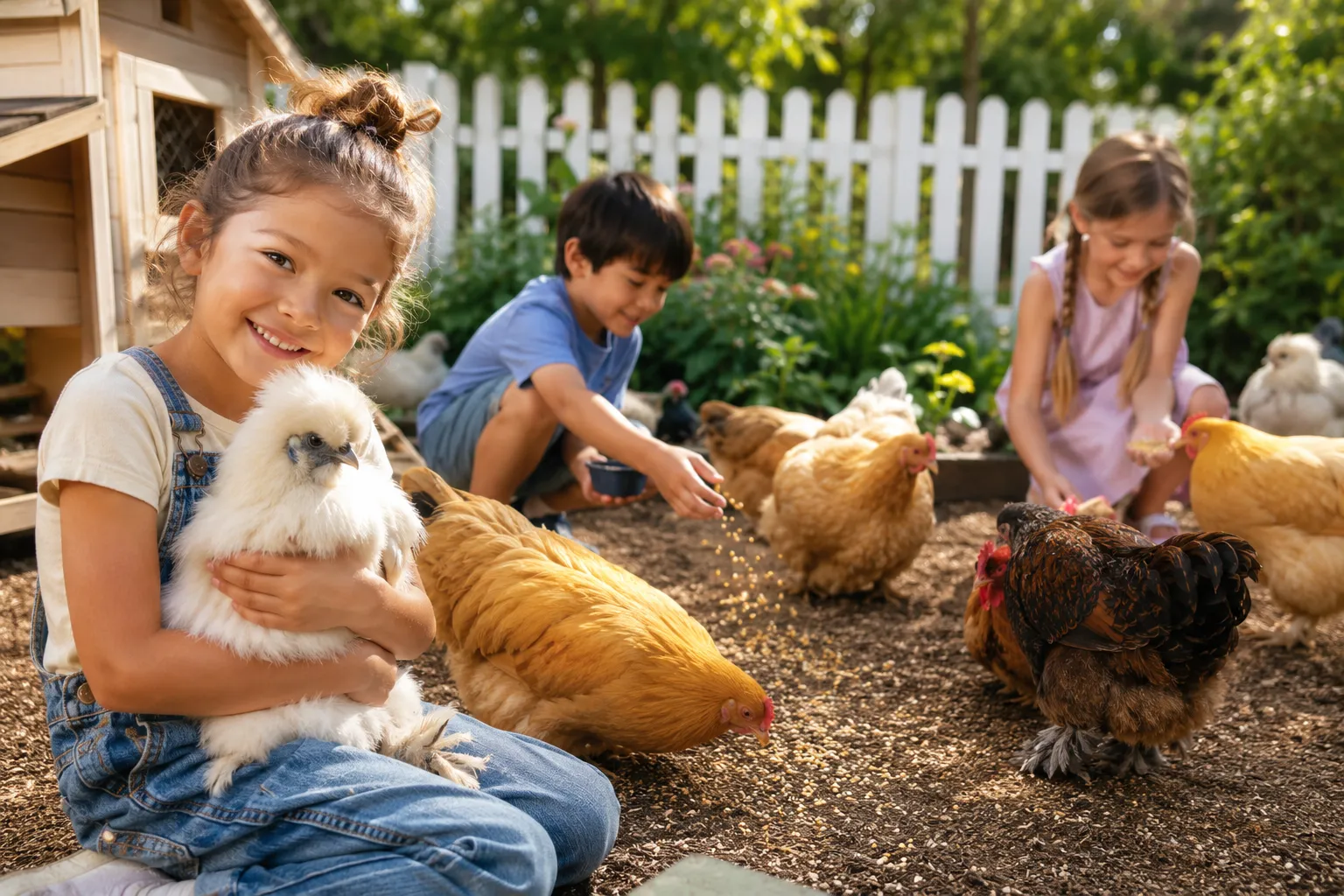
Quick Answer: The friendliest chicken breeds for kids include Silkies, Buff Orpingtons, Cochins, and Australorps, all known for their calm temperaments and tolerance of handling. These breeds are docile, rarely aggressive, and adapt well to family environments where children want to interact with their flock. When choosing chickens for kids, prioritize breeds with established reputations for gentleness and avoid flighty or nervous varieties.
Key Takeaways
- Silkies, Buff Orpingtons, and Cochins rank as the top three friendliest chicken breeds for families with children
- Bantam varieties of friendly breeds work well for younger children due to their smaller size and easier handling
- Children should be at least 4-5 years old before handling chickens independently, with supervision until age 8-10
- Even docile breeds may peck when startled or protecting food, so teaching proper approach techniques is essential
- Friendly breeds typically cost $5-$30 per chick and $15-$50 for started pullets, depending on breed and source
- Roosters of any breed are generally not recommended around young children due to protective instincts
- Common mistakes include choosing breeds based on appearance alone and not socializing chicks early
- Most kid-friendly breeds are also excellent layers, producing 200-280 eggs annually
What Are the Friendliest Chicken Breeds for Young Children?
The friendliest chicken breeds for young children are Silkies, Buff Orpingtons, Cochins, Australorps, and Wyandottes. These breeds have been selectively bred for docile temperaments and show consistent tolerance for handling, making them ideal first chickens for families.
Top Kid-Friendly Breeds:
- Silkies, Exceptionally calm, fluffy appearance appeals to children, enjoy being held, go broody frequently (good for teaching about mothering behavior)
- Buff Orpingtons, Large but gentle, cold-hardy, patient with children’s attention, excellent dual-purpose birds
- Cochins, Fluffy feathered feet, very docile, tolerate confinement well, minimal flight ability makes them easy to catch
- Australorps, Friendly without being overly needy, good layers, calm demeanor, less broody than Silkies
- Wyandottes, Slightly more independent but still gentle, beautiful laced feathers, hardy in various climates
Choose Silkies or Cochins if your children are younger (under 7) and want chickens they can cuddle and carry around frequently. Choose Buff Orpingtons or Australorps if you want a balance between friendliness and practical egg production with less brooding behavior.
Common mistake: Assuming all chickens within a breed will have identical personalities. Individual temperament varies, so handle chicks frequently from day one to ensure they become comfortable with human interaction regardless of breed.
Silkie Chickens vs Buff Orpingtons for Kids
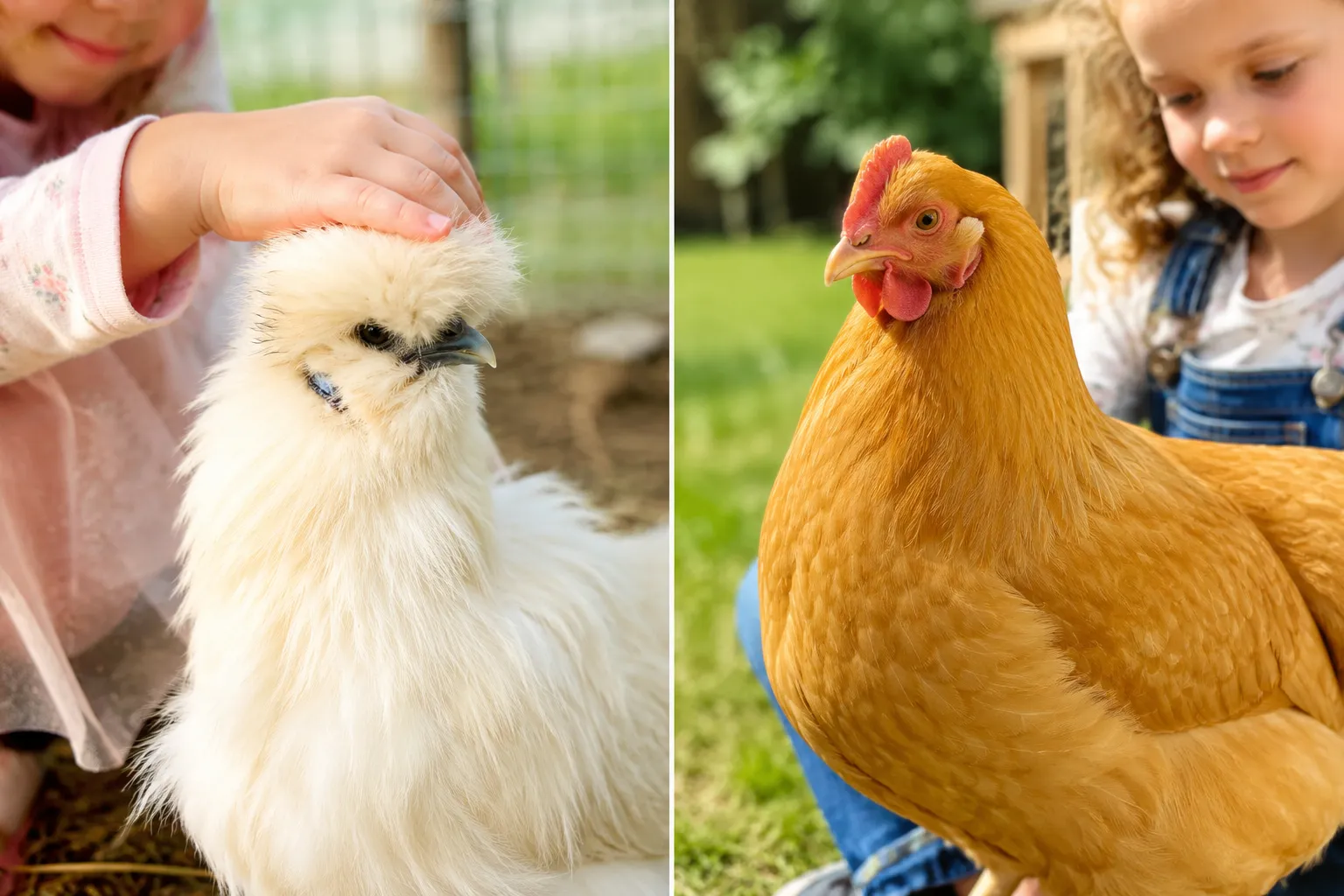
Silkies are better for children who prioritize cuddling and pet-like interaction, while Buff Orpingtons excel when families want both friendliness and consistent egg production. Silkies have unique fluffy plumage that feels like fur and weigh 2-3 pounds, making them easy for small children to hold. Buff Orpingtons are larger (7-8 pounds) with traditional feathers and lay approximately 200-280 brown eggs per year compared to Silkies’ 100-120 small cream eggs.
Key Differences:
| Feature | Silkies | Buff Orpingtons |
|---|---|---|
| Weight | 2-3 lbs | 7-8 lbs |
| Egg Production | 100-120/year (small) | 200-280/year (large) |
| Broodiness | Very high (often broody) | Moderate |
| Cold Tolerance | Poor (fluffy feathers get wet) | Excellent |
| Best For | Younger kids (5-8) wanting pets | Families wanting pets + eggs |
| Handling Ease | Very easy (lightweight) | Easy but requires two hands |
Choose Silkies if: Your children are under 8 years old, you live in a mild climate, egg production is not a priority, and your kids want chickens that feel and act more like small pets than livestock.
Choose Buff Orpingtons if: You want reliable egg layers that are still friendly, you experience cold winters, your children are over 7 and can handle larger birds safely, and you want chickens that balance production with temperament.
Edge case: Silkies cannot fly and have poor vision due to head feathers, making them vulnerable to predators. They require extra protection and should not free-range unsupervised in areas with hawks or dogs.
How Much Does a Kid-Friendly Chicken Cost?
Kid-friendly chicken breeds typically cost $5-$10 per day-old chick, $15-$30 for started pullets (8-12 weeks old), and $25-$50 for point-of-lay hens (16-20 weeks old). Silkies and specialty color varieties may cost 20-50% more than standard breeds. Initial setup costs (coop, feeder, waterer, bedding) add $300-$800 for a small backyard flock of 3-4 chickens.
Price Breakdown by Source:
- Hatcheries (mail-order): $4-$8 per chick, minimum orders often required (15-25 chicks)
- Local feed stores: $5-$12 per chick, no minimum, available spring through early summer
- Private breeders: $10-$30 per chick for show-quality or rare colors
- Started pullets: $20-$35 each, ready to integrate into flock, skip brooding phase
- Rescue/rehoming: $5-$20 each, temperament may be unknown, good for experienced families
Ongoing monthly costs for 3-4 chickens average $30-$50 and include feed ($20-$30), bedding ($5-$10), treats and supplements ($5-$10). These costs remain consistent regardless of breed friendliness.
Money-saving tip: Buy straight-run chicks (unsexed) at $3-$5 each instead of sexed pullets, but be prepared that approximately 50% will be roosters that you’ll need to rehome. This approach works only if you have a plan for unwanted males.
Why Is My Chicken Scared of My Kids?
Chickens become scared of children when they experience sudden movements, loud noises, chasing, or improper handling that triggers their prey-animal instincts. Even naturally friendly breeds will avoid children who run at them, scream, or grab them from above without warning. Fear responses are often learned behaviors from negative early experiences and can take weeks of patient, calm interaction to reverse.
Common Causes of Fear:
- Overhead approach, Chickens instinctively fear predators (hawks) coming from above
- Fast movements, Quick gestures trigger flight response
- Inconsistent handling, Occasional rough treatment creates unpredictable fear
- Lack of early socialization, Chickens not handled as chicks remain wary of humans
- Negative associations, Being grabbed only for unpleasant experiences (vet checks, coop cleaning)
Rebuilding Trust (2-4 Week Process):
- Sit quietly in the run for 15-20 minutes daily without trying to touch chickens
- Offer treats (mealworms, scratch grains) from an open palm at chicken’s eye level
- Let chickens approach children rather than children chasing chickens
- Practice slow movements and quiet voices around the flock
- Create positive associations by having kids be the primary treat-givers
Choose this approach if your chickens are already adults and showing fear. For chicks, handle them 10-15 minutes daily from day one to prevent fear from developing.
Edge case: Some chickens from hatcheries or commercial operations have minimal human contact in early weeks and may never become truly friendly. Breeds matter, but early socialization (first 8 weeks) has equal or greater impact on adult temperament.
Best Chicken Breeds for Families with Toddlers
The best chicken breeds for families with toddlers (ages 2-4) are Silkies, Cochins, and Orpingtons because they tolerate unpredictable movements, have calm temperaments, and are large enough to not be easily injured by clumsy handling. Toddlers should always be supervised during chicken interactions, and bantam varieties of these breeds offer a good size match for small children learning gentle touch.
Toddler-Specific Considerations:
- Size matters: Standard-sized Orpingtons (7-8 lbs) are less likely to be accidentally hurt than lightweight breeds
- Flightiness: Cochins and Silkies rarely fly or panic, reducing startling incidents
- Pecking tolerance: These breeds show patience with poking and patting that would irritate flightier birds
- Noise tolerance: Less reactive to toddler squeals and sudden sounds
Safety Rules for Toddlers:
- Never leave toddlers alone with chickens, even friendly breeds
- Teach “gentle touch” with one-finger petting before allowing full handling
- Supervise all treat-giving to prevent finger-pecking accidents
- Wash hands immediately after chicken contact (Salmonella prevention)
- Keep toddlers away during feeding time when chickens are more assertive
Alternative approach: Set up a “chicken viewing area” where toddlers can watch chickens through fencing and toss treats over the barrier. This allows interaction without handling until the child develops better motor control (typically age 4-5).
Common mistake: Allowing toddlers to chase chickens as a game. This stresses the birds, teaches poor interaction habits, and can result in aggressive pecking when a chicken feels cornered.
Are Bantam Chickens Good for Children?
Bantam chickens are excellent for children ages 5-10 because their smaller size (1-2 pounds) makes them easier to catch, hold, and carry safely. Bantam versions of friendly breeds like Silkies, Cochins, and Wyandottes retain the docile temperament of their standard-sized counterparts while being less intimidating for young children. However, bantams lay smaller eggs (3-4 bantam eggs equal 2-3 standard eggs) and are more vulnerable to predators and cold weather.
Advantages for Kids:
- Manageable weight: Children can hold bantams with one hand once they learn proper technique
- Less intimidating: Smaller birds reduce fear in hesitant children
- Easier to catch: Shorter legs and smaller size make handling practice less frustrating
- Space-efficient: Bantams need 2-3 square feet per bird vs. 4 square feet for standard breeds
Disadvantages to Consider:
- Fragile: More easily injured by rough handling or accidental drops
- Cold sensitivity: Require extra coop insulation in northern climates
- Predator vulnerability: Hawks, cats, and dogs pose greater threats
- Lower egg production: Smaller eggs and often fewer total eggs per year
Choose bantams if your children are ages 5-8, you have limited space, and your family prioritizes the pet aspect over egg production. Choose standard-sized friendly breeds if your children are over 8, you want meaningful egg production, or you live in an area with significant predator pressure.
Best bantam breeds for kids: Silkie bantams (naturally small), Cochin bantams (fluffy and calm), and Sebright bantams (beautiful but slightly more active).
What Age Can Kids Start Handling Chickens Safely?
Children can start handling chickens safely at age 4-5 with direct adult supervision, progressing to independent handling around age 8-10 depending on the child’s maturity and the chicken’s temperament. Before age 4, children should interact with chickens only through supervised observation and treat-giving without picking up birds. Proper handling technique requires coordination, gentle grip strength, and impulse control that most children develop between ages 5-7.
Age-Based Guidelines:
Ages 2-4 (Observation Only):
- Watch chickens through fencing
- Toss treats into the run with supervision
- Pet chickens while adult holds them
- Learn “gentle hands” concept
Ages 5-7 (Supervised Handling):
- Pick up chickens with adult assistance
- Hold chickens while seated on ground
- Practice proper two-handed hold for 1-2 minutes
- Adult remains within arm’s reach
Ages 8-10 (Monitored Independence):
- Catch and hold chickens independently
- Carry chickens short distances
- Perform basic care tasks (feeding, egg collecting)
- Adult checks in regularly but not constantly present
Ages 11+ (Independent Care):
- Full chicken care responsibility
- Recognize signs of illness or stress
- Handle all routine maintenance
- Occasional adult oversight
Red flags that a child isn’t ready: Chasing chickens, squeezing too tightly, dropping birds when startled, refusing to wash hands after handling, or showing frustration when chickens won’t cooperate.
Teaching tip: Start with the calmest chicken in your flock (often an older hen) rather than flighty young pullets. Success with one bird builds confidence for handling others.
Do Docile Chickens Still Peck Children?
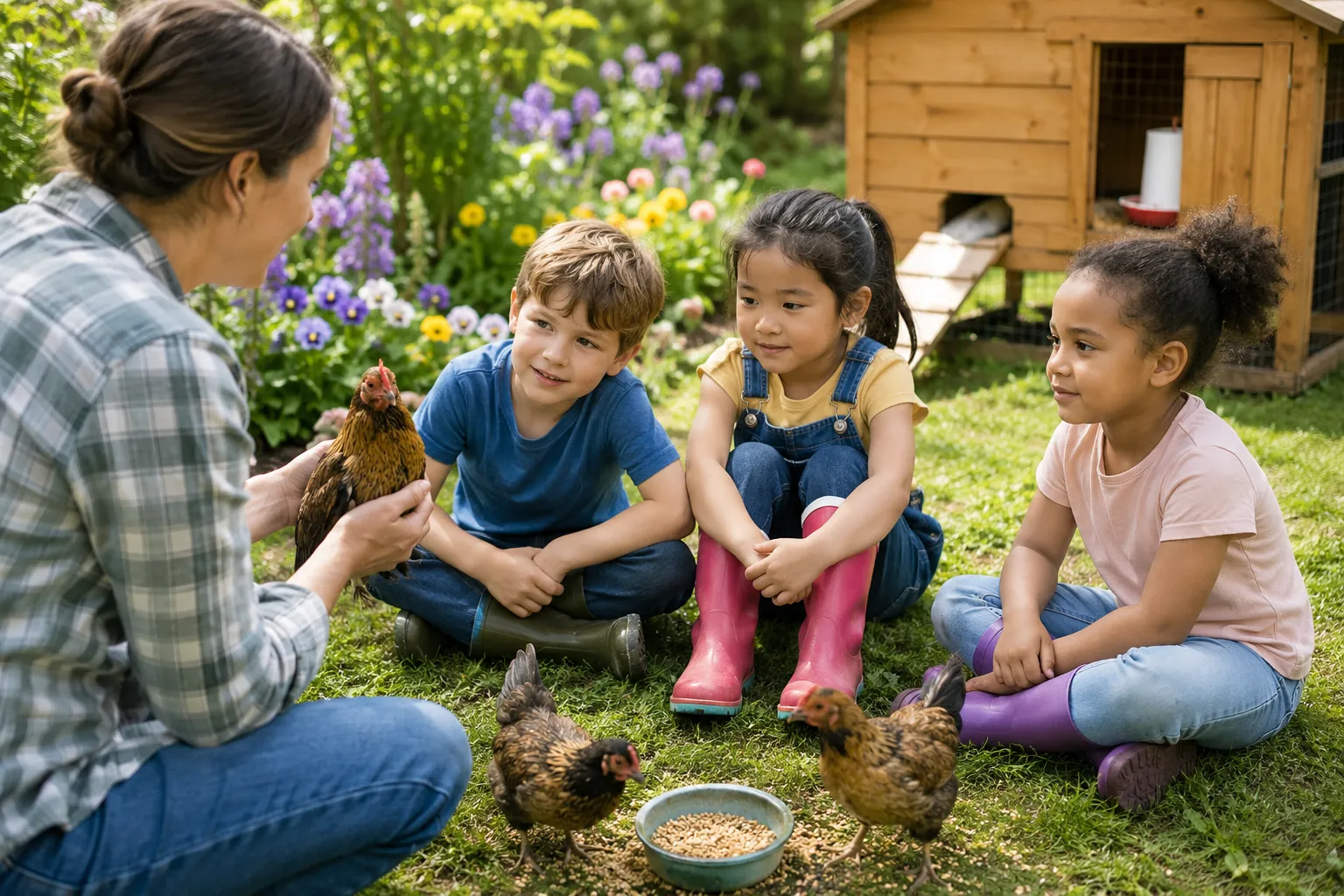
Yes, even docile chickens will peck children when startled, protecting food, investigating shiny objects, or establishing boundaries. Pecking is normal chicken communication and does not indicate aggression in friendly breeds. Most pecks from docile breeds are gentle exploratory taps that don’t break skin, but food-motivated pecking or defensive pecking when cornered can cause small bruises or scratches.
Common Pecking Scenarios:
- Treat-giving: Chickens peck at fingers that smell like food or hold treats
- Jewelry/buttons: Shiny objects trigger investigative pecking
- Sudden movements: Startled chickens may peck defensively
- Cornering: Chickens peck when they feel trapped and can’t escape
- Broody hens: Normally docile hens become protective when sitting on eggs
Preventing Pecking Incidents:
- Teach flat-palm feeding: Treats on open palm, not pinched between fingers
- Remove jewelry: Take off rings, bracelets, and dangling earrings before handling
- Approach slowly: Give chickens time to see you coming
- Respect boundaries: If a chicken moves away, don’t pursue
- Avoid broody hens: Teach kids to identify and leave sitting hens alone
Pain scale: Exploratory pecks from docile breeds feel like a firm pinch. Food-motivated pecks can break skin but rarely cause significant injury. Aggressive pecks from roosters or protective hens can cause bleeding and bruising.
Choose Silkies or Cochins if you’re particularly concerned about pecking, as these breeds have the gentlest pecking behavior. Avoid Mediterranean breeds (Leghorns, Minorcas) which have sharper, more frequent pecking tendencies.
Alternatives to Chickens for Kids Who Want Pets
The best alternatives to chickens for kids wanting farm-style pets include quail (smaller, quieter, lay eggs), rabbits (cuddly, trainable, require less outdoor space), and guinea pigs (indoor-friendly, social, easy care). Ducks can substitute for chickens but require water features and are messier. For families in urban areas with chicken restrictions, these alternatives often face fewer zoning limitations while still providing animal care experience.
Comparison of Alternatives:
Quail:
- Pros: Lay eggs, quiet, small space needs (1 sq ft per bird), mature in 6-8 weeks
- Cons: Flighty, don’t enjoy handling, short lifespan (2-3 years)
- Best for: Families wanting eggs without chicken-sized commitment
Rabbits:
- Pros: Affectionate, litter-trainable, live 8-12 years, soft and cuddly
- Cons: Require daily indoor time, vet care more expensive, don’t produce food
- Best for: Kids wanting a true pet relationship with daily interaction
Guinea Pigs:
- Pros: Indoor housing, social and vocal, easy care, good for apartments
- Cons: No outdoor free-ranging, require companion (minimum 2), shorter lifespan (5-7 years)
- Best for: Younger children (ages 5-8) or families with no yard space
Ducks:
- Pros: Friendly personalities, lay eggs, entertaining to watch, pest control
- Cons: Very messy, need water source, loud (females quack constantly)
- Best for: Families with ponds or willing to maintain kiddie pools
Why families choose alternatives: Zoning restrictions prohibit chickens, landlord won’t allow outdoor coops, family wants indoor pets, children have allergies to feather dander, or noise concerns in dense neighborhoods.
Consider chickens instead if your children want outdoor responsibility, your family values egg production, you have adequate yard space (minimum 10 sq ft per bird), and local regulations permit backyard flocks.
Common Mistakes When Getting Chickens for Kids
The most common mistakes when getting chickens for kids include choosing breeds based on appearance rather than temperament, buying chickens before children are developmentally ready, underestimating daily care requirements, and failing to socialize chicks during the critical first 8 weeks. These errors lead to fearful chickens, frustrated children, and families rehoming their flock within the first year.
Top 10 Mistakes:
- Picking pretty over friendly: Choosing Polish or Leghorns for looks despite flighty temperaments
- Skipping chick handling: Not socializing chicks daily, resulting in unfriendly adults
- Buying too many: Starting with 10+ chickens when 3-4 would teach responsibility better
- Wrong age match: Getting chickens for toddlers who aren’t ready for safe handling
- No predator protection: Underestimating local predators (hawks, raccoons, dogs)
- Impulse buying: Purchasing Easter chicks without research or preparation
- Assuming low maintenance: Not realizing chickens need daily care 365 days per year
- Missing zoning laws: Buying chickens before checking local regulations and HOA rules
- No backup plan: Having no caregiver for vacations or family emergencies
- Keeping roosters: Not rehoming males, leading to noise complaints and aggression issues
How to Avoid These Mistakes:
- Research breeds for 2-3 weeks before purchasing
- Handle chicks 10-15 minutes daily starting day one
- Start with 3-4 hens maximum for first-time families
- Wait until youngest child is at least 4 years old
- Build or buy a predator-proof coop before bringing chickens home
- Plan for 15-30 minutes of daily care (feeding, watering, egg collecting, coop maintenance)
- Check local zoning laws and HOA restrictions first
- Identify a chicken-sitter before emergencies arise
Recovery tip: If you’ve already made these mistakes, most are fixable. Spend 2-3 weeks doing daily treat-training to improve friendliness, rehome excess chickens to reduce overwhelm, and upgrade coop security incrementally.
Are Roosters Safe Around Children?
Roosters are generally not safe around young children because even friendly breeds become territorial and protective as they mature, leading to aggressive behaviors like flogging (jumping and striking with spurs), chasing, and pecking. While some roosters tolerate children, their behavior is unpredictable and can change suddenly during breeding season or when they perceive threats to their hens. Families with children under 12 should keep hen-only flocks.
Rooster Risks:
- Spurs: Sharp leg spurs can cause deep scratches and puncture wounds
- Flogging: Roosters jump at perceived threats, striking with feet and spurs
- Unpredictability: Friendly juvenile roosters often become aggressive at 6-12 months
- Protective instinct: Roosters attack when children approach hens, even gently
- Size advantage: Roosters are larger and stronger than hens, making attacks more dangerous
Rare Exceptions:
Some Silkie and Cochin roosters remain docile throughout their lives, but this cannot be guaranteed. Even within gentle breeds, individual temperament varies significantly. Roosters raised with extensive human handling from day one show better tolerance but may still become aggressive during breeding season (spring).
If you already have a rooster:
- Never allow children under 10 near the rooster unsupervised
- Teach children to carry a barrier (board, bucket) when entering the run
- Watch for warning signs (lowered head, fluffed neck feathers, sideways approach)
- Rehome aggressive roosters immediately, behavior rarely improves
Legal note: Many urban and suburban areas prohibit roosters due to noise, even if hens are allowed. Check local ordinances before acquiring straight-run chicks that may include males.
Best practice: Order sexed pullets (99% female accuracy) from hatcheries or buy started pullets from local farms to avoid rooster surprises entirely.
Which Chicken Breeds Are Too Aggressive for Kids?
Chicken breeds too aggressive for kids include most game breeds (Old English Game, Modern Game, Asil), Mediterranean breeds (Leghorns, Minorcas, Andalusians), and some active dual-purpose breeds (Rhode Island Reds, Welsummers). These breeds were developed for traits like high egg production, competitive showing, or fighting ability rather than docile temperament, making them flighty, nervous, or outright aggressive toward handlers.
Breeds to Avoid with Children:
Game Breeds (High Aggression):
- Old English Game
- Modern Game
- Asil
- Shamo
- Reason: Bred for fighting, naturally aggressive, especially males
Mediterranean Breeds (Flighty/Nervous):
- Leghorns
- Minorcas
- Andalusians
- Anconas
- Reason: High-strung, don’t tolerate handling, peck frequently
Problematic Dual-Purpose Breeds:
- Rhode Island Reds (can be bossy and aggressive)
- Welsummers (active and less tolerant of handling)
- Marans (beautiful eggs but often standoffish)
- Reason: Bred for production over temperament
Breeds with Mixed Reviews:
- Polish: Beautiful crests but poor vision makes them nervous and unpredictable
- Hamburgs: Active and flighty, don’t enjoy being held
- Lakenvelders: Rare breed, often nervous around people
Why these breeds are problematic: Game breeds have genetic aggression that cannot be trained out. Mediterranean breeds have high energy and nervous systems that make them reactive to sudden movements (common with children). Some dual-purpose breeds prioritize production traits over friendliness.
Exception: Individual birds within these breeds may be calm, but the odds are against you. When choosing chickens for kids, select breeds with consistent temperament reputations rather than gambling on outliers.
How to Teach Kids to Hold Chickens Properly
Teaching kids to hold chickens properly requires demonstrating the two-handed secure hold, practicing while seated, and emphasizing calm movements and quiet voices. The correct technique supports the chicken’s body weight, prevents wing flapping, and keeps the bird feeling secure. Children should master this hold before attempting to walk with chickens or perform care tasks while holding birds.
Step-by-Step Holding Technique:
Step 1: Approach Calmly
- Walk slowly toward the chicken
- Speak in a quiet, calm voice
- Let the chicken see you coming (no surprise grabs)
- Corner gently against a wall or in a nesting box
Step 2: The Catch
- Place both hands over the chicken’s back, covering wings
- Scoop up in one smooth motion
- Bring immediately against your body
Step 3: The Secure Hold
- Dominant hand: Under the chicken’s breast, supporting weight
- Other hand: Over the back, gently holding wings against body
- Chicken’s feet should dangle freely or rest on your forearm
- Bird should be snug against your torso
Step 4: Holding Duration
- Start with 30-60 seconds for nervous chickens
- Gradually increase to 5-10 minutes as chicken relaxes
- Set down immediately if chicken struggles violently
Common Holding Mistakes:
❌ Grabbing from above (triggers predator fear)
❌ Holding too loosely (chicken flaps and escapes)
❌ Squeezing too tightly (causes injury and fear)
❌ Holding by wings or legs (painful and dangerous)
❌ Walking while holding (before mastering stationary hold)
Practice Progression:
- Week 1: Catch and hold while seated on ground, 1-2 minutes
- Week 2: Hold while standing still, 3-5 minutes
- Week 3: Walk slowly while holding, 5-10 steps
- Week 4: Carry chicken across yard, perform simple tasks
Safety rule: Children should always sit down when first picking up a chicken. This prevents injury if the child drops the bird or loses balance.
Best chickens for practice: Start with Silkies or Cochins, which tolerate handling mistakes better than flighty breeds. Avoid practicing with young pullets (under 16 weeks) as they’re more nervous than mature hens.
Do Friendly Chicken Breeds Lay Fewer Eggs?
Friendly chicken breeds do not necessarily lay fewer eggs than other breeds. Buff Orpingtons, Australorps, and Wyandottes are both docile and excellent layers, producing 200-280 eggs annually. However, the friendliest breeds like Silkies and Cochins do lay significantly fewer eggs (100-150 per year) because they were bred primarily for ornamental qualities and broodiness rather than production. The correlation between friendliness and egg production depends on the breed’s original purpose.
Egg Production by Friendly Breeds:
| Breed | Temperament | Eggs/Year | Egg Size | Egg Color |
|---|---|---|---|---|
| Australorp | Very friendly | 250-300 | Large | Brown |
| Buff Orpington | Very friendly | 200-280 | Large | Brown |
| Wyandotte | Friendly | 200-240 | Large | Brown |
| Easter Egger | Friendly | 200-280 | Large | Blue/green |
| Silkie | Very friendly | 100-120 | Small | Cream |
| Cochin | Very friendly | 150-180 | Medium | Brown |
Why Some Friendly Breeds Lay Less:
- Broodiness: Silkies and Cochins go broody frequently, stopping egg production for 3-4 weeks at a time
- Ornamental breeding: These breeds were developed for appearance and temperament, not production
- Energy allocation: Extremely fluffy feathering requires energy that could otherwise go to egg production
- Size: Bantam versions of any breed lay smaller and fewer eggs
Best of both worlds: Choose Australorps, Buff Orpingtons, or Easter Eggers if you want both friendly chickens and strong egg production. These breeds were developed as dual-purpose birds with temperament as a secondary selection trait.
Production decline: All chickens lay most heavily in years 1-3, declining 10-20% annually after that. Friendly breeds follow the same pattern as production breeds but may start from a lower baseline.
Choose production-focused friendly breeds if your family wants to offset feed costs with egg sales or consumption. Choose ornamental friendly breeds if eggs are a bonus rather than the primary goal and you prioritize pet qualities.
Frequently Asked Questions
What is the calmest chicken breed for beginners?
Buff Orpingtons are the calmest chicken breed for beginners, combining docile temperament with cold-hardiness, good egg production (200-280 eggs/year), and tolerance for various climates. They rarely go broody, making them more consistent layers than Silkies or Cochins.
Can chickens recognize individual children?
Yes, chickens can recognize and remember individual children, distinguishing between family members based on appearance, voice, and behavior patterns. Chickens form stronger bonds with children who handle them gently and provide treats regularly.
How long do kid-friendly chickens live?
Kid-friendly chicken breeds typically live 5-8 years with proper care, though some individuals reach 10-12 years. Silkies and Cochins often live longer (8-10 years) than production-focused breeds due to lower metabolic demands from reduced egg laying.
Should I get chicks or adult chickens for my kids?
Get day-old chicks if your children are age 8+ and can participate in daily brooding care, as this builds strong bonds. Choose started pullets (16-20 weeks) for younger children (ages 5-7) who aren’t ready for fragile chick care but can handle near-adult birds.
Do chickens like being petted?
Most chickens tolerate rather than enjoy petting, but Silkies, Cochins, and well-socialized Orpingtons show signs of contentment (relaxed posture, soft clucking) when petted gently on the back and under the chin. Avoid petting heads or wings, which triggers discomfort.
How many chickens should a family with kids start with?
Families with kids should start with 3-4 chickens, providing enough birds for social dynamics without overwhelming new chicken keepers. This number produces 12-20 eggs weekly, enough for a family of four, and allows for individual personalities while maintaining manageable care requirements.
What if my child is afraid of chickens?
If your child fears chickens, start with observation only, progress to tossing treats from outside the run, then sit quietly inside the run without touching birds. Choose Silkies or bantam Cochins for their small size and calm demeanor. Never force interaction; let the child set the pace over several weeks.
Can chickens live indoors as house pets?
Chickens should not live indoors as house pets due to constant droppings (chickens cannot be house-trained), dust from feathers, and their need for outdoor space to express natural behaviors. However, Silkies can visit indoors briefly while wearing chicken diapers for supervised interaction.
Do I need a rooster for hens to lay eggs?
No, hens lay eggs without a rooster present. Roosters are only necessary if you want fertilized eggs for hatching chicks. Hen-only flocks are safer for families with children and quieter for neighbors.
What’s the best way to introduce new chickens to kids?
Introduce new chickens to kids by first allowing 2-3 days for birds to settle into their new environment without handling. Then begin with 5-minute supervised sessions where children sit quietly and offer treats. Gradually increase handling time as chickens show comfort (approaching children, eating from hands).
How do I know if a chicken is sick?
Sick chickens show lethargy, reduced appetite, staying separate from the flock, drooping wings, discharge from eyes or nostrils, or changes in droppings. Teach children to report these signs immediately, as chickens hide illness until it’s advanced. Isolate sick birds and consult a veterinarian.
Are chickens good pets for kids with allergies?
Chickens may trigger allergies in sensitive children due to feather dander, dust from bedding, and proteins in droppings. Children with bird allergies or asthma should interact with chickens outdoors only, wash hands immediately after contact, and avoid coop cleaning duties. Consider allergy testing before committing to a flock.
Conclusion
Choosing the friendliest chicken breeds for kids transforms backyard chicken keeping from a chore into a rewarding family experience. Silkies, Buff Orpingtons, Cochins, and Australorps consistently rank as the best breeds for children due to their calm temperaments, tolerance for handling, and forgiving nature with beginner mistakes. The right breed depends on your children’s ages, your family’s priorities (pet vs. production), and your climate.
Take these next steps:
- Assess readiness: Ensure your youngest child is at least 4-5 years old and can follow gentle-handling rules
- Check regulations: Verify local zoning laws and HOA restrictions before purchasing chickens
- Choose your breed: Select Silkies for maximum friendliness, Buff Orpingtons for friendliness plus production, or bantam versions for younger children
- Prepare housing: Build or buy a predator-proof coop with 3-4 square feet per bird before bringing chickens home
- Start small: Begin with 3-4 hens to learn care requirements without becoming overwhelmed
- Socialize early: Handle chicks 10-15 minutes daily during the first 8 weeks to ensure friendly adult birds
- Teach proper technique: Practice the two-handed hold while seated before allowing children to walk with chickens
Remember that individual personality varies within breeds, and early socialization matters as much as genetics. With patient teaching, appropriate breed selection, and consistent gentle handling, your family can enjoy years of fresh eggs, outdoor responsibility lessons, and genuine bonds with your feathered flock.


