
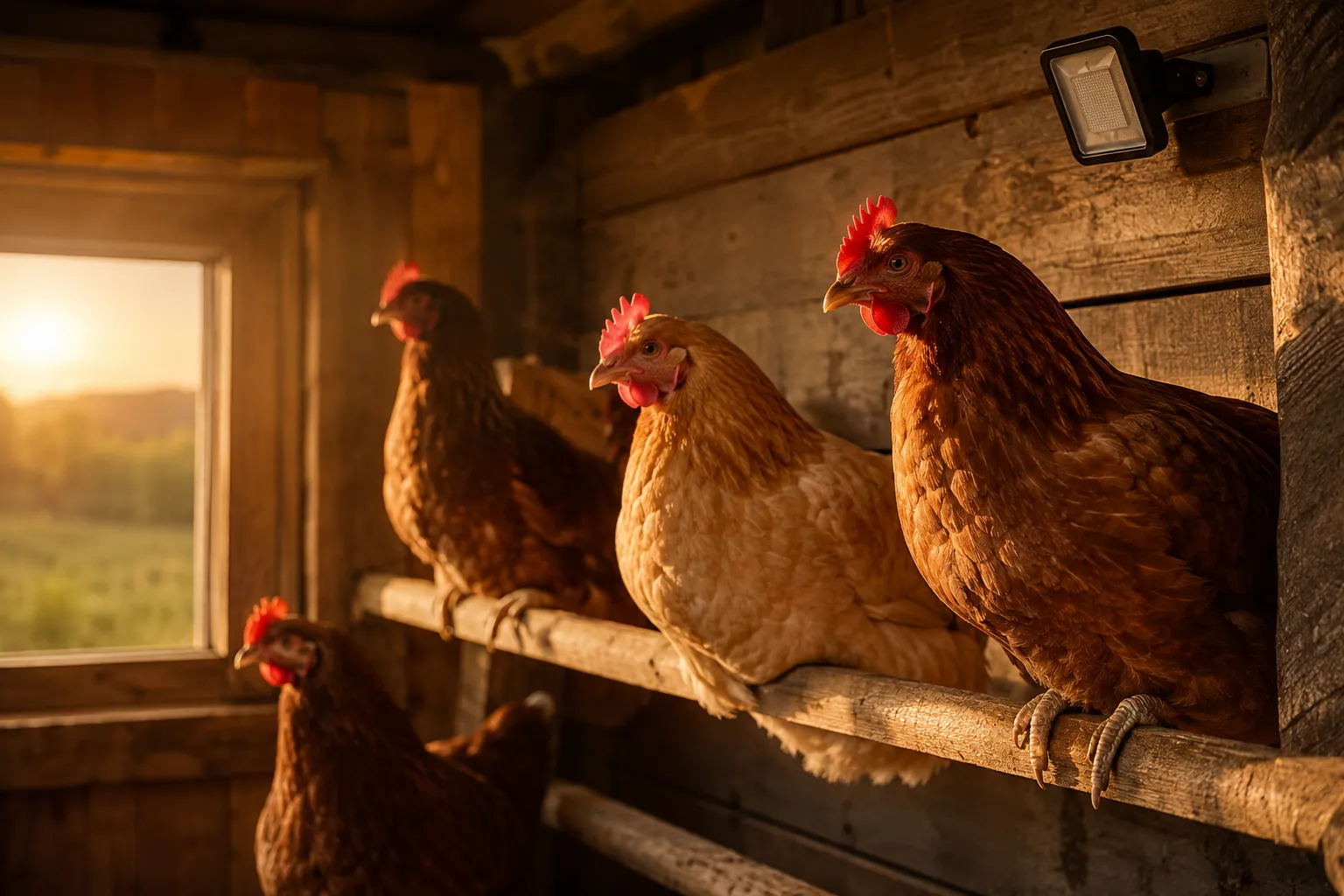
Most backyard chicken keepers discover quickly that their flock doesn’t need artificial light at night, in fact, chickens require complete darkness to rest properly. While supplemental lighting can boost winter egg production during daylight hours, leaving lights on overnight disrupts their natural sleep cycle and can harm their health. The question “Do Chickens Need Light at Night?” has a clear answer: no, and providing darkness is essential for their well-being.
Key Takeaways
- Chickens need 8-10 hours of complete darkness each night for proper rest and health
- Artificial light at night disrupts sleep cycles and can cause stress, aggression, and health problems
- Supplemental lighting should only be used in the morning, never at night, to extend daylight hours in winter
- Baby chicks under 6 weeks need constant warmth from a heat lamp, but this is for temperature, not light
- Red lights are gentler than white lights if any nighttime illumination is absolutely necessary for safety
- Egg production depends on total daylight hours (12-16 hours), not nighttime lighting
- Complete darkness helps chickens roost naturally and maintain their circadian rhythm
- Too much light causes feather pecking, reduced immunity, and shortened lifespans
- Free-range chickens follow natural light cycles and rarely need artificial supplementation
Do Chickens Need Light at Night to Sleep?
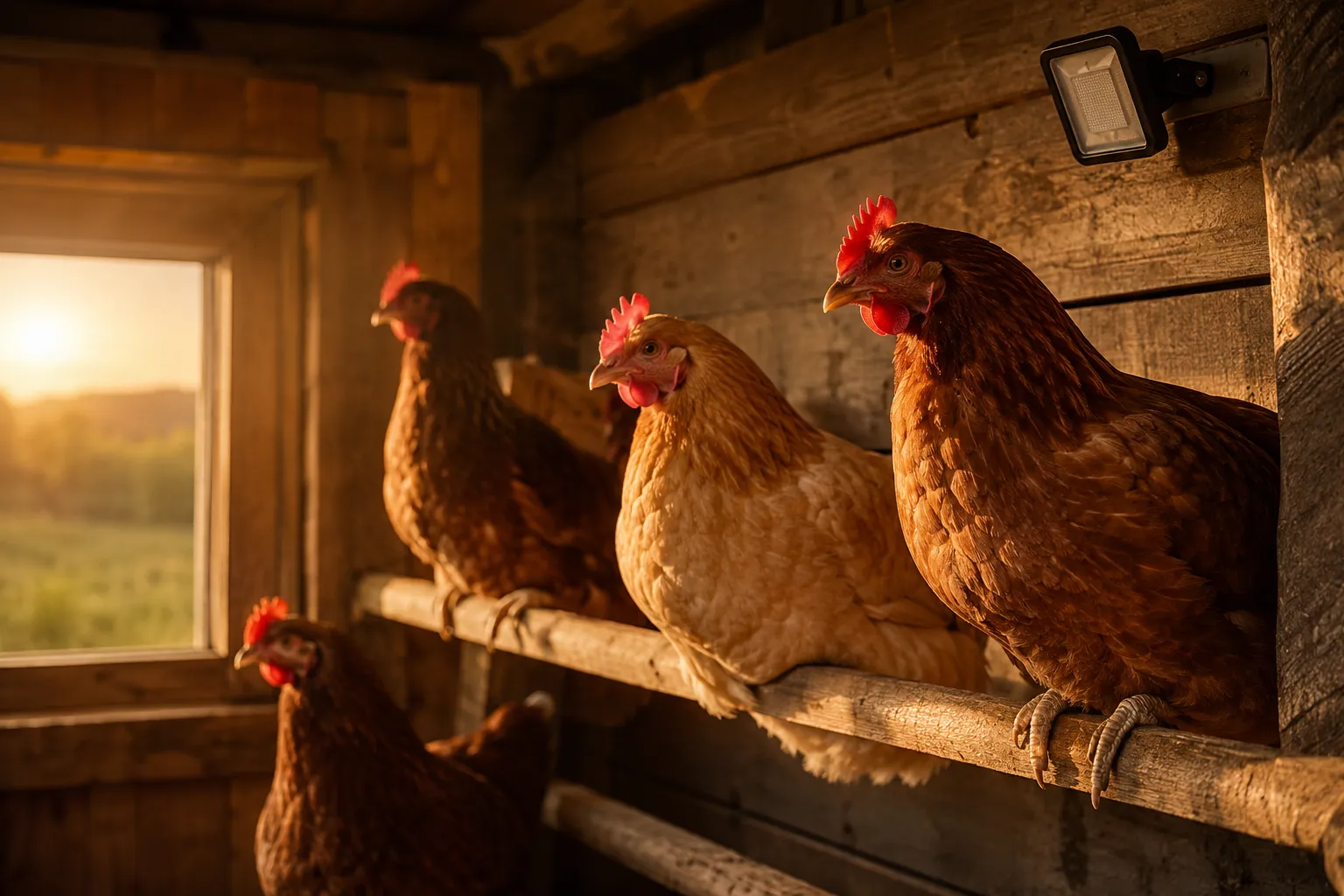
Chickens do not need light at night to sleep, they actually require complete darkness to rest properly. Like most birds, chickens have a natural circadian rhythm that signals them to roost when the sun sets and become active at dawn.
When darkness falls, chickens instinctively seek their roosting spots and settle in for the night. Their eyes are designed for daytime vision, and they become nearly blind in low light conditions, which is why they naturally stop moving and sleep once it gets dark.
What happens during nighttime rest:
- Chickens enter deep sleep cycles that restore energy
- Their immune systems strengthen and repair cellular damage
- Stress hormones decrease significantly
- Body temperature drops slightly to conserve energy
- Digestive systems slow down for overnight fasting
Adding artificial light at night interferes with these natural processes. Chickens may stay awake longer than they should, leading to exhaustion and stress. Some birds may even try to continue eating and moving around when they should be resting.
Common mistake: New chicken keepers sometimes worry their flock is scared of the dark and leave a light on “for comfort.” This actually causes more harm than good, as chickens are hardwired to sleep in darkness and don’t experience fear of the dark the way humans might.
What Happens If Chickens Don’t Get Light at Night?
If chickens don’t get artificial light at night, they experience completely normal and healthy sleep patterns, this is exactly what should happen. The absence of nighttime lighting allows chickens to follow their natural biological rhythms, resulting in better overall health, stronger immune systems, and more balanced behavior.
Benefits of proper darkness:
- Improved sleep quality: Chickens complete full rest cycles without interruption
- Better egg production: Well-rested hens lay more consistently during their active season
- Reduced aggression: Adequate rest decreases stress-related pecking and fighting
- Stronger immunity: Darkness triggers melatonin production, which supports immune function
- Natural molting cycles: Chickens can properly shed and regrow feathers on schedule
- Longer lifespans: Proper rest reduces wear on their bodies and organs
The real problems occur when chickens do get artificial light at night. Constant illumination confuses their internal clocks, leading to chronic stress, exhaustion, and health complications.
Choose darkness if: You want healthy, long-lived chickens with natural laying cycles. Choose nighttime lighting only if you have a specific safety concern (predator entry point, injury monitoring) and use the dimmest red light possible for the shortest duration.
How Many Hours of Darkness Do Chickens Need?
Chickens need a minimum of 8 hours of complete darkness each night, though 10-12 hours is ideal for optimal health and rest. This darkness period allows them to complete full sleep cycles and maintain their natural circadian rhythm.
The total light-dark cycle should add up to 24 hours, with most healthy laying hens thriving on 14-16 hours of light (natural plus supplemental if needed) and 8-10 hours of darkness during peak production seasons.
Darkness requirements by season:
- Spring/Summer: Natural daylight provides 14-16 hours of light; no supplementation needed
- Fall: Days shorten to 10-12 hours; optional morning supplementation to reach 14-16 hours total
- Winter: Natural light drops to 8-10 hours; many keepers add 4-6 hours of morning light
- Year-round minimum: Never reduce darkness below 8 hours, even with supplementation
What happens with too little darkness:
- Hens become exhausted and irritable
- Egg quality declines (thin shells, double yolks, irregular shapes)
- Feather pecking and cannibalism increase
- Immune systems weaken, making birds susceptible to disease
- Reproductive systems wear out faster, shortening productive lifespan
Edge case: During extreme northern or southern latitudes with very long summer days (18+ hours of natural light), chickens naturally reduce laying or take breaks. Don’t try to force year-round production by eliminating darkness, this will harm your flock.
Should I Leave a Light On in My Chicken Coop at Night?
You should not leave a light on in your chicken coop at night under normal circumstances. Chickens need complete darkness to sleep properly, and nighttime lighting disrupts their rest, causes stress, and can lead to serious health and behavioral problems.
The only situations where a nighttime light might be justified are temporary safety concerns, for example, if you’re monitoring a sick or injured bird, or if there’s an active predator threat that requires you to check the coop during night hours. Even then, use the dimmest red light possible and turn it off as soon as the situation is resolved.
Why nighttime coop lights cause problems:
- Sleep disruption: Chickens can’t enter deep sleep with light present
- Increased aggression: Tired, stressed birds peck at each other more frequently
- Overworked reproductive systems: Hens forced into constant production develop health issues
- Predator attraction: Lights can actually draw predators to your coop at night
- Fire hazard: Heat lamps and electrical fixtures in coops pose significant fire risks
The right way to use supplemental lighting:
If you want to maintain egg production during short winter days, add light in the morning before dawn, not at night. Set a timer to turn lights on at 4-5 AM so your flock gets 14-16 hours of total light, then let natural sunset trigger their roosting behavior. This preserves their natural evening routine and ensures they get proper darkness for rest.
Common mistake: Leaving a heat lamp on all night in winter. Adult chickens are cold-hardy and don’t need supplemental heat in most climates. If temperatures drop dangerously low (below -10°F/-23°C for cold-hardy breeds), use a flat-panel heater designed for coops, not a heat lamp, and keep the coop dark.

Red Light vs White Light for Chickens at Night
Red light is significantly better than white light for chickens if any nighttime illumination is absolutely necessary, though complete darkness remains the ideal. Chickens perceive red light as dimmer and less stimulating than white light, so it causes less disruption to their sleep cycles and natural behaviors.
How chickens see different light colors:
- White/blue light: Appears very bright to chickens; fully activates their circadian rhythm and signals “daytime”
- Red light: Appears much dimmer; chickens can barely see it, so it minimally disrupts sleep
- Green/yellow light: Falls between white and red in terms of visibility and disruption
When to use red light:
- Monitoring a sick or injured bird overnight
- Temporary predator threat requiring night checks
- Helping chickens adjust to a new coop for the first 1-2 nights
- Emergency situations requiring you to enter the coop after dark
Red light advantages:
- Reduces stress compared to white light
- Allows you to see while minimally disturbing sleeping birds
- Less likely to trigger aggressive pecking behavior
- Doesn’t fully suppress melatonin production like white light does
Important limitation: Even red light should be used sparingly and temporarily. It’s not a solution for permanent nighttime lighting. If you find yourself needing light in the coop every night, address the underlying problem (predator-proof the coop, move sick birds to a separate recovery area, improve coop security) rather than leaving any light on long-term.
Choose red light if: You must use nighttime lighting for a specific, temporary reason. Choose complete darkness if: Your coop is secure and your flock is healthy (which should be the case 99% of the time).
Do Baby Chicks Need Light at Night?
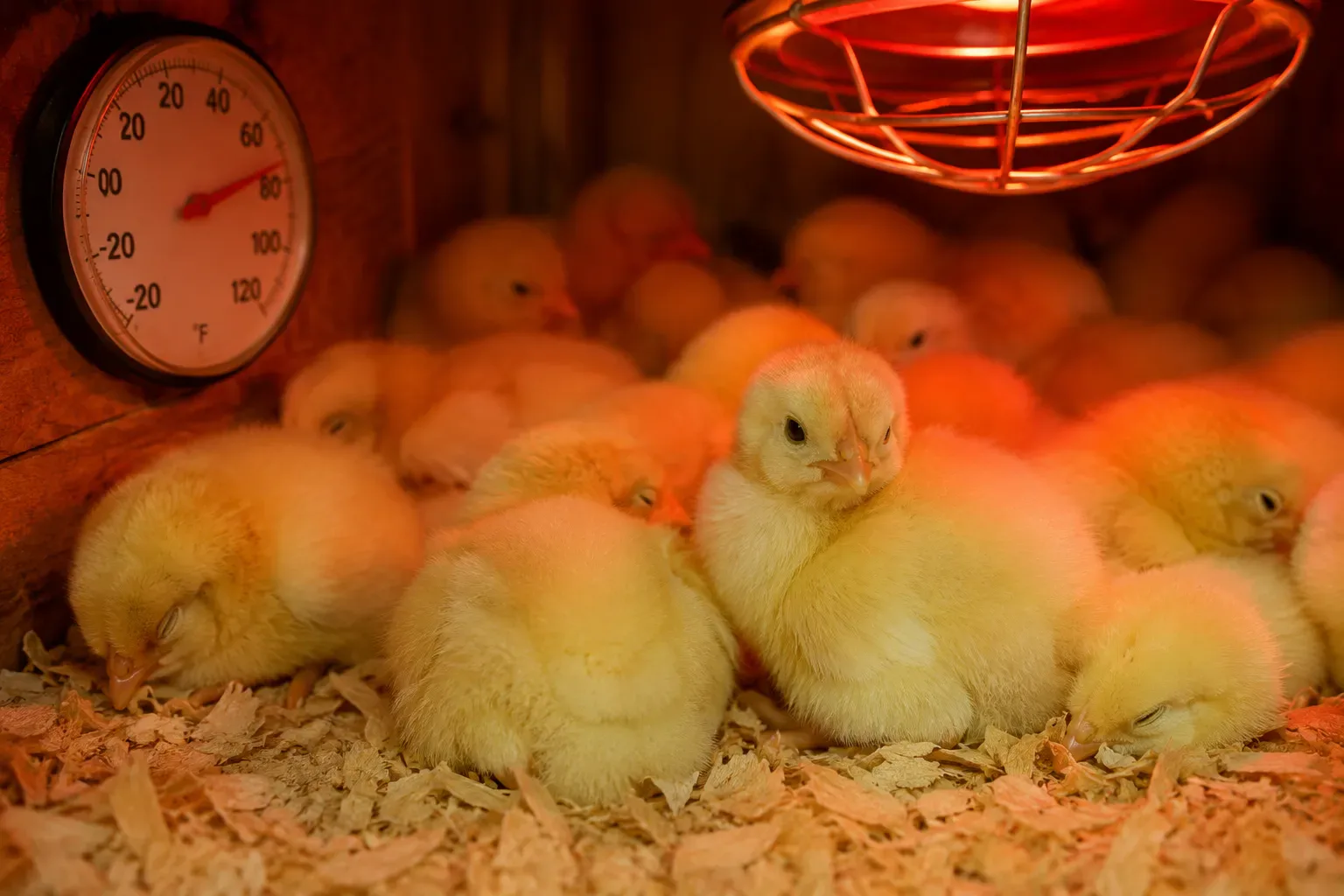
Baby chicks under 6 weeks old need a heat source running 24 hours a day, which typically means a heat lamp stays on at night, but this is for warmth, not light. The heat is essential for survival since chicks can’t regulate their body temperature effectively until they develop full feathers.
Heat requirements by age:
- Week 1: 95°F (35°C) constant temperature
- Week 2: 90°F (32°C)
- Week 3: 85°F (29°C)
- Week 4: 80°F (27°C)
- Week 5: 75°F (24°C)
- Week 6+: Room temperature if fully feathered
Best practices for brooder lighting:
- Use a red heat bulb instead of white to provide warmth with less light intensity
- Consider a flat-panel brooder heater that provides warmth without light
- Position the heat source over only half the brooder so chicks can move to a cooler, darker area to sleep
- Observe chick behavior: if they huddle directly under the light, they’re cold; if they avoid it completely, they’re too hot
What chicks actually need at night:
Warmth is non-negotiable, but constant bright light is not ideal even for chicks. While they can tolerate 24-hour lighting better than adult chickens, providing some dim periods or using red bulbs helps establish healthier sleep patterns from the start.
After 6 weeks: Once chicks are fully feathered and can regulate their temperature, transition them to the same light schedule as adult chickens, no nighttime lighting, just natural darkness for 8-10 hours.
Common mistake: Keeping bright white heat lamps on 24/7 for weeks. This can cause chicks to become stressed, develop pecking behaviors, and struggle with the transition to normal coop conditions. Switch to red bulbs or panel heaters as soon as possible.
Will Chickens Stop Laying Eggs Without Light at Night?
Chickens will not stop laying eggs simply because they don’t have light at night, egg production depends on total daylight hours (12-16 hours), not nighttime lighting. What matters is the cumulative amount of light chickens receive during their active hours, which naturally decreases in fall and winter.
How light affects egg production:
- 14-16 hours of light: Peak laying for most breeds (5-7 eggs per week)
- 12-14 hours of light: Moderate laying (3-5 eggs per week)
- 10-12 hours of light: Reduced laying (1-3 eggs per week)
- Below 10 hours: Many hens stop laying and enter molt
During winter months when natural daylight drops to 8-10 hours, many backyard flocks naturally reduce or stop egg production. This is healthy and normal, it gives hens’ reproductive systems a rest period.
If you want winter eggs:
Add supplemental light in the morning, not at night. Set a timer to turn coop lights on at 4-5 AM so your flock gets 14-16 total hours of light by sunset. This maintains production while still allowing proper darkness for rest.
The trade-off to consider:
Forcing year-round production with artificial light shortens a hen’s productive lifespan. Chickens are born with a finite number of eggs, and pushing them to lay through winter without a natural break can lead to:
- Earlier onset of reproductive problems
- Increased risk of egg binding and prolapse
- Shorter overall laying life (2-3 years instead of 4-5)
- Higher stress levels and reduced quality of life
Choose natural cycles if: You’re okay with fewer or no eggs in winter and want your hens to live longer, healthier lives. Choose supplemental morning lighting if: You need consistent egg production year-round and accept the trade-offs.
Can Too Much Light at Night Harm Chickens?
Too much light at night can seriously harm chickens, causing chronic stress, behavioral problems, weakened immunity, and shortened lifespans. Chickens evolved to sleep in complete darkness, and disrupting this natural pattern has cascading negative effects on their physical and mental health.
Health problems caused by excessive nighttime light:
- Chronic stress: Elevated cortisol levels from sleep deprivation
- Weakened immune system: Reduced melatonin production impairs disease resistance
- Reproductive exhaustion: Overworked ovaries and oviducts lead to prolapse and egg binding
- Feather pecking and cannibalism: Tired, stressed birds become aggressive
- Poor egg quality: Thin shells, blood spots, irregular shapes
- Shortened lifespan: Constant production without rest wears out body systems faster
Behavioral changes to watch for:
- Increased aggression and pecking
- Restlessness and pacing at night
- Reduced appetite or irregular eating patterns
- Lethargy during normal active hours
- Excessive vocalization or distress calls
How much light is too much:
Any artificial light left on continuously through the night is too much. Even low-level lighting (like a nightlight or security light) can disrupt sleep if it’s constant. Chickens need true darkness, not just dim light, for at least 8 hours every night.
Edge case: If your coop is near a street light, security light, or other external light source you can’t control, take steps to block it. Use blackout curtains, paint windows, or add baffles to prevent light pollution from entering the coop at night.
Do Free-Range Chickens Need Artificial Light?
Free-range chickens typically do not need artificial light because they naturally follow the sun’s cycle and self-regulate their activity based on available daylight. These chickens experience the full spectrum of seasonal changes and adapt their laying patterns accordingly, which is healthier than forced year-round production.
Advantages of natural light cycles for free-range flocks:
- Chickens naturally reduce laying in winter and rest their reproductive systems
- Molting occurs on schedule, allowing proper feather replacement
- Immune systems remain strong through natural seasonal rhythms
- Behavioral patterns stay balanced without artificial manipulation
- Lifespans tend to be longer with natural breaks in production
When free-range chickens might benefit from supplemental light:
- Commercial operations: Where consistent egg production is economically necessary
- Extreme northern/southern latitudes: Where winter daylight drops below 8 hours
- Specific breed needs: Some heritage breeds are more sensitive to light changes
How to supplement light for free-range chickens (if needed):
Even with free-range access, add light in the morning inside the coop before birds go outside. Set timers to provide 14-16 total hours of light during short winter days, but always maintain 8-10 hours of complete darkness at night.
The natural approach:
Many backyard chicken keepers with free-range flocks choose to skip supplemental lighting entirely, accepting reduced winter egg production as a fair trade for healthier, longer-lived birds. Chickens that follow natural cycles often lay well for 4-5 years, compared to 2-3 years for birds pushed into year-round production.
Choose natural cycles if: Your free-range flock is primarily for personal eggs and you value bird welfare over maximum production. Choose morning supplementation if: You need consistent winter eggs and your birds have access to proper darkness at night.
Best Type of Light for Chicken Coop at Night
The best type of light for a chicken coop at night is no light at all, complete darkness is ideal. However, if you absolutely must use lighting for a temporary safety or health reason, a low-wattage red LED bulb (5-15 watts) is the least disruptive option.
If nighttime lighting is unavoidable:
Red LED bulbs (best option):
- Appear very dim to chickens
- Minimal sleep disruption
- Energy-efficient and cool-running
- Safe and low fire risk
- 5-15 watts is sufficient
What to avoid at night:
- ❌ White or blue LED lights (too stimulating)
- ❌ Fluorescent lights (harsh and flickering)
- ❌ Heat lamps (fire hazard, too bright)
- ❌ Motion-activated lights (startle sleeping birds)
- ❌ High-wattage bulbs of any color
For daytime/morning supplemental lighting:
If you’re adding light to extend daylight hours in winter, use these during morning hours only:
- White LED bulbs (40-60 watts equivalent): Energy-efficient, bright enough to trigger laying
- Fluorescent tubes: Provide even light distribution across the coop
- Automatic timers: Essential for consistent light schedules
Lighting setup best practices:
- Mount lights securely to prevent falls
- Use weatherproof fixtures rated for damp locations
- Keep bulbs away from flammable bedding and nesting materials
- Install on timers, never leave on continuously
- Position lights to provide even coverage without dark corners
Safety first: More coop fires are caused by lighting equipment than any other factor. If you use any artificial lighting, inspect fixtures monthly, replace damaged cords immediately, and never run extension cords through walls or under bedding.
Do Chickens Need Complete Darkness to Roost?
Chickens do not absolutely require complete darkness to roost initially, they’ll settle onto their perches at dusk even with some ambient light, but they do need complete darkness to sleep deeply and restfully through the night. The roosting behavior is triggered primarily by decreasing light levels and their internal clock, while quality sleep depends on true darkness.
The roosting process:
As the sun sets and light levels drop, chickens instinctively seek their roosting spots and settle in for the night. This behavior begins in twilight conditions (not complete darkness) and is driven by:
- Decreasing light intensity signaling day’s end
- Internal circadian rhythm timing
- Social cues from flock members
- Learned routine and habit
Why complete darkness matters after roosting:
Once chickens are settled on their roosts, complete darkness becomes essential for:
- Deep sleep cycles: Chickens need darkness to enter REM sleep
- Melatonin production: This hormone regulates sleep and supports immunity
- Physical rest: Muscles and organs repair during dark periods
- Stress reduction: Darkness signals safety and rest time
What counts as “complete darkness”:
Chickens need true darkness, not just dim light. A small amount of moonlight filtering through a window is fine and natural, but artificial light sources (street lights, security lights, nightlights) should be blocked.
Common scenario: Chickens will roost in a coop with a small window that lets in moonlight or ambient neighborhood light, but they’ll sleep better and be healthier if you add curtains or covers to block artificial light pollution.
Edge case: If chickens refuse to roost at their normal time, the problem usually isn’t lack of darkness, it’s more likely mites, predator stress, or inadequate roosting space. Address the underlying issue rather than adding light.
Common Mistakes with Chicken Coop Lighting
Many chicken keepers make lighting errors that harm their flock’s health, reduce egg quality, or create safety hazards. Understanding these common mistakes helps you avoid problems and maintain a healthier, more productive flock.
Top lighting mistakes:
1. Leaving lights on 24/7
- Causes chronic stress and exhaustion
- Leads to aggressive pecking and cannibalism
- Shortens productive lifespan significantly
- Fix: Ensure 8-10 hours of complete darkness every night
2. Adding light at night instead of morning
- Disrupts natural roosting behavior
- Prevents proper sleep cycles
- Creates confusion when lights suddenly go off
- Fix: Use timers to add light in early morning (4-5 AM), not evening
3. Using heat lamps for adult chickens
- Major fire hazard in coops with bedding
- Unnecessary for cold-hardy adult birds
- Creates dependency on artificial heat
- Fix: Adult chickens don’t need heat in most climates; use flat-panel heaters only in extreme cold
4. Inconsistent lighting schedules
- Confuses chickens’ circadian rhythms
- Causes irregular laying patterns
- Increases stress levels
- Fix: Use automatic timers for consistent daily schedules
5. Too much light too fast
- Shocking systems into production causes health problems
- Increases risk of prolapse and egg binding
- Fix: Gradually increase light by 15-30 minutes per week if supplementing
6. Ignoring light pollution from external sources
- Street lights, security lights, and neighbor’s lights disrupt sleep
- Often overlooked as a problem source
- Fix: Add blackout curtains or covers to windows facing light sources
7. Using motion-activated lights
- Startles sleeping chickens repeatedly
- Prevents deep sleep cycles
- Creates chronic stress
- Fix: Use timer-controlled lights only, never motion sensors at night
8. Forcing year-round production without breaks
- Exhausts reproductive systems
- Shortens laying life from 5 years to 2-3 years
- Increases health problems
- Fix: Allow natural winter breaks or accept shorter productive lifespans
How to tell if your lighting setup is wrong:
- Chickens seem tired or lethargic during the day
- Increased feather pecking or aggression
- Irregular or poor-quality eggs
- Birds reluctant to enter coop at night
- Excessive noise or restlessness after dark
How to Tell If My Chickens Are Getting Enough Light
You can tell if your chickens are getting enough light by monitoring their laying patterns, behavior, energy levels, and overall health. Chickens receiving optimal light (14-16 hours during laying season) will be active, produce consistent eggs, and display calm, social behavior.
Signs your chickens are getting adequate light:
✅ Consistent egg production: Hens lay 5-7 eggs per week during peak season
✅ Active foraging behavior: Birds are energetic and engaged during daylight hours
✅ Healthy feather condition: Smooth, glossy plumage without excessive pecking damage
✅ Calm, social interactions: Minimal aggression, normal flock hierarchy
✅ Good appetite: Regular eating and drinking patterns
✅ Natural roosting behavior: Birds settle at dusk without resistance
Signs your chickens need more daylight (not nighttime light):
⚠️ Reduced egg production: Dropping from 5-7 eggs to 2-3 or fewer per week
⚠️ Lethargy during day: Birds seem sluggish or uninterested in activity
⚠️ Early molting: Feather loss starting in late summer instead of fall
⚠️ Irregular laying: Eggs come at odd times or skip multiple days
Signs your chickens are getting too much light or not enough darkness:
🚨 Increased aggression: Feather pecking, bullying, or cannibalism
🚨 Restlessness at night: Noise, movement, or distress after dark
🚨 Poor egg quality: Thin shells, blood spots, irregular shapes
🚨 Exhausted appearance: Droopy posture, closed eyes during day
🚨 Stress behaviors: Pacing, excessive vocalization, reduced appetite
How to measure light in your coop:
- Natural light: Count hours from sunrise to sunset in your location
- Supplemental light: Use a timer and track total hours (natural + artificial)
- Target range: 14-16 hours total light during laying season, 8-10 hours darkness
- Winter minimum: Don’t let total light drop below 12 hours if you want consistent eggs
Seasonal adjustments:
- Spring/Summer: Natural light is sufficient; no supplementation needed
- Fall: Begin adding morning light when days drop below 14 hours
- Winter: Maintain 14-16 total hours with morning supplementation
- Late winter: Gradually reduce supplemental light as days lengthen naturally
Quick assessment: If your hens are laying well, acting normally, and roosting peacefully at night, your lighting is probably fine. Problems with light usually show up as behavioral changes or production issues before serious health problems develop.
Frequently Asked Questions
Can chickens see in the dark?
No, chickens have very poor night vision and become nearly blind in darkness. This is why they naturally roost and sleep when the sun sets, they can’t navigate or function safely in low light conditions.
How long should I leave a light on for chickens?
Never leave lights on continuously. If using supplemental lighting in winter, provide 14-16 total hours of light (including natural daylight) and ensure 8-10 hours of complete darkness for rest.
Will a nightlight help chickens feel safe?
No, chickens don’t experience fear of darkness like humans. A nightlight actually disrupts their sleep and causes stress. Complete darkness makes them feel secure and allows proper rest.
What color light is best for egg production?
White or full-spectrum light during daytime hours is best for stimulating egg production. Red light is only appropriate for minimal nighttime illumination in emergency situations, not for boosting laying.
Do chickens need light in winter?
Chickens don’t need light at night in winter, but many keepers add supplemental light in the morning to maintain 14-16 total daylight hours and sustain egg production through short winter days.
How do I transition chickens to supplemental lighting?
Gradually increase light by 15-30 minutes per week until you reach 14-16 total hours. Sudden changes shock their systems and can cause health problems. Always add light in the morning, not evening.
Can I use solar lights in my chicken coop?
Solar lights are generally not recommended because they’re difficult to control with timers and often stay on too long. If you must use them, choose models with timers and ensure they turn off to provide darkness.
Why are my chickens not roosting at night?
Chickens refusing to roost usually indicates mites, predator stress, inadequate perch space, or illness, not a lighting problem. Inspect for parasites and ensure roosts are comfortable and secure.
Is it okay to check on chickens at night with a flashlight?
Occasional brief checks with a flashlight are fine for emergencies, but frequent nighttime disturbances stress the flock. Use a dim red flashlight if you must check regularly, and minimize disruption.
Do different chicken breeds need different amounts of light?
Most breeds need 14-16 hours of light for optimal laying, but some heritage breeds are more sensitive to seasonal changes and may reduce production naturally in winter regardless of supplemental lighting.
How bright should coop lights be?
For morning supplemental lighting, use 40-60 watt equivalent LED bulbs or fluorescent tubes that provide even, bright light. For emergency nighttime use only, 5-15 watt red LEDs are sufficient.
Will my chickens stop laying if I don’t use artificial light?
Many chickens naturally reduce or stop laying in winter when daylight drops below 12-14 hours. This is healthy and normal, giving their reproductive systems a rest period that extends their productive lifespan.
Conclusion
The answer to “Do Chickens Need Light at Night?” is clear: no, chickens need complete darkness for 8-10 hours every night to rest properly and maintain good health. While supplemental lighting can help sustain egg production during short winter days, it should only be added in the morning hours, never at night.
Providing proper darkness isn’t just about letting chickens sleep, it’s essential for their immune function, stress management, behavioral health, and longevity. Chickens that get adequate rest in complete darkness lay better quality eggs, live longer, and experience fewer health problems than those exposed to constant or nighttime lighting.
Your next steps:
- Audit your current setup: Check for light pollution from external sources and eliminate any nighttime lighting in your coop
- Ensure 8-10 hours of darkness: Make this non-negotiable for your flock’s health
- If supplementing light: Use timers to add light in early morning (4-5 AM) only, maintaining natural evening routines
- Monitor your flock: Watch for signs of adequate rest (calm behavior, consistent laying, healthy feathers)
- Consider natural cycles: Evaluate whether you really need year-round production or can accept seasonal breaks for healthier, longer-lived birds
Remember, chickens evolved to thrive with natural light cycles. The closer you can keep to sunrise-and-sunset rhythms, with complete darkness at night, the healthier and happier your flock will be.


