
Quick Answer
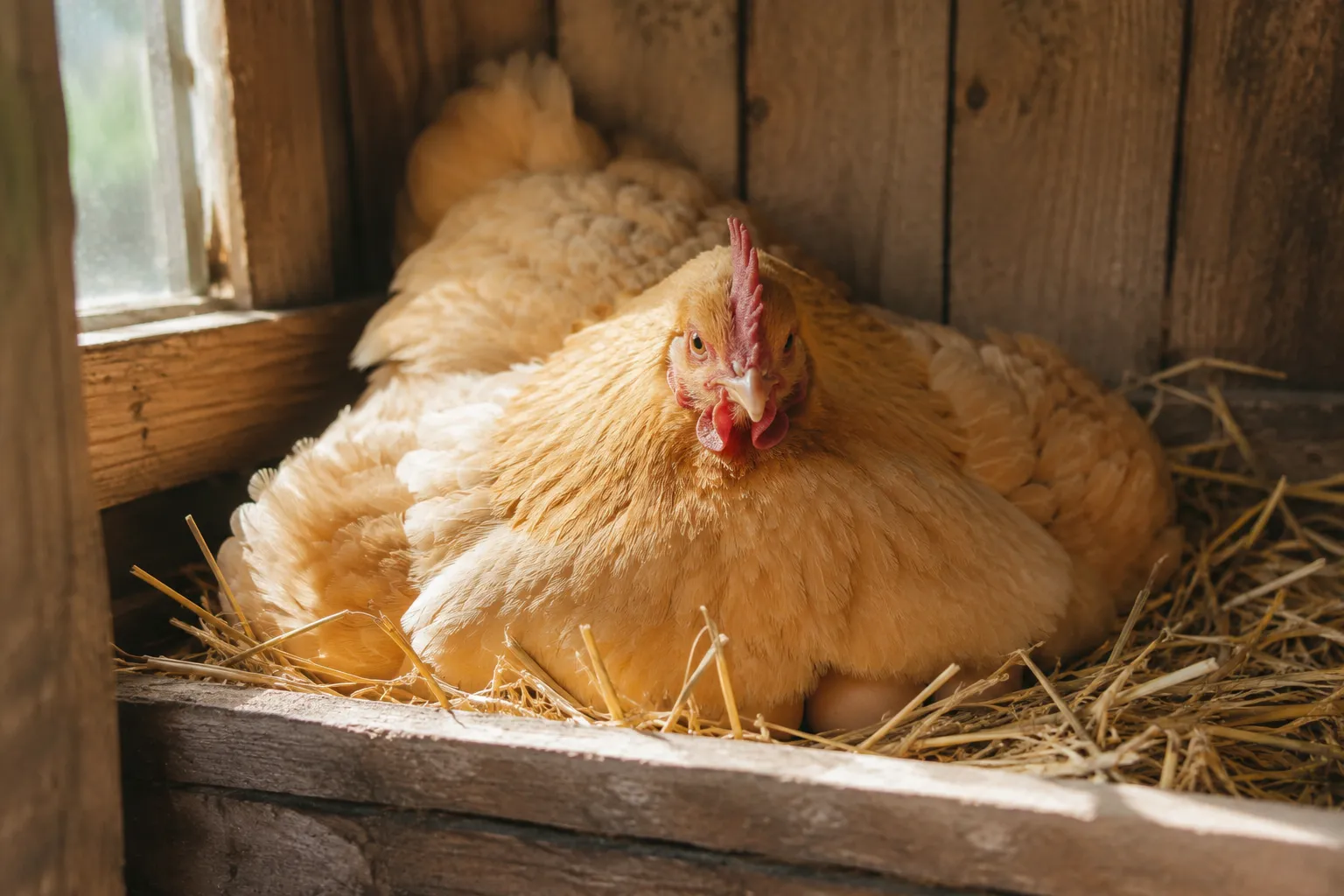
A broody hen is a chicken that has entered a hormonal state where she wants to sit on eggs and hatch chicks, even if no fertile eggs are present. She’ll stop laying, refuse to leave the nest, puff up her feathers, and become protective or aggressive. Whether you should let her hatch eggs or break her broodiness depends on whether you want chicks and whether her health is at risk from prolonged sitting.
Key Takeaways
- Broodiness is a natural hormonal state triggered by instinct, not illness, causing hens to sit on eggs for 21 days to hatch them
- Broody hens stop laying eggs during the broody period and for several weeks after, temporarily reducing your flock’s production
- Common signs include puffed feathers, growling or pecking when approached, flattened posture in the nest, and refusing to leave the coop
- You have two main options: let her hatch fertile eggs if you want chicks, or break her broodiness if you need her back to laying
- Breaking broodiness takes 3-5 days using a wire-bottom broody breaker cage that prevents nesting behavior
- Certain breeds go broody more often including Silkies, Cochins, Orpingtons, and Brahmas, while production breeds rarely do
- Broody hens can lose significant weight and may neglect food and water, requiring daily health checks
- Moving a broody hen is risky but possible if done at night and with minimal disturbance to avoid abandonment
- Store-bought eggs won’t hatch under a broody hen because they’re unfertilized, though she doesn’t know the difference
- Most hens return to normal laying within 4-8 weeks after broodiness ends, with no permanent damage to production
What Does It Mean When a Hen Goes Broody?
When a hen goes broody, she enters a hormonal state driven by maternal instinct to incubate eggs and raise chicks. Her body temperature rises slightly, hormone levels shift, and her behavior changes dramatically to focus entirely on sitting on a clutch of eggs for the 21-day incubation period required to hatch them.
This is a completely natural process that wild chickens and many heritage breeds still exhibit. The hen’s body is responding to environmental cues like lengthening daylight hours, a collection of eggs in the nest, and her own hormonal cycle. Once broodiness sets in, she becomes single-minded about her mission.
What triggers broodiness:
- Accumulation of eggs in a nesting box (even unfertilized ones)
- Seasonal changes, especially spring and early summer
- Genetic predisposition in certain breeds
- Hormonal fluctuations related to laying cycles
- Seeing other hens sitting on nests
The broody hen doesn’t understand whether eggs are fertile or not. She’ll sit on golf balls, wooden eggs, or even an empty nest if that’s all she has. Her instinct is simply to incubate whatever is in her chosen spot.
How to Tell If My Chicken Is Broody or Sick
A broody hen displays specific behavioral patterns that differ from illness, though new chicken keepers often confuse the two. A broody hen will puff up her feathers, flatten herself in the nest, and make growling or clucking sounds when approached. She’ll also have a noticeably bare patch on her chest where she’s plucked feathers to provide direct warmth to eggs.
Signs your hen is broody (not sick):
- Stays in the nesting box 23+ hours per day
- Puffed feathers and flattened, pancake-like posture
- Growls, pecks, or screams when you approach
- Spreads wings over eggs protectively
- Leaves nest only once daily for quick food, water, and large droppings
- Alert eyes and responsive to threats
- Bare brood patch on chest
Signs your hen might be sick instead:
- Lethargic with closed or dull eyes
- Labored breathing or discharge from eyes/nose
- Doesn’t react defensively when touched
- Sitting hunched in corners away from nesting boxes
- Diarrhea or abnormal droppings stuck to feathers
- Comb appears pale, purple, or discolored
- No interest in food or water even when removed from nest
The key difference: A broody hen is alert, defensive, and purposeful. A sick hen is withdrawn, unresponsive, and shows physical symptoms of illness. If you gently lift a broody hen, she’ll likely puff up and complain loudly. A sick hen will be limp and unresponsive.
Broody Hen vs Regular Hen Behavior Differences
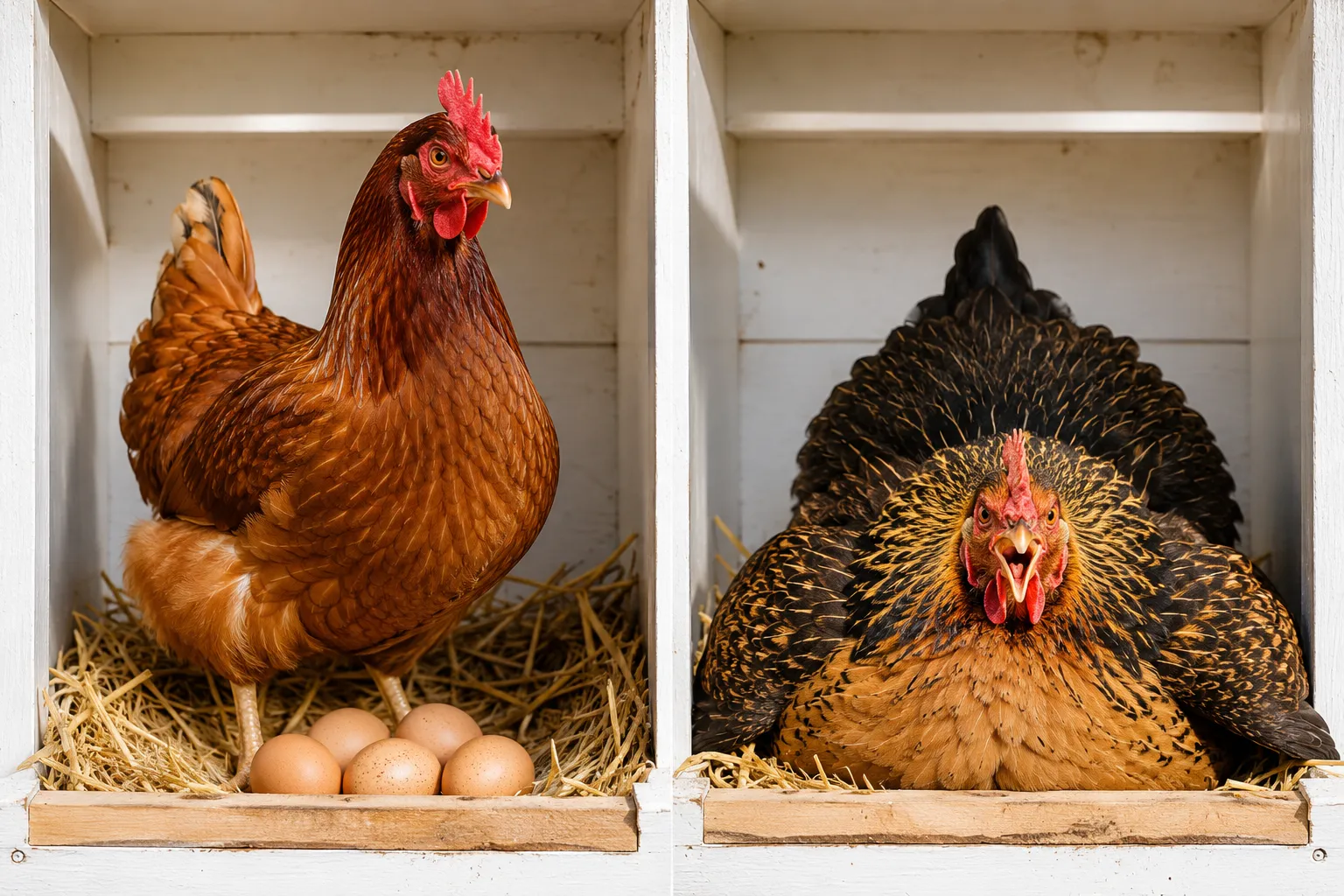
The behavioral contrast between a broody hen and a regular laying hen is dramatic and easy to spot once you know what to look for. Regular hens visit the nesting box for 20-30 minutes to lay an egg, then leave to forage, socialize, and go about their day. Broody hens essentially move into the nesting box and refuse to leave.
| Behavior | Regular Hen | Broody Hen |
|---|---|---|
| Time in nest | 20-30 minutes daily | 23+ hours daily |
| Temperament | Calm, friendly | Aggressive, protective |
| Feather appearance | Sleek, normal | Puffed up, spread wide |
| Vocalizations | Normal clucks | Growling, screaming |
| Egg laying | Daily or regular schedule | Stops completely |
| Eating habits | Forages throughout day | One quick trip daily |
| Body temperature | Normal | Elevated |
| Droppings | Regular, frequent | Large, infrequent (broody poops) |
Regular hens maintain their social position in the flock, participate in dust baths, and show interest in treats and activities. Broody hens abandon all normal chicken behavior in favor of sitting. They’ll even skip favorite treats and ignore flock dynamics entirely.
The physical transformation is equally striking. A broody hen’s chest becomes hot to the touch, her comb may pale slightly from reduced circulation, and she’ll lose weight rapidly if the broody period extends beyond a week.
How Long Does a Broody Hen Stay Broody?
A broody hen will naturally stay broody for approximately 21 days, which is the incubation period for chicken eggs. If she’s sitting on fertile eggs, she’ll remain broody until the chicks hatch, then continue in “mother hen” mode for another 6-8 weeks while raising the chicks.
However, if she’s sitting on unfertilized eggs or no eggs at all, the timeline becomes unpredictable. Some hens will give up after 2-3 weeks when nothing hatches. Others will remain stubbornly broody for 2-3 months, continuing to sit despite the absence of chicks.
Typical broodiness timeline:
- Days 1-3: Hen begins sitting more frequently, testing the behavior
- Days 4-7: Full broodiness sets in, refuses to leave nest
- Days 8-21: Peak broody behavior if sitting on fertile eggs
- Day 21+: Chicks hatch (if eggs are fertile) or hen may continue sitting
- Weeks 4-12: Without intervention, some hens stay broody this long
Factors that affect duration:
- Whether eggs are present and fertile
- Individual hen’s determination level
- Breed genetics (some breeds are more persistent)
- Environmental conditions and stress
- Whether you’re actively trying to break her broodiness
If you don’t want chicks and don’t intervene, expect most hens to remain broody for 3-6 weeks before naturally breaking. This extended period causes significant weight loss and health risks, making intervention advisable.
Should I Let My Broody Hen Hatch Eggs or Stop Her?
The decision to let a broody hen hatch eggs or break her broodiness depends on whether you want more chickens, have fertile eggs available, and can manage the consequences of either choice. Let her hatch if you want chicks and have a rooster or can source fertile eggs. Break her broodiness if you need her back to laying, don’t want more chickens, or she’s losing too much weight.
Let her hatch eggs if:
- You want to expand your flock with chicks
- You have fertile eggs (from your rooster or purchased)
- She’s in good body condition and healthy
- You have space for additional chickens
- You can manage roosters if half the chicks are male
- You have a safe, separate area for her and chicks
- You’re prepared for 8+ weeks of no eggs from her
Break her broodiness if:
- You don’t want more chickens
- You need her egg production
- She’s losing dangerous amounts of weight
- You have no fertile eggs available
- Your local laws prohibit roosters (limiting chick placement)
- She’s blocking nesting boxes other hens need
- She’s gone broody repeatedly and needs a break
Common mistake: Letting a hen sit on unfertilized eggs “to see what happens.” Nothing will happen except she’ll lose weight and health for weeks. If you’re going to let her sit, commit to providing fertile eggs within the first few days.
Choose based on your goals. Both options are valid, but indecision leads to an unhealthy hen sitting indefinitely on eggs that will never hatch.
How to Break a Broody Hen Fast
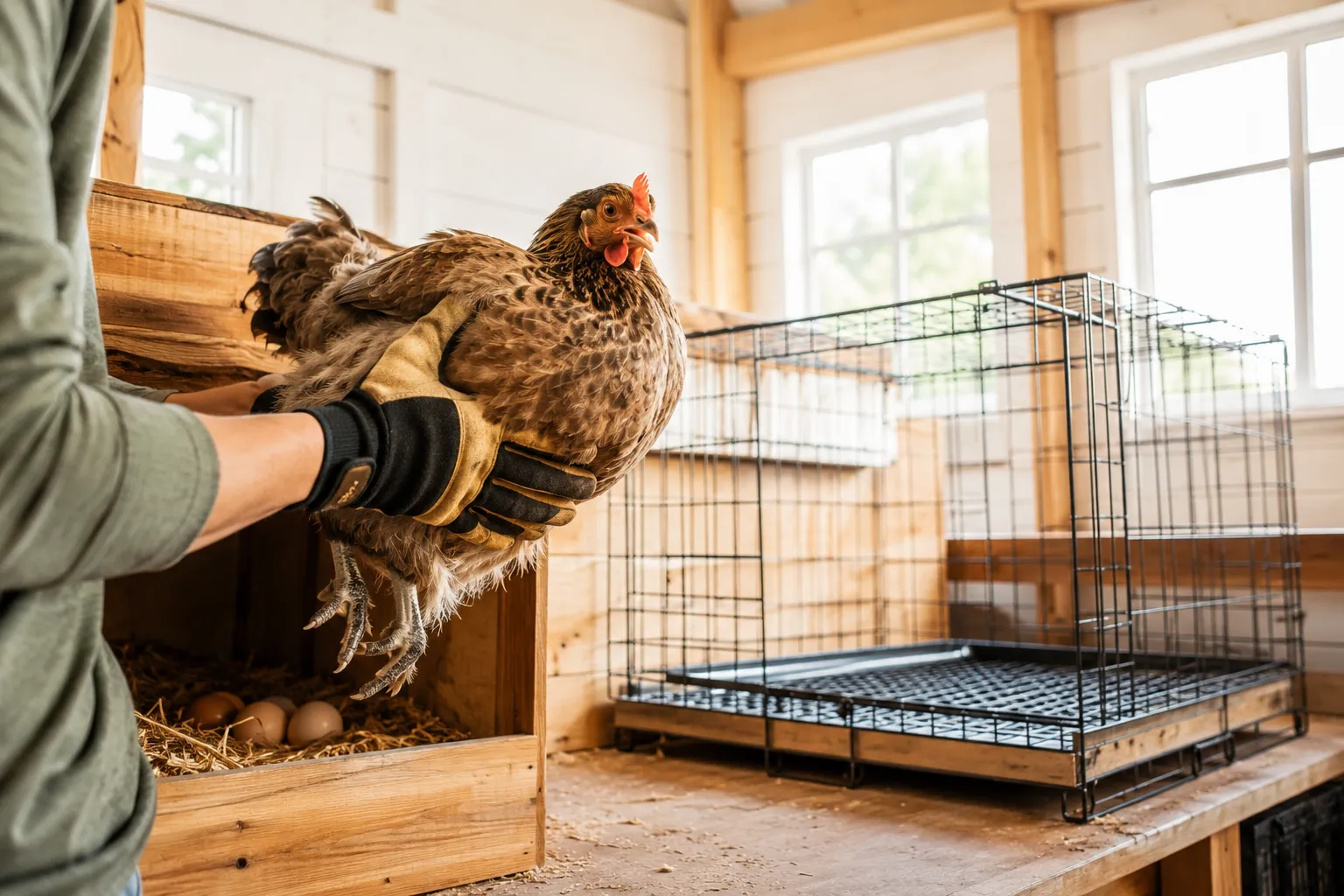
Breaking a broody hen requires disrupting her ability to maintain the warm, dark, comfortable nesting environment her hormones are telling her to create. The most effective method is a wire-bottom broody breaker cage placed in a well-lit, cool area where she cannot settle into nesting behavior.
The broody breaker method (3-5 days):
- Remove her from the nest in the evening and place her in a wire-bottom cage (rabbit hutch or dog crate with wire floor works well)
- Elevate the cage so air circulates underneath, cooling her chest and belly
- Provide food and water but no bedding, nesting material, or dark corners
- Keep in a bright, active area of the coop or garage where she can see the flock
- Check twice daily for signs she’s eating, drinking, and moving around
- After 3-5 days, return her to the flock in the evening
- Monitor for 48 hours to ensure she doesn’t immediately return to the nest
Alternative methods (less effective):
- Cold water dunk: Submerging her chest in cool water for 30 seconds, twice daily (stressful and less reliable)
- Repeated removal: Taking her off the nest every hour (exhausting for you, often ineffective)
- Blocking nest access: Preventing access to nesting boxes (she’ll often find another spot)
Why the broody breaker works: The wire floor prevents her from creating a warm nest, the elevation cools her body temperature, and the bright environment disrupts the hormonal signals driving broodiness. Most hens break within 3-5 days using this method.
Important: Check her body condition daily. If she’s already lost significant weight, provide extra protein and monitor closely. Some extremely determined hens may require 7-10 days in the broody breaker.
What Happens If You Don’t Collect Eggs from a Broody Hen?
If you don’t collect eggs from a broody hen, she’ll continue sitting on an ever-growing pile of eggs laid by herself and other hens who use the same nesting box. This creates a chaotic situation where eggs of different ages are mixed together, making it impossible to know which eggs are viable if any are fertile.
The practical problems multiply quickly. Eggs laid on different days will hatch on different days if they’re fertile, meaning early chicks can distract the hen from continuing to incubate later eggs. Older eggs may rot under the hen, creating a mess and potential bacterial problems. Other hens may continue adding eggs to the pile, overwhelming the broody hen’s ability to cover them all effectively.
Consequences of not collecting eggs:
- Mixed-age eggs lead to staggered hatching over many days
- Hen cannot effectively incubate more than 10-12 eggs
- Rotten eggs may explode, creating unsanitary conditions
- Other hens disturb the broody hen to lay their eggs
- Impossible to track which eggs are fertile or fresh
- Increased risk of broken eggs and bacterial contamination
Best practice: When you identify a broody hen, immediately mark or remove all existing eggs. If you want her to hatch chicks, provide a specific set of fertile eggs all laid within 7 days of each other. If you don’t want chicks, remove all eggs and begin breaking her broodiness.
Leaving the situation unmanaged wastes eggs, stresses the hen, and creates a health hazard in your coop.
Can a Broody Hen Starve Herself?
A broody hen can lose dangerous amounts of weight and theoretically starve herself, though most will take brief breaks to eat and drink before reaching critical condition. Broody hens typically leave the nest once every 24 hours for 10-20 minutes to eat, drink, and defecate, but some extremely determined hens may skip even these breaks for 2-3 days at a time.
The weight loss can be dramatic. A broody hen may lose 20-30% of her body weight over a 3-4 week broody period, which puts significant stress on her organs and immune system. Hens in poor body condition before going broody are at highest risk.
Warning signs of dangerous weight loss:
- Prominent keel bone (breastbone) easily felt with no muscle covering
- Sunken eyes or lethargic behavior even when off nest
- Weakness or inability to stand when removed from nest
- Pale comb and wattles indicating anemia
- Refusing food and water even when offered directly
How to protect a broody hen’s health:
- Check her body condition every 2-3 days by feeling her breast muscle
- Remove her from the nest once daily to ensure she eats and drinks
- Offer high-protein treats like scrambled eggs, mealworms, or tuna
- Provide water directly near the nest if she’s extremely reluctant to leave
- Break broodiness if she’s losing weight too rapidly or showing weakness
Most broody hens manage their health instinctively, but human intervention prevents the small percentage who become dangerously obsessed with sitting. If you’re letting her hatch eggs, daily health checks are essential.
Best Chicken Breeds That Go Broody Often
Certain heritage and ornamental chicken breeds retain strong broody instincts, while modern production breeds have had broodiness largely bred out to maximize egg laying. If you want a hen that will reliably go broody and raise chicks, choose from breeds known for maternal behavior.
Breeds that go broody frequently:
- Silkies: Go broody almost constantly, excellent mothers, will hatch any eggs including duck or turkey
- Cochins: Very broody, gentle, good for hatching and raising chicks
- Orpingtons: Moderate to frequent broodiness, calm and reliable mothers
- Brahmas: Broody tendencies, especially in spring and summer
- Australorps: More broody than most dual-purpose breeds
- Sussex: Moderate broodiness, good mothers when they commit
- Wyandottes: Occasional broodiness, varies by individual hen
Breeds that rarely or never go broody:
- Leghorns: Bred for egg production, almost never broody
- Rhode Island Reds: Occasional broodiness but uncommon in modern lines
- Production hybrids (ISA Brown, Golden Comet, etc.): Broodiness bred out
- Andalusians: Rarely broody
- Hamburgs: Almost never broody
Choose Silkies or Cochins if: You want a dedicated broody hen to hatch eggs from your other breeds. These breeds are so broody they’re often used as surrogate mothers for other chickens’ eggs or even other poultry species.
Avoid production breeds if: You’re hoping for natural chick rearing. These birds are optimized for laying, not mothering, and you’ll need an incubator instead.
Do Broody Hens Stop Laying Eggs Permanently?
Broody hens do not stop laying eggs permanently, but they will stop completely during the broody period and for several weeks afterward while their hormones reset. Most hens return to normal laying within 4-8 weeks after broodiness ends, whether they hatched chicks or were broken from broodiness.
The temporary pause in laying occurs because the hormones driving broodiness (prolactin) suppress the hormones responsible for egg production. Once broodiness breaks, either naturally or through intervention, the hen’s reproductive system gradually restarts.
Timeline for return to laying:
- During broodiness: Zero eggs for 3-6+ weeks
- If hatching chicks: No eggs for 6-8 weeks while raising chicks
- After breaking broodiness: 2-4 weeks before first egg
- Full production: 4-8 weeks to return to normal laying schedule
Factors affecting return to laying:
- Age of the hen (older hens take longer to restart)
- Time of year (fall/winter delays return)
- Nutritional status and body condition
- Whether she hatched chicks or was broken from broodiness
- Individual hen variation
Long-term impact: Repeated broodiness throughout a season can significantly reduce a hen’s annual egg production. A hen who goes broody three times in one year might lay 100 fewer eggs than her non-broody sisters. However, her lifetime laying capacity isn’t damaged; she simply takes extended breaks.
If egg production is your priority, break broodiness quickly or choose breeds that rarely go broody.
How to Move a Broody Hen to a Separate Nesting Box
Moving a broody hen to a separate nesting box or broody area is risky because disruption can break her broodiness or cause her to abandon the eggs. However, it’s sometimes necessary to protect her from other hens or give her a safer space. The key is moving her at night when she’s calmer and ensuring the new location is ready before the move.
Step-by-step moving process:
- Prepare the new location first with fresh bedding, food, water, and the eggs you want her to hatch
- Wait until after dark when the hen is calm and less likely to panic
- Gently lift her while she’s sitting, supporting her body fully
- Move her and the eggs together if possible, or place eggs in the new nest first
- Set her directly on the eggs in the new location
- Leave her undisturbed for 12-24 hours in dim lighting
- Check the next morning to see if she’s still sitting
- If she abandons the nest, return her to the original location and try again in 2-3 days
Tips for success:
- Move her within the first 3-4 days of broodiness, not after she’s been sitting for weeks
- Make the new nest as similar as possible to the original (same bedding type, darkness level)
- Ensure the new location is quiet, safe from predators, and away from flock traffic
- Some hens will accept the move immediately; others will return to the original nest
- Be prepared with a backup plan if she refuses the new location
Common mistake: Moving a broody hen during the day when she’s alert. This almost always results in her abandoning the nest and returning to the original location or breaking broodiness entirely.
Success rate: About 60-70% of broody hens will accept a nighttime move if done carefully within the first few days of broodiness.
Common Mistakes When Dealing with a Broody Hen
New chicken keepers often make predictable errors when encountering their first broody hen, either through misunderstanding her needs or applying the wrong intervention at the wrong time. These mistakes can harm the hen’s health, waste fertile eggs, or prolong broodiness unnecessarily.
Mistake 1: Letting her sit on unfertilized eggs indefinitely
Without fertile eggs, she’ll sit for weeks or months with no result, losing dangerous amounts of weight. Either provide fertile eggs within 3-4 days or break her broodiness immediately.
Mistake 2: Repeatedly removing her from the nest without a plan
Simply taking her off the nest several times a day rarely breaks broodiness and just stresses both of you. Use a proper broody breaker cage instead.
Mistake 3: Ignoring her health and body condition
Broody hens can deteriorate quickly. Check her weight and ensure she’s eating and drinking every 2-3 days, especially if she’s been broody for more than a week.
Mistake 4: Moving her too late in the broody cycle
After a hen has been sitting for 10+ days, moving her will likely cause abandonment. Move within the first 3-4 days or leave her where she is.
Mistake 5: Providing too many eggs
A hen can only effectively cover and incubate 10-12 eggs depending on her size. More than that leads to uneven heating and poor hatch rates.
Mistake 6: Disturbing her constantly to “check on her”
Excessive handling and nest checks can break broodiness or cause egg abandonment. Check her health every 2-3 days but otherwise leave her alone.
Mistake 7: Not separating her from the flock
Other hens will continue laying eggs in her nest, creating a mixed-age clutch. They may also harass her or break eggs. A broody hen with chicks needs separation for safety.
Mistake 8: Expecting her to lay eggs while broody
Broodiness completely stops egg production. Don’t count on any eggs from her until 4-8 weeks after broodiness ends.
Is a Broody Hen Dangerous to Other Chickens?
A broody hen is generally not dangerous to other adult chickens, though she may become more aggressive and defensive than usual, especially if other hens approach her nest. Her aggression is defensive rather than predatory and is focused on protecting her perceived eggs and nesting space.
The main risk is to newly hatched chicks from other hens. A broody hen with chicks will fiercely defend them and may attack other chickens who come too close, potentially injuring smaller or younger birds. Additionally, other hens may peck at or kill chicks that aren’t their own if the broody hen and her babies aren’t separated from the main flock.
Typical broody hen aggression:
- Pecking and growling at humans who reach into the nest
- Puffing up and spreading wings to appear larger
- Charging at other hens who approach her nesting box
- Screaming or making alarm calls when disturbed
- Pecking at other hens’ feet if they try to lay in her box
When separation is necessary:
- If she’s blocking the only nesting boxes and other hens can’t lay
- When chicks hatch, to protect them from the flock
- If she’s being bullied or harassed by dominant hens
- If she’s losing access to food and water due to flock dynamics
Broody hens with chicks: Once chicks hatch, the hen becomes extremely protective and will attack any chicken (or human) she perceives as a threat. This is normal maternal behavior but requires management. Most chicken keepers separate the broody hen and chicks into a protected area for 4-6 weeks until the chicks are large enough to integrate safely.
The aggression is temporary and hormone-driven. Once broodiness ends or chicks are raised, the hen returns to her normal temperament and flock position.
Can You Put Store-Bought Eggs Under a Broody Hen?
You cannot successfully hatch store-bought eggs under a broody hen because commercial eggs sold in grocery stores are unfertilized and will never develop into chicks, regardless of how long a hen sits on them. Store-bought eggs come from commercial laying operations that don’t keep roosters, so the eggs are simply unfertilized ova with no potential for embryo development.
The broody hen doesn’t know the difference between fertile and unfertilized eggs. She’ll sit on store-bought eggs with the same dedication she’d give fertile eggs, but after 21 days (or longer), nothing will hatch. This wastes her time, energy, and body condition for no result.
Why store-bought eggs won’t hatch:
- No rooster present at commercial farms means no fertilization
- Eggs are often refrigerated, which kills any potential embryo
- Eggs may be weeks old before reaching stores
- Commercial breeds are selected for laying, not fertility
What to use instead:
- Fertile eggs from your own rooster if you keep one with your hens
- Purchased fertile hatching eggs from local farms, hatcheries, or online suppliers
- Fertile eggs from a friend’s flock that includes a rooster
- Specialty breed eggs if you want to introduce new genetics
Where to buy fertile eggs:
- Local farms and homesteaders (check Craigslist, Facebook groups)
- Online hatching egg suppliers (shipped via priority mail)
- Feed stores that connect local breeders with buyers
- Poultry shows and swap meets
Cost: Fertile hatching eggs typically cost $1-5 per egg for common breeds, $5-15 per egg for specialty or show-quality breeds.
If you want your broody hen to hatch chicks, invest in actual fertile eggs within the first 3-4 days of her broodiness. Otherwise, break her broodiness rather than letting her sit on eggs that will never hatch.
Frequently Asked Questions
How do I know if my hen is broody?
A broody hen stays in the nesting box 23+ hours per day, puffs up her feathers, growls or pecks when approached, and refuses to leave the nest. She’ll have a bare patch on her chest and will only leave once daily for food, water, and large droppings.
Can I stop a hen from going broody?
You cannot prevent broodiness entirely in breeds with strong maternal instincts, but you can break it quickly using a wire-bottom broody breaker cage. Collecting eggs frequently and not allowing eggs to accumulate in nests may reduce the trigger for broodiness.
Will a broody hen hurt her eggs?
No, broody hens are extremely careful with eggs and turn them regularly to ensure even heating. They instinctively know how to handle eggs gently and will adjust their position to protect them.
How many eggs can a broody hen sit on?
Most hens can effectively cover and incubate 10-12 eggs depending on their body size. Larger breeds like Cochins or Orpingtons can handle 12-14 eggs, while smaller breeds like Silkies should sit on 8-10 eggs maximum.
Do I need to help chicks hatch under a broody hen?
No, broody hens manage the entire hatching process naturally and will help chicks emerge from eggs when needed. Human intervention usually causes more harm than good. Only assist if a chick has been pipped (broken through the shell) for more than 24 hours without progress.
Can two broody hens share a nest?
Two broody hens sharing a nest usually leads to problems including broken eggs, fighting, and confusion over which eggs belong to whom. It’s best to separate broody hens into individual nesting areas.
What do I feed a broody hen?
Feed the same layer feed as usual, but offer high-protein treats like scrambled eggs, mealworms, or tuna to help maintain her body condition. Ensure she has constant access to fresh water, as she may only drink once per day.
Will a broody hen adopt chicks that aren’t hers?
Many broody hens will accept chicks placed under them at night, especially within the first few days of broodiness or just as their eggs are hatching. Success rates vary by individual hen temperament.
How do I introduce a broody hen and chicks to the flock?
Wait until chicks are 4-6 weeks old and large enough that other chickens won’t harm them. Introduce them in a protected area where the flock can see them but not attack, gradually allowing supervised interaction over 1-2 weeks.
Can a hen go broody without a rooster?
Yes, broodiness is triggered by hormones and environmental factors, not by the presence of a rooster. Hens will go broody and sit on unfertilized eggs with the same dedication as fertile ones.
Why does my hen keep going broody?
Some breeds and individual hens have very strong maternal instincts and will go broody repeatedly throughout spring and summer. Breaking broodiness quickly each time and choosing less broody breeds are the only solutions.
Is it cruel to break a broody hen?
No, breaking broodiness using humane methods like a broody breaker cage is not cruel and actually protects the hen’s health by preventing dangerous weight loss and extended periods without proper nutrition.
Conclusion
Understanding what a broody hen is and how to respond appropriately ensures both the hen’s health and your flock management goals. A broody hen is simply following powerful maternal instincts, sitting on eggs for 21 days in hopes of hatching chicks. Whether you choose to let her hatch fertile eggs or break her broodiness depends entirely on your situation: your desire for chicks, available resources, and the hen’s body condition.
The key is making a decision quickly. Don’t let a hen sit indefinitely on unfertilized eggs, losing weight and health for no purpose. If you want chicks, provide fertile eggs within 3-4 days and ensure she has a safe, separate space. If you don’t want chicks, use a wire-bottom broody breaker cage for 3-5 days to reset her hormones and return her to normal laying.
Your next steps:
- Check your broody hen’s body condition every 2-3 days by feeling her breast muscle
- Decide within 72 hours whether to let her hatch eggs or break her broodiness
- Source fertile eggs immediately if you want her to hatch chicks
- Set up a broody breaker cage if you need her back to laying
- Monitor her return to normal behavior and egg production over the following 4-8 weeks
Remember that broodiness is temporary, natural, and manageable. With the right approach, you can either welcome new chicks to your flock or have your hen back to laying eggs within a week. The choice is yours, but informed action protects your hen’s welfare and keeps your backyard flock thriving in 2026.


