
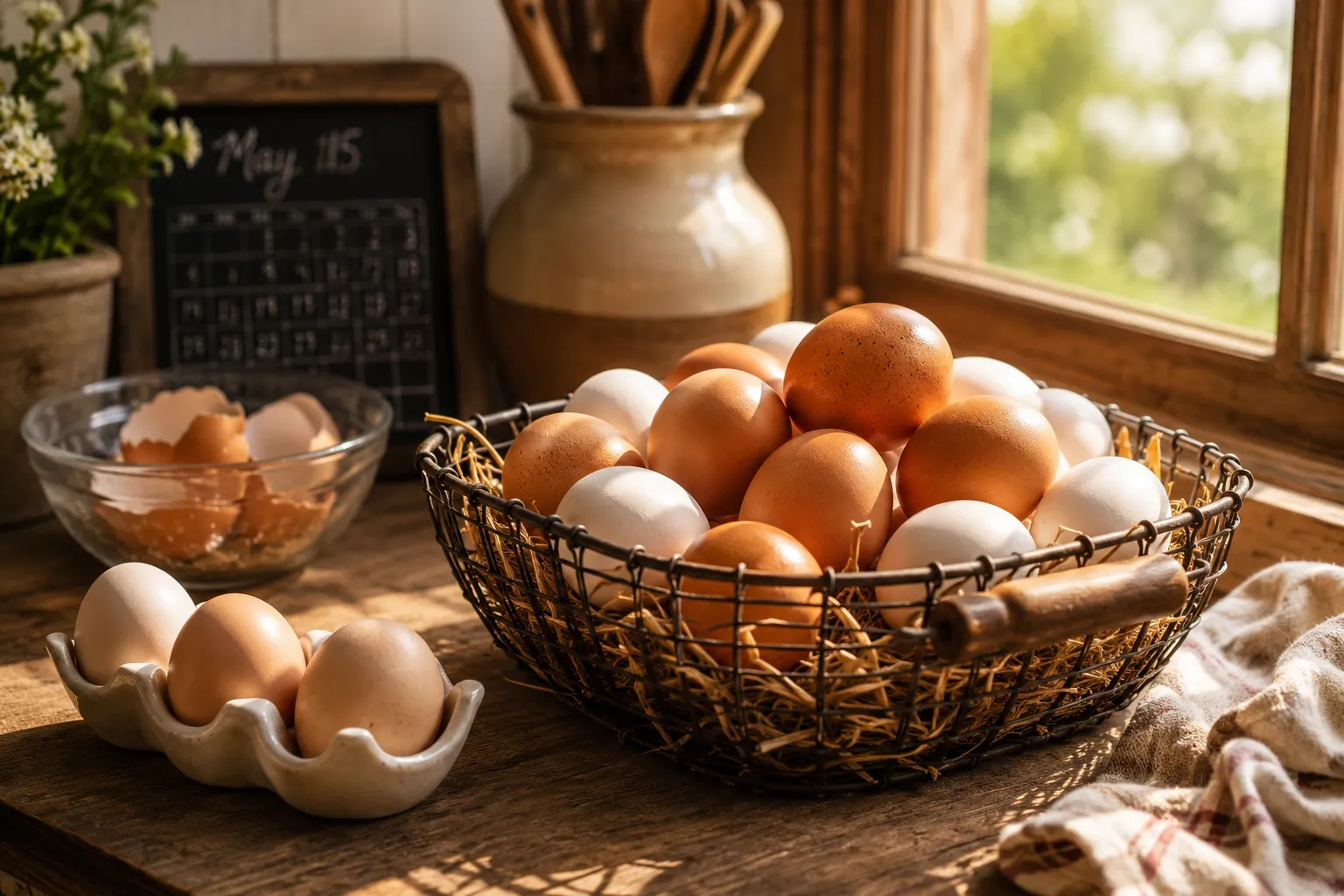
Fresh eggs from backyard chickens can last 3-5 weeks at room temperature if unwashed (with the protective bloom intact) or up to 3 months when refrigerated. Washed eggs must be refrigerated immediately and typically last 4-5 weeks. The key factors affecting egg longevity are whether the bloom has been removed, storage temperature, and humidity levels.
Key Takeaways
- Unwashed eggs with intact bloom last 3-5 weeks at room temperature and up to 3 months refrigerated
- Washed eggs must be refrigerated and last about 4-5 weeks in the fridge
- The bloom (cuticle) is a natural protective coating that seals the porous eggshell against bacteria
- Store-bought eggs are pre-washed and last 3-5 weeks refrigerated from purchase date
- The float test reliably indicates freshness: fresh eggs sink, old eggs float
- Proper storage means pointed-end down in a cool, consistent environment
- Room temperature storage only works for unwashed eggs in climates below 70°F
- Hard-boiled eggs last just 1 week refrigerated, less than fresh eggs
- Eating old eggs risks food poisoning from Salmonella bacteria
- European eggs often remain unrefrigerated because hens are vaccinated and eggs aren’t washed
How Long Do Fresh Eggs Last Unrefrigerated?
Fresh eggs with their natural bloom intact can last 2-3 weeks at room temperature in moderate climates (below 70°F), and some chicken keepers report up to 4-5 weeks in consistently cool conditions. The bloom, also called the cuticle, is a protective coating the hen deposits on the egg just before laying that seals the shell’s pores against bacteria and moisture loss.
Key factors for room temperature storage:
- Temperature consistency matters most, fluctuating temperatures cause condensation that can pull bacteria through the shell
- Keep eggs below 70°F, warmer temperatures accelerate aging and bacterial growth
- Store in a cool, dry spot away from direct sunlight and heat sources
- Never wash eggs you plan to store unrefrigerated, washing removes the protective bloom
- Use oldest eggs first by dating them with a pencil when collected
Common mistake: Many backyard chicken keepers leave eggs on the counter in summer when kitchen temperatures regularly exceed 75°F. At these temperatures, eggs age rapidly and the risk of bacterial penetration increases significantly. If your home stays warm, refrigeration is the safer choice even for unwashed eggs.
How Long Do Farm Fresh Eggs Last in the Fridge?
Farm fresh eggs stored in the refrigerator last 2-3 months when unwashed with bloom intact, and 4-5 weeks after washing. Refrigeration dramatically slows the aging process and bacterial growth, making it the safest storage method regardless of whether eggs have been washed.
Refrigeration best practices:
- Store eggs in their carton rather than the refrigerator door to minimize temperature fluctuations
- Keep temperature at 35-40°F for optimal preservation
- Place eggs pointed-end down so the air cell stays at the top and the yolk remains centered
- Don’t wash until ready to use if eggs came to you unwashed
- Mark collection dates on cartons to track age
The extended shelf life of refrigerated unwashed eggs makes this the preferred method for most backyard chicken keepers, especially those with productive flocks. Refrigeration also provides peace of mind about food safety, particularly during warm weather or if you’re unsure about storage conditions.
Do Unwashed Eggs Last Longer Than Washed Eggs?
Yes, unwashed eggs last significantly longer than washed eggs because the natural bloom creates a protective barrier against bacteria and moisture loss. Unwashed eggs can remain fresh for 2-3 weeks at room temperature or up to 3 months refrigerated, while washed eggs must be refrigerated immediately and typically last only 4-5 weeks.
Why the bloom matters:
- Seals approximately 17,000 pores in each eggshell
- Blocks Salmonella and other bacteria from entering the egg
- Prevents moisture loss that causes eggs to age and shrink
- Maintains egg quality by keeping the white thick and the yolk firm
When you should wash eggs:
- Visible dirt, manure, or debris on the shell
- Cracked or damaged shells (use immediately after washing)
- Preparing eggs for customers who expect clean shells
- Before cracking eggs for cooking (wash just before use)
Choose unwashed storage if: Your eggs are clean, you have proper storage conditions, and you want maximum shelf life. Many chicken keepers use a dry brush or fine sandpaper to remove light debris without compromising the bloom.
How to Tell If Fresh Eggs Have Gone Bad
The float test is the most reliable method to check egg freshness: place the egg in a bowl of water, and fresh eggs sink flat while old eggs float due to the enlarged air cell. You can also crack the egg onto a plate and check for off-odors, watery whites, or flat yolks, all of which indicate spoilage.
The float test explained:
- Fresh (0-2 weeks): Egg sinks and lies flat on the bottom
- Still good (3-4 weeks): Egg sinks but stands on its pointed end
- Questionable (5+ weeks): Egg floats partially or tilts upward
- Bad: Egg floats completely to the surface
Additional freshness indicators:
- Smell test: Crack the egg into a bowl, any sulfur or rotten odor means discard immediately
- Visual inspection: Fresh eggs have thick, gel-like whites and round, high yolks; old eggs have watery whites and flat yolks
- Shell condition: Slimy or powdery shells indicate bacterial growth
- Candling: Hold egg up to a bright light, fresh eggs appear mostly opaque, old eggs show large air cells and visible movement
When in doubt, throw it out. The cost of a single egg is never worth the risk of food poisoning.
How Long Do Store-Bought Eggs Last Compared to Farm Eggs?
Store-bought eggs typically last 3-5 weeks from the purchase date when refrigerated, while farm-fresh unwashed eggs can last up to 3 months refrigerated or 2-3 weeks at room temperature. The difference comes down to processing: commercial eggs are washed, removing the protective bloom, while farm eggs often retain this natural coating.
Key differences:
| Factor | Store-Bought Eggs | Farm Fresh Eggs |
|---|---|---|
| Washing | Always washed and sanitized | Often unwashed |
| Bloom | Removed during processing | Intact if unwashed |
| Age at purchase | Often 2-4 weeks old | Can be same-day fresh |
| Storage requirement | Must refrigerate | Flexible if unwashed |
| Typical shelf life | 3-5 weeks refrigerated | 2-3 months refrigerated (unwashed) |
Understanding sell-by dates: The date stamped on store-bought egg cartons is typically 30 days from packing, but eggs often remain safe to eat for 3-5 weeks beyond that date if properly refrigerated. The Julian date (a three-digit number representing the day of the year) tells you when eggs were packed.
Choose farm eggs if: You want maximum freshness, prefer unwashed eggs with natural protection, and have access to a reliable local source. Choose store-bought if you need consistent availability, prefer pre-washed eggs, or don’t have local farm options.
Can You Eat Eggs After the Expiration Date?
Yes, eggs are typically safe to eat for 3-5 weeks past the expiration date if they’ve been continuously refrigerated and pass the float test and smell test. The “expiration” or “sell-by” date on egg cartons is a quality guideline, not a safety deadline, and properly stored eggs remain edible well beyond this date.
Understanding egg dates:
- Sell-by date: When stores should remove eggs from shelves (usually 30 days after packing)
- Best-by date: Peak quality window, not a safety cutoff
- Expiration date: Conservative estimate for optimal freshness
- Pack date: Julian date (001-365) showing when eggs were packaged
Safety guidelines for older eggs:
- Always perform the float test before using eggs past their date
- Crack each egg into a separate bowl and smell before adding to recipes
- Use older eggs for thoroughly cooked dishes (hard-boiled, baked goods) rather than soft-scrambled or sunny-side up
- Discard any egg with an off-odor, unusual color, or slimy texture
Common mistake: Throwing away perfectly good eggs based solely on the printed date. Many chicken keepers and frugal cooks safely use refrigerated eggs 6-8 weeks past the carton date after confirming freshness through testing.
How to Store Fresh Eggs to Make Them Last Longer
Store unwashed eggs in the refrigerator, pointed-end down, in their original carton to maximize shelf life up to 3 months. For room temperature storage, keep unwashed eggs in a cool spot (below 70°F) away from sunlight and use within 2-3 weeks. Never wash eggs until immediately before use.
Optimal storage setup:
- Location: Middle or back of refrigerator (not the door) where temperature stays most consistent
- Container: Original carton or egg skelter to protect shells and prevent odor absorption
- Orientation: Pointed end down keeps the air cell at the top and yolk centered
- Temperature: 35-40°F for refrigeration, below 70°F for room temperature
- Humidity: Moderate humidity prevents excessive moisture loss
Storage methods for different situations:
For maximum shelf life (3 months): Refrigerate unwashed eggs immediately after collection, store in cartons, maintain consistent temperature.
For convenience (2-3 weeks): Keep unwashed eggs in a cool kitchen spot in a wire basket or egg skelter for easy access.
For washed eggs (4-5 weeks): Refrigerate immediately after washing, store in cartons, use within a month.
Advanced preservation: Some chicken keepers use water glassing (sodium silicate solution) or mineral oil coating to preserve eggs for 6-12 months, though these methods require specific techniques and aren’t necessary for most backyard flocks.
Do Fresh Eggs Need to Be Refrigerated Right Away?
No, fresh unwashed eggs with intact bloom don’t need immediate refrigeration and can sit at room temperature for several hours or even days without spoiling. However, refrigerating eggs soon after collection extends their shelf life significantly and is the safest practice, especially in warm weather or if you’re unsure about storage conditions.
When immediate refrigeration matters:
- Washed eggs: Must be refrigerated within 2 hours of washing
- Hot weather: Temperatures above 75°F accelerate aging and bacterial growth
- Cracked or damaged shells: Refrigerate and use within 2 days
- Uncertain bloom status: If eggs might have been washed or the bloom compromised
When you can wait:
- Clean, unwashed eggs in cool weather (below 70°F)
- Eggs you plan to sell or give away within a few days
- Eggs collected during the day that you’ll process in the evening
Best practice for backyard chicken keepers: Collect eggs daily, brush off any debris without washing, and refrigerate within 24 hours. This simple routine maximizes shelf life while giving you flexibility in your daily schedule.
What Happens If You Eat Old Eggs?
Eating old or spoiled eggs can cause food poisoning from Salmonella bacteria, resulting in symptoms like nausea, vomiting, diarrhea, fever, and abdominal cramps that typically appear 6-72 hours after consumption. While properly stored old eggs that pass freshness tests are usually safe, truly spoiled eggs pose serious health risks.
Food poisoning symptoms:
- Stomach cramps and abdominal pain
- Diarrhea (sometimes bloody)
- Nausea and vomiting
- Fever and chills
- Headache and muscle aches
- Symptoms lasting 4-7 days in most cases
Risk factors that increase danger:
- Young children and infants have developing immune systems
- Pregnant women risk passing infection to the fetus
- Elderly adults may experience severe complications
- Immunocompromised individuals face higher risk of serious illness
The difference between old and spoiled: An egg that’s 6-8 weeks old but properly refrigerated and passes the float test is “old” but typically safe. An egg with a foul odor, slimy shell, or that floats completely is “spoiled” and should never be eaten.
Prevention is simple: Test questionable eggs before use, cook eggs thoroughly (160°F internal temperature), and trust your senses, if an egg smells off or looks unusual, discard it.
How Long Do Hard-Boiled Fresh Eggs Last?
Hard-boiled eggs last only 1 week in the refrigerator, significantly less than fresh eggs, because boiling removes the protective bloom and makes the shell more porous. Store hard-boiled eggs in their shells in a covered container and refrigerate within 2 hours of cooking.
Why hard-boiled eggs spoil faster:
- Cooking removes the bloom’s protective barrier
- Heat makes the shell more porous and permeable
- Peeled eggs last only 5 days because the shell protection is gone
- Bacteria can penetrate more easily after cooking
Storage tips for hard-boiled eggs:
- Keep shells on until ready to eat
- Store in a covered container (not the egg carton)
- Mark the container with the cooking date
- Keep refrigerated at 35-40°F
- Don’t store near strong-smelling foods (eggs absorb odors easily)
Signs of spoiled hard-boiled eggs:
- Sulfur or rotten smell when peeled
- Slimy or chalky shell texture
- Gray or green ring around the yolk (indicates overcooking, not spoilage, but affects quality)
- Unusual discoloration of the white or yolk
Meal prep tip: If you’re hard-boiling eggs for the week, cook them on Sunday and use by the following Saturday. For longer storage, consider pickling hard-boiled eggs, which extends shelf life to 3-4 months refrigerated.
Why Do European Eggs Last Longer Without Refrigeration?
European eggs last longer unrefrigerated primarily because hens are vaccinated against Salmonella and eggs aren’t washed, leaving the protective bloom intact. This combination of disease prevention and natural protection allows eggs to be safely stored at room temperature for 2-3 weeks, a common practice throughout Europe.
Key differences in European egg production:
- Mandatory Salmonella vaccination for laying hens in the EU since 1990s
- Eggs are not washed during processing, preserving the bloom
- Room temperature distribution maintains consistent temperature (no cold chain)
- Different food safety philosophy focuses on prevention at the source rather than sanitization
The U.S. approach:
- Eggs are washed and sanitized to remove surface contamination
- Vaccination is voluntary, not mandatory
- Refrigeration compensates for bloom removal
- Cold chain maintained from farm to consumer
Neither system is inherently better, both achieve low rates of egg-related illness through different methods. The U.S. system prioritizes surface cleanliness and refrigeration, while the European system emphasizes disease prevention and natural protection.
For backyard chicken keepers: You can adopt elements of both approaches by keeping your flock healthy, collecting eggs promptly, storing unwashed eggs with bloom intact, and refrigerating for maximum shelf life. This hybrid approach offers the best of both worlds.
Common Mistakes When Storing Fresh Eggs
The most common storage mistakes include washing eggs before storage (removing protective bloom), storing eggs in the refrigerator door (temperature fluctuates), and keeping eggs past their prime without testing freshness. These errors reduce shelf life and increase food safety risks.
Top storage mistakes to avoid:
Mistake #1: Washing eggs immediately after collection
- Removes the protective bloom
- Makes refrigeration mandatory
- Reduces shelf life by 50% or more
- Solution: Brush off debris or spot-clean with sandpaper; wash only before use
Mistake #2: Storing eggs in the refrigerator door
- Temperature fluctuates with every opening
- Causes condensation that can pull bacteria through shell
- Accelerates aging
- Solution: Store in the main body of the fridge in original carton
Mistake #3: Mixing old and new eggs without dating
- Can’t track age or use oldest first
- Risk of using spoiled eggs
- Wastes fresh eggs by discarding whole batches
- Solution: Date cartons with collection date using pencil
Mistake #4: Storing eggs pointed-end up
- Air cell moves to the side
- Yolk can touch the shell membrane
- Reduces quality and shelf life
- Solution: Always store pointed-end down
Mistake #5: Keeping eggs at room temperature in warm climates
- Accelerates aging dramatically
- Increases bacterial growth risk
- Reduces safe storage time to days instead of weeks
- Solution: Refrigerate if your home stays above 70°F
Mistake #6: Not testing questionable eggs before use
- Risk of food poisoning
- Wastes ingredients if egg is bad
- Ruins recipes with off-flavors
- Solution: Always float-test and smell-test older eggs
How Long Do Fresh Eggs Last at Room Temperature with Bloom Intact?
Fresh eggs with intact bloom last 2-3 weeks at room temperature in cool conditions (below 70°F), and up to 4-5 weeks in consistently cool environments around 60°F. The bloom’s protective coating prevents bacterial penetration and moisture loss, making room temperature storage viable for unwashed eggs in appropriate climates.
Factors affecting room temperature shelf life:
- Temperature consistency: Stable cool temperatures (60-70°F) are better than fluctuating conditions
- Humidity levels: Moderate humidity (60-70%) prevents excessive moisture loss
- Air circulation: Good ventilation prevents mold and bacterial growth
- Cleanliness: Eggs with minimal debris last longer
- Collection frequency: Daily collection ensures eggs don’t sit in nesting boxes
Optimal room temperature storage conditions:
- Cool pantry, basement, or cellar (60-68°F)
- Away from direct sunlight and heat sources
- In a wire basket or egg skelter for air circulation
- Pointed-end down for best quality
- Used in order of collection (oldest first)
When room temperature storage isn’t safe:
- Summer temperatures regularly exceed 75°F
- High humidity environments (above 80%)
- Homes without air conditioning in warm climates
- Eggs with compromised or questionable bloom
- Cracked or damaged shells
The bottom line: Room temperature storage works well for unwashed eggs in cool climates and gives you the flexibility to keep eggs accessible on the counter. However, refrigeration always extends shelf life further and provides an extra margin of safety, making it the preferred choice for most backyard chicken keepers.
FAQ
How can you tell if an egg is still good? Use the float test: place the egg in a bowl of water. Fresh eggs sink flat, slightly older but still good eggs sink but stand upright, and bad eggs float. Also crack the egg into a bowl and check for any sulfur or rotten smell, which indicates spoilage.
Should I wash my fresh eggs before storing them? No, don’t wash eggs before storage. Washing removes the protective bloom that keeps bacteria out and moisture in. Only wash eggs immediately before cracking them for cooking. If eggs are dirty, use a dry brush or fine sandpaper to remove debris without compromising the bloom.
Can I freeze fresh eggs for long-term storage? Yes, you can freeze eggs for up to 12 months. Crack eggs into a bowl, beat until blended, and pour into freezer-safe containers or ice cube trays. Never freeze eggs in their shells as they’ll expand and crack. Thaw frozen eggs in the refrigerator and use in cooked dishes.
Why do my farm eggs have different colored yolks than store eggs? Yolk color depends entirely on the hen’s diet, not freshness or nutritional value. Hens eating grass, bugs, and plants with carotenoids produce deep orange yolks, while hens on grain-only diets produce pale yellow yolks. Both are equally nutritious and fresh.
Do eggs need to be at room temperature for baking? Room temperature eggs blend more easily into batters and create better texture in baked goods. Take refrigerated eggs out 30-60 minutes before baking, or place them in warm (not hot) water for 5-10 minutes to bring them to room temperature quickly.
How long do duck or quail eggs last compared to chicken eggs? Duck and quail eggs follow the same storage guidelines as chicken eggs. Unwashed eggs with intact bloom last 2-3 weeks at room temperature or up to 3 months refrigerated. Duck eggs have slightly thicker shells and may last a few days longer than chicken eggs.
Can you eat eggs that have been left out overnight? Unwashed eggs with intact bloom can safely sit out overnight at room temperature below 70°F. Washed eggs or eggs in warm conditions (above 75°F) should not be left out more than 2 hours. When in doubt, refrigerate eggs and perform freshness tests before using.
What’s the white stringy thing in fresh eggs? The chalazae are twisted strands of egg white that anchor the yolk in the center of the egg. Prominent chalazae are actually a sign of freshness, they become less visible as eggs age. They’re completely safe to eat and don’t need to be removed.
Do brown eggs last longer than white eggs? No, shell color doesn’t affect shelf life. Brown and white eggs last equally long when stored properly. Shell color is determined by the hen’s breed, not the egg’s quality, freshness, or storage characteristics.
How do you store eggs if you don’t have a refrigerator? Store unwashed eggs with intact bloom in a cool, dark place below 70°F such as a basement, cellar, or cool pantry. Use within 2-3 weeks. For longer preservation without refrigeration, consider water glassing (preserving in sodium silicate solution) or coating with mineral oil.
Can you tell if an egg is fertilized by looking at it? You cannot tell if an egg is fertilized by looking at the shell or even by cracking it open unless you know what to look for (a small white bullseye on the yolk). Fertilized eggs are safe to eat and taste identical to unfertilized eggs. They have the same shelf life when stored properly.
Why do some eggs have blood spots? Blood spots are caused by the rupture of small blood vessels during egg formation and are completely safe to eat. They don’t indicate fertilization or affect freshness. You can remove the spot with a spoon if desired, or simply cook the egg as normal.
Conclusion
Understanding how long fresh eggs last empowers backyard chicken keepers to maximize their flock’s productivity while ensuring food safety. The key takeaway is simple: unwashed eggs with intact bloom offer remarkable flexibility, lasting 2-3 weeks at room temperature or up to 3 months refrigerated, while washed eggs require refrigeration and have a shorter 4-5 week shelf life.
Your action plan for egg storage success:
- Collect eggs daily to prevent damage and maintain quality
- Keep eggs unwashed until immediately before use to preserve the protective bloom
- Refrigerate for maximum shelf life, it’s the safest choice for most situations
- Store pointed-end down in cartons away from the refrigerator door
- Date your cartons and use oldest eggs first
- Test questionable eggs using the float test and smell test before cooking
- Trust your senses, when in doubt, throw it out
Whether you’re managing a small backyard flock or a larger homestead operation, proper egg storage ensures you’ll enjoy fresh, safe eggs for weeks or even months after collection. The natural protection of the bloom, combined with cool storage temperatures, gives farm-fresh eggs a significant advantage over store-bought alternatives.
Start implementing these storage practices today, and you’ll reduce waste, improve food safety, and get the most value from your hardworking hens. Your future self (and your breakfast plate) will thank you.