
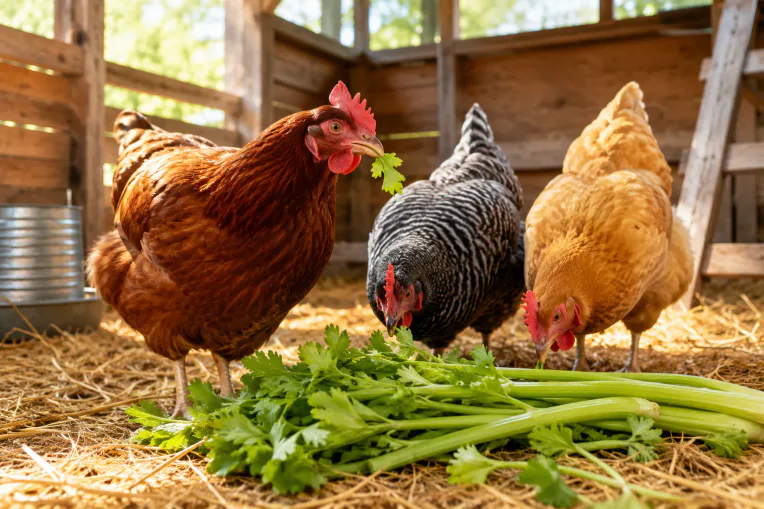
Quick Answer: Yes, chickens can safely eat celery, including the stalks, leaves, and even the base. Celery provides hydration, fiber, and essential vitamins like A and K, making it a healthy treat for your flock. However, you should chop celery into small pieces (about half an inch) to prevent the stringy fibers from causing choking or digestive blockages, and feed it in moderation as part of a balanced diet.
Key Takeaways
- Celery is safe for chickens when properly prepared by chopping into small pieces to avoid choking hazards from stringy fibers
- All parts are edible: chickens can eat celery stalks, leaves, and the base without harm
- Nutritional benefits include hydration (95% water content), vitamins A, K, and C, plus minerals like potassium
- Portion control matters: celery should make up no more than 10% of daily diet, offered as a treat 2-3 times per week
- Baby chicks under 3-4 weeks should not eat celery due to choking risk and underdeveloped digestive systems
- Preparation is key: always chop celery into pieces no larger than half an inch, or hang whole stalks for pecking
- Raw is better than cooked: chickens prefer raw celery, which retains more nutrients and natural crunch
- Individual preferences vary: some chickens love celery while others ignore it, and both reactions are completely normal
- Avoid toxic vegetables: never feed chickens raw potatoes, green tomatoes, onions, or avocado, which are genuinely dangerous
Is Celery Safe for Chickens to Eat?
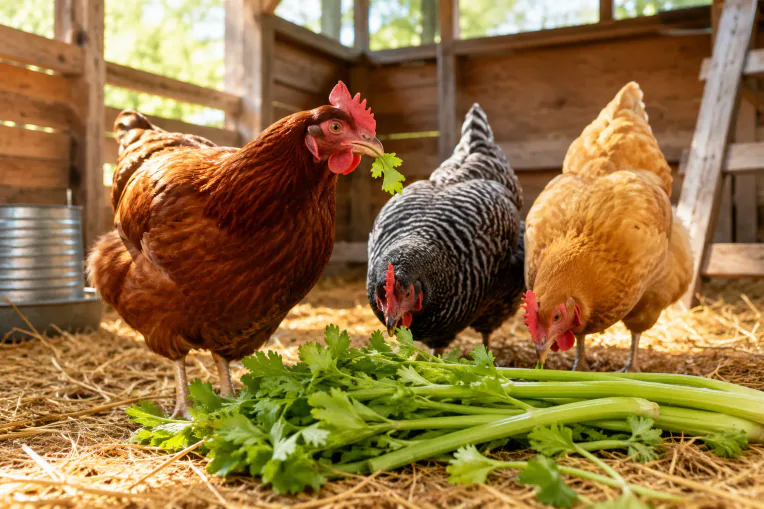
Celery is completely safe for chickens when prepared correctly. The vegetable contains no toxic compounds and offers valuable nutrients including vitamins A, K, and C, along with minerals like potassium and folate. The primary safety concern involves the long, fibrous strings that run through celery stalks, which can wrap around a chicken’s crop or intestines if swallowed in large pieces.
Why celery gets a safety warning:
- The stringy fibers can create blockages in the digestive tract if chickens swallow long strands
- Chickens don’t chew food the way mammals do; they peck and swallow pieces whole
- The crop (a pouch in the throat where food is stored) can become impacted with tangled celery strings
- Proper preparation eliminates these risks entirely
What makes celery beneficial:
- High water content (about 95%) helps keep chickens hydrated, especially in hot weather
- Low calorie density means chickens can enjoy it without weight gain
- Natural fiber supports healthy digestion when given in appropriate amounts
- Antioxidants like flavonoids support overall immune health
Choose celery if you want a hydrating, low-calorie treat that adds variety to your flock’s diet. Skip it if you’re not willing to take the time to chop it properly, as whole stalks pose genuine choking risks.
Can Chickens Eat Celery Leaves and Stalks?
Chickens can safely eat both celery leaves and stalks, and many chickens actually prefer the tender leaves over the tougher stalks. The leaves contain higher concentrations of vitamins A and C compared to the stalks, making them nutritionally superior. The stalks provide more fiber and water content, offering different benefits.
Celery leaves:
- More nutrient-dense than stalks
- Softer texture that’s easier for chickens to eat
- No stringy fibers to worry about
- Can be fed whole or chopped without safety concerns
Celery stalks:
- Require chopping to prevent choking hazards
- Provide satisfying crunch that chickens enjoy
- Higher water content for hydration
- Must be cut into small pieces (half-inch or smaller)
The celery base:
- The white bottom portion is safe and edible
- Often contains more concentrated flavor
- Should still be chopped into manageable pieces
- Some chickens find it slightly bitter
Don’t waste any part of the celery plant when feeding your flock. The entire vegetable from top to bottom is safe and nutritious when properly prepared.
How to Prepare Celery for Chickens
Proper preparation is the single most important factor in safely feeding celery to chickens. Always chop celery stalks into pieces no larger than half an inch to eliminate choking hazards from the stringy fibers. You can also remove the strings manually by peeling them away with a vegetable peeler or knife, though chopping is faster and equally effective.
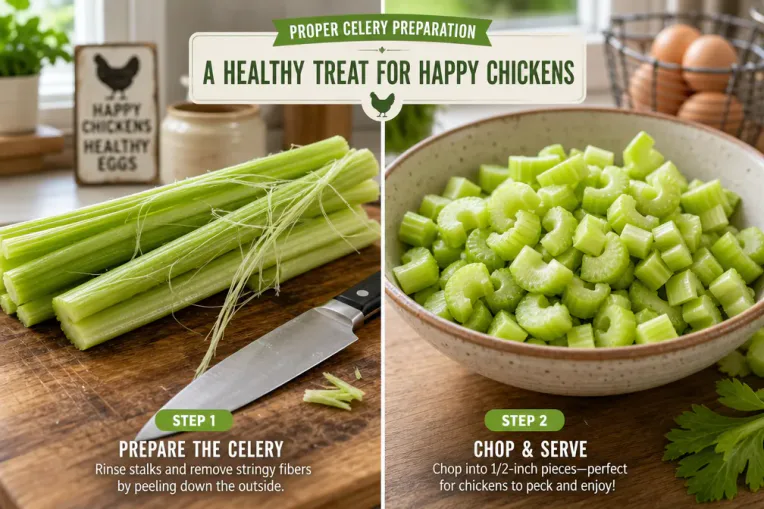
Step-by-step preparation method:
- Wash thoroughly under running water to remove dirt, pesticides, and bacteria
- Trim the ends and remove any brown or wilted portions
- Chop stalks crosswise into pieces about ½ inch long (the shorter, the safer)
- Separate leaves from stalks if desired (leaves can be left whole)
- Mix with other treats or scatter in the run to encourage foraging behavior
Alternative preparation methods:
- Hanging method: Tie whole celery stalks with twine and hang them at chicken head height so birds can peck at them (the pecking action naturally creates small pieces)
- Freezing: Chop celery and freeze it in ice cube trays with water for a cooling summer treat
- Mashing: Blend celery into a mash with other vegetables for sick or elderly chickens who have trouble eating solid foods
Common mistake to avoid: Never toss whole celery stalks into the coop and assume chickens will naturally break them down safely. Hungry chickens will attempt to swallow large pieces, creating serious health risks.
Can Celery Strings Choke Chickens?
Yes, the stringy fibers in celery stalks can cause choking or crop impaction in chickens if the celery is not properly prepared. These tough, fibrous strings don’t break down easily in a chicken’s digestive system and can tangle together, forming blockages in the crop or intestines. This is why chopping celery into small pieces is non-negotiable for chicken safety.
How celery strings cause problems:
- Long fibers wrap around themselves in the crop, creating a tangled mass
- The crop becomes impacted and unable to pass food to the stomach
- Chickens may stop eating, appear lethargic, or show a swollen crop area
- In severe cases, veterinary intervention or crop surgery may be needed
Warning signs of crop impaction:
- Visibly swollen or pendulous crop that doesn’t empty overnight
- Sour smell coming from the chicken’s beak
- Loss of appetite and lethargy
- Regurgitation or difficulty swallowing
Prevention is simple:
- Always chop celery into pieces ½ inch or smaller
- Remove visible strings with a vegetable peeler if you prefer extra caution
- Monitor your flock after introducing any new food
- Provide grit (small stones) to help chickens grind fibrous foods in their gizzard
If you notice a chicken with a swollen crop that doesn’t empty by morning, isolate the bird, remove food (but not water), and consult a veterinarian experienced with poultry. Crop impaction requires prompt treatment to prevent serious complications.
How Much Celery Can Chickens Eat Per Day?
Chickens should eat celery only as an occasional treat, making up no more than 10% of their total daily diet. For an average-sized laying hen, this translates to roughly 1-2 tablespoons of chopped celery, offered 2-3 times per week rather than daily. The bulk of a chicken’s diet (90%) should come from a nutritionally complete layer feed formulated to meet all their dietary requirements.
Portion guidelines by chicken size:
- Standard breeds (Rhode Island Red, Plymouth Rock): 1-2 tablespoons chopped celery per bird
- Bantam breeds (Silkie, Sebright): ½-1 tablespoon chopped celery per bird
- Large breeds (Brahma, Jersey Giant): 2-3 tablespoons chopped celery per bird
Why moderation matters:
- Too many treats dilute the balanced nutrition from layer feed
- Excess celery can cause watery droppings due to high water content
- Chickens may fill up on low-calorie treats and ignore their protein-rich feed
- Egg production can decline if hens don’t get adequate protein and calcium
Feeding frequency recommendations:
- 2-3 times per week: Ideal frequency for celery as a treat
- Not daily: Daily feeding can create nutritional imbalances
- Rotate treats: Offer different vegetables throughout the week for variety
Choose celery as one of several rotating treats rather than a daily staple. If you notice watery droppings or decreased egg production after introducing celery, reduce the frequency or portion size.
Can Baby Chicks Eat Celery?
Baby chicks under 3-4 weeks old should not eat celery due to choking risks and their underdeveloped digestive systems. Young chicks have tiny throats and crops that cannot safely handle fibrous foods, even when chopped small. Additionally, chicks require a precisely balanced starter feed with higher protein content (18-20%) to support rapid growth, and treats can disrupt this critical nutritional balance.
Age-based feeding guidelines:
- 0-3 weeks: No celery or treats; only chick starter feed and water
- 4-8 weeks: Introduce finely minced celery (smaller than adult portions) in tiny amounts
- 8+ weeks: Can eat celery prepared the same way as adult chickens
Why young chicks need to wait:
- Their crops and digestive tracts are still developing
- They need maximum nutrition from starter feed for healthy growth
- Even small pieces of celery can cause blockages in tiny systems
- Treats can lead to nutritional deficiencies during critical growth periods
When you do introduce celery to older chicks:
- Wait until they’re at least 4 weeks old
- Chop even smaller than you would for adults (¼ inch pieces)
- Offer only a tiny amount (½ teaspoon per chick)
- Ensure they have access to chick grit to help grind the fiber
Common mistake: Well-meaning chicken keepers often want to give chicks treats too early. Resist the urge and focus on providing high-quality starter feed until chicks are mature enough to handle variety safely.
Celery vs Lettuce for Chickens: Which Is Better?
Both celery and lettuce are safe, hydrating treats for chickens, but celery offers slightly more nutritional value with higher levels of vitamins A and K, plus more fiber. Lettuce (especially dark leafy varieties like romaine) provides more folate and iron, while iceberg lettuce offers minimal nutrition beyond water. The “better” choice depends on your goals: choose celery for fiber and vitamins, or dark lettuce for iron and easier preparation.
Nutritional comparison:
| Nutrient | Celery (per 100g) | Romaine Lettuce (per 100g) | Iceberg Lettuce (per 100g) |
|---|---|---|---|
| Water content | 95% | 95% | 96% |
| Vitamin A | High | Very high | Low |
| Vitamin K | High | Very high | Moderate |
| Fiber | 1.6g | 2.1g | 1.2g |
| Preparation needed | Must chop | Can tear by hand | Can tear by hand |
Choose celery if:
- You want a crunchy treat that encourages pecking behavior
- You’re looking for a low-calorie option with decent fiber
- You have time to chop it properly
- Your chickens enjoy variety in texture
Choose lettuce if:
- You want quick, no-prep feeding (just tear and toss)
- You’re feeding baby chicks over 4 weeks (softer texture)
- You want to boost iron intake
- Your chickens are picky about fibrous foods
Best practice: Rotate both vegetables along with other safe options like cucumbers, squash, and leafy greens to provide maximum variety and prevent boredom. No single treat should dominate your chickens’ diet.
Do Chickens Like Eating Celery?
Chicken preferences for celery vary widely by individual bird and flock. Some chickens enthusiastically devour celery, especially the tender leaves, while others completely ignore it in favor of other treats. This variation is completely normal and doesn’t indicate any health problem. Chickens have individual taste preferences just like humans, and factors like breed, age, and previous diet exposure influence their food choices.
Factors that affect celery acceptance:
- Texture preference: Some chickens prefer soft foods and avoid crunchy vegetables
- Flavor sensitivity: Celery has a mild but distinct taste that some birds find unappealing
- Novelty: Chickens raised on varied diets are more likely to try new foods
- Flock dynamics: If dominant hens eat celery, others often follow their lead
- Preparation method: Chickens may prefer leaves over stalks, or vice versa
How to encourage picky eaters:
- Mix chopped celery with favorite treats like mealworms or corn
- Offer celery leaves first, as they’re more palatable than stalks
- Hang whole stalks to trigger natural pecking instincts
- Be patient; it may take several exposures before chickens try new foods
- Don’t force it; some chickens will simply never like celery
When to stop offering celery:
If your entire flock consistently ignores celery after multiple attempts, there’s no reason to keep offering it. Focus on vegetables they do enjoy, such as cucumbers, tomatoes, or leafy greens. Forcing unwanted food creates waste and doesn’t benefit your chickens.
Can Chickens Eat Celery Every Day or Just as a Treat?
Celery should be fed only as an occasional treat, not as a daily food. While celery is safe and nutritious, feeding it every day can lead to nutritional imbalances because chickens may fill up on low-calorie, low-protein celery instead of eating their complete layer feed. Treats of any kind, including celery, should never exceed 10% of a chicken’s total daily diet, with the remaining 90% coming from formulated feed.
Why daily feeding is problematic:
- Protein deficiency: Layer feed contains 16-18% protein; celery has less than 1%
- Calcium shortage: Laying hens need high calcium for strong eggshells; celery provides minimal calcium
- Reduced egg production: Hens eating too many treats often lay fewer or smaller eggs
- Watery droppings: Daily celery consumption can cause persistently loose stools due to high water content
Optimal feeding schedule:
- 2-3 times per week: Ideal frequency for celery treats
- Rotate with other vegetables: Offer different treats on different days
- Morning feeding: Give treats after chickens have eaten their layer feed
- Seasonal adjustment: Increase hydrating treats like celery during hot summer months
Signs you’re feeding too much celery:
- Chickens leave layer feed uneaten in favor of treats
- Egg production declines
- Eggshells become thin or soft
- Droppings are consistently watery rather than formed
Treat celery like dessert for your flock: enjoyable in moderation but problematic if it replaces nutritious main meals. If you want to offer daily variety, rotate among many different safe vegetables rather than feeding the same treat every day.
What Vegetables Are Toxic to Chickens?

Several common vegetables are genuinely toxic to chickens and should never be fed to your flock. The most dangerous include raw or green potatoes (which contain solanine), onions and garlic in large quantities (which cause anemia), raw dried beans (which contain phytohaemagglutinin), and avocado (which contains persin). Additionally, the green parts of tomato and pepper plants, rhubarb leaves, and moldy or spoiled vegetables of any kind pose serious health risks.
Vegetables that are toxic to chickens:
- Raw potatoes and potato peels: Contain solanine, especially when green or sprouted; causes neurological problems and digestive upset
- Green tomatoes: Unripe tomatoes and all tomato plant leaves/stems contain solanine (ripe red tomatoes are safe)
- Onions and garlic: Large amounts cause hemolytic anemia by destroying red blood cells; small amounts occasionally are debated but best avoided
- Avocado: Skin, pit, and flesh contain persin, which is toxic to birds and can cause heart damage
- Raw dried beans: Contain phytohaemagglutinin (kidney beans especially); cooked beans are safe
- Rhubarb leaves: High in oxalic acid, which is toxic (rhubarb stalks in small amounts are safe)
Parts of common plants that are toxic:
- Tomato and pepper plant leaves and stems (fruits are safe when ripe)
- Potato plant leaves and flowers
- Eggplant leaves and flowers (ripe eggplant fruit is safe)
Safe vegetables for comparison:
- Celery (all parts, when chopped)
- Cucumbers
- Squash and pumpkins
- Carrots
- Leafy greens (lettuce, kale, spinach, cabbage)
- Ripe tomatoes
- Cooked sweet potatoes
- Broccoli and cauliflower
- Peas and corn
What to do if your chicken eats toxic vegetables:
- Remove the toxic food source immediately
- Isolate the affected bird if showing symptoms
- Provide fresh water
- Contact a veterinarian experienced with poultry
- Monitor for symptoms like lethargy, difficulty breathing, or unusual droppings
When in doubt about a new vegetable, research it specifically before offering it to your flock. The general rule: if it’s safe for humans to eat raw, it’s usually safe for chickens, but there are important exceptions.
My Chicken Won’t Eat Celery: Is That Normal?
Yes, it’s completely normal for some chickens to refuse celery. Chickens have individual taste preferences, and not every bird will enjoy every food offered. Some chickens prefer soft, sweet treats like berries or melon, while others avoid crunchy or fibrous vegetables like celery. This selective eating doesn’t indicate illness or nutritional deficiency as long as your chickens are eating their regular layer feed and maintaining healthy weight and egg production.
Why some chickens avoid celery:
- Texture aversion: The fibrous, stringy texture may be unappealing to some birds
- Mild flavor: Celery’s subtle taste doesn’t excite chickens who prefer sweeter or more flavorful foods
- Unfamiliarity: Chickens raised on limited diets may be suspicious of new foods
- Individual preference: Just like humans, chickens have personal likes and dislikes
When to be concerned:
- If a chicken suddenly stops eating all foods, including layer feed (indicates illness)
- If the entire flock refuses all treats but previously ate them (check for spoilage or contamination)
- If a chicken is losing weight or has stopped laying eggs (nutritional or health issue)
What to do about picky eaters:
- Don’t worry about it; focus on foods your chickens do enjoy
- Ensure they’re eating adequate layer feed (the only truly essential food)
- Try offering celery prepared differently (leaves vs. stalks, chopped vs. hanging)
- Mix celery with favorite treats to increase acceptance
- Accept that some chickens will never like certain foods
Alternative hydrating vegetables if chickens refuse celery:
- Cucumbers (usually more popular than celery)
- Watermelon
- Zucchini
- Lettuce
- Tomatoes (ripe only)
Remember that treats are optional extras, not nutritional necessities. As long as your chickens eat their complete layer feed and have access to fresh water, they’re getting everything they need regardless of whether they eat celery.
Should I Chop Celery Into Small Pieces for Chickens?
Yes, you must chop celery into small pieces (approximately half an inch or smaller) before feeding it to chickens. This is not optional or overly cautious; it’s a critical safety measure to prevent choking and crop impaction from the long, stringy fibers that run through celery stalks. Chickens do not chew food like mammals; they peck and swallow pieces whole, so large chunks of fibrous celery can tangle in their crop or digestive tract.
Proper chopping guidelines:
- Size: Cut crosswise into pieces no larger than ½ inch (smaller is safer)
- Method: Use a sharp knife and cutting board; chop perpendicular to the fibers
- Consistency: Make pieces uniform so all chickens can eat them safely
- Leaves: Can be left whole or roughly torn; they don’t pose choking hazards
Alternative to chopping:
Hang whole celery stalks at chicken head height using twine or a vegetable holder. Chickens will peck at the stalks, naturally creating small pieces as they eat. This method provides enrichment and foraging activity while maintaining safety, as the pecking action prevents large pieces from being swallowed whole.
What happens if you don’t chop celery:
- Chickens may swallow long strands of celery fibers
- Fibers can wrap around themselves in the crop, forming a tangled mass
- The crop becomes impacted and unable to pass food properly
- Affected chickens may require veterinary intervention or surgery
Time-saving tip: Chop a large batch of celery at once and freeze it in portion-sized containers. Frozen celery loses some crunch but remains safe and nutritious, and you can grab pre-portioned servings whenever you want to offer treats.
Never assume chickens will naturally break down celery into safe pieces. Taking two minutes to chop celery properly can prevent serious health emergencies.
Can Chickens Eat Cooked Celery or Only Raw?
Chickens can safely eat both raw and cooked celery, though most chickens prefer raw celery for its satisfying crunch and fresh taste. Cooking celery softens the fibrous strings, which actually reduces choking hazards, but it also diminishes some water-soluble vitamins like vitamin C and changes the texture in ways many chickens find less appealing. If you have leftover cooked celery from soups or stir-fries, it’s perfectly safe to offer to your flock.
Raw celery advantages:
- Retains maximum vitamin and mineral content
- Provides satisfying crunch that chickens enjoy
- Offers hydration from fresh water content
- Encourages natural pecking and foraging behavior
Cooked celery advantages:
- Softer texture is easier for elderly or sick chickens to eat
- Reduced fiber toughness lowers choking risk slightly
- Can be mixed into warm mashes for cold weather feeding
- Uses kitchen scraps that would otherwise be wasted
Cooking methods and safety:
- Plain cooked celery: Safe (boiled, steamed, roasted)
- Celery cooked with butter or oil: Safe in small amounts
- Celery cooked with onions or garlic: Avoid; these are toxic to chickens
- Celery in salty broths or soups: Avoid; excess salt is harmful to chickens
- Heavily seasoned celery: Avoid; spices and salt can cause digestive upset
Best practices for feeding cooked celery:
- Let it cool to room temperature before offering
- Chop into small pieces even if softened by cooking
- Avoid celery cooked with toxic ingredients (onions, garlic, excessive salt)
- Mix with other vegetables for variety
When cooked celery is the better choice:
- For chickens recovering from illness who need soft foods
- During winter when warm mashes provide comfort
- When you have kitchen scraps and want to reduce waste
- For elderly chickens with difficulty eating hard foods
Most healthy adult chickens will prefer raw celery, but cooked celery is a perfectly acceptable alternative and can be especially useful in specific situations. The most important factor remains proper preparation (chopping into small pieces) regardless of whether the celery is raw or cooked.
What Are the Health Benefits of Celery for Chickens?
Celery provides several health benefits for chickens, primarily through hydration, fiber, and essential vitamins and minerals. The vegetable is 95% water, making it an excellent hydrating treat during hot weather when chickens need extra fluids. Celery also contains vitamins A, K, and C, which support immune function, blood clotting, and vision, along with minerals like potassium that help regulate fluid balance and muscle function.
Key nutritional benefits:
- Hydration: 95% water content helps prevent dehydration, especially in summer
- Vitamin A: Supports healthy vision, immune function, and egg production
- Vitamin K: Essential for proper blood clotting and bone health
- Vitamin C: Boosts immune system (though chickens produce their own vitamin C)
- Potassium: Regulates fluid balance and supports heart and muscle function
- Folate: Supports cell division and healthy feather growth
- Antioxidants: Flavonoids and polyphenols combat oxidative stress
Digestive benefits:
- Natural fiber promotes healthy gut motility
- Low calorie content prevents weight gain
- Encourages foraging behavior and mental stimulation
When celery is especially beneficial:
- Hot weather: Extra hydration helps chickens regulate body temperature
- Molting season: Vitamins support feather regrowth
- Stress periods: Antioxidants help chickens cope with environmental stressors
- Weight management: Low-calorie treat for overweight chickens
Limitations to understand:
- Celery is not a significant protein source (chickens need 16-18% protein)
- It provides minimal calcium (laying hens need high calcium for eggshells)
- It cannot replace complete layer feed
- Benefits are modest; celery is a supplement, not a superfood
Comparison to layer feed:
Layer feed is scientifically formulated to provide complete nutrition with optimal protein, calcium, and vitamin levels. Celery offers variety and hydration but cannot match the nutritional density of quality feed. Think of celery as a healthy snack that complements a balanced diet rather than a nutritional powerhouse on its own.
Offer celery as part of a varied treat rotation alongside other vegetables, fruits, and protein sources like mealworms to give your chickens the most diverse and interesting diet possible while maintaining their primary nutrition from layer feed.
Frequently Asked Questions
Can chickens eat celery seeds?
Yes, chickens can safely eat celery seeds in small amounts. The seeds are non-toxic and contain concentrated nutrients, but they’re very small and should be offered sparingly mixed with other foods. Most chickens will ignore individual seeds in favor of larger food items.
How do I know if my chicken has crop impaction from celery?
A chicken with crop impaction will have a visibly swollen, hard, or squishy crop that doesn’t empty overnight. Other signs include loss of appetite, lethargy, sour-smelling breath, and regurgitation. If you suspect crop impaction, isolate the bird and consult an avian veterinarian immediately.
Can chickens eat celery root (celeriac)?
Yes, chickens can eat celery root when it’s chopped into small pieces. Celeriac is safe and nutritious, offering similar benefits to celery stalks. Peel the tough outer skin and chop the white flesh into small cubes before offering it to your flock.
Is organic celery better for chickens than conventional?
Organic celery reduces pesticide exposure, which is beneficial for chickens just as it is for humans. However, thoroughly washing conventional celery removes most surface pesticides and makes it safe for chickens. Choose organic if it’s available and affordable, but don’t avoid feeding celery entirely if only conventional is available.
Can I feed chickens celery that’s gone limp?
Yes, limp celery is safe for chickens as long as it’s not moldy, slimy, or foul-smelling. Wilted celery has simply lost water but retains most nutrients. Chickens often don’t mind the softer texture, and it’s a good way to use celery that’s past its prime for human consumption.
Will celery change the taste of eggs?
No, feeding celery to chickens will not noticeably affect the taste of their eggs. The mild flavor of celery doesn’t transfer to eggs the way strong-flavored foods like fish or onions might. Your eggs will taste the same whether or not you feed celery.
Can roosters eat celery?
Yes, roosters can eat celery following the same guidelines as hens. Chop it into small pieces and offer it as an occasional treat. Roosters have the same dietary needs as hens except they don’t require the extra calcium for egg production.
How long does chopped celery last before feeding it to chickens?
Freshly chopped celery should be fed within a few hours if left at room temperature, or it can be refrigerated for up to 3 days in an airtight container. Frozen chopped celery lasts several months. Always discard celery that smells off or shows signs of mold.
Can chickens eat celery juice or celery pulp from juicing?
Yes, chickens can eat celery pulp left over from juicing. The pulp is safe and contains fiber, though most vitamins have been extracted into the juice. Celery juice itself can be offered in small amounts mixed with water, but whole celery provides more nutritional value.
Do I need to remove celery strings before feeding chickens?
You don’t need to manually remove strings if you chop celery into small pieces (½ inch or smaller). Chopping breaks up the strings into manageable lengths. However, if you prefer extra caution or want to feed larger pieces, you can remove strings with a vegetable peeler.
Can chickens eat celery from the grocery store?
Yes, grocery store celery is perfectly safe for chickens. Wash it thoroughly to remove any surface pesticides or dirt, then chop and serve. Both conventional and organic celery from stores are appropriate for chicken treats.
Will chickens eat celery if I just throw whole stalks in the coop?
Some chickens will peck at whole stalks, but this creates a serious choking hazard if they manage to tear off and swallow long pieces. Never throw whole stalks into the coop. Either chop the celery first or hang whole stalks at head height so chickens can only peck small pieces.
Conclusion
Celery is a safe, nutritious, and hydrating treat for chickens when prepared correctly. The key to feeding celery safely lies in proper preparation: always chop stalks into pieces no larger than half an inch to prevent choking hazards from the stringy fibers. Both the stalks and leaves are edible and beneficial, providing hydration, vitamins A and K, and natural fiber that supports digestive health.
Remember that celery should remain an occasional treat, offered 2-3 times per week and making up no more than 10% of your chickens’ total diet. The foundation of chicken nutrition must always be a complete layer feed that provides the protein, calcium, and balanced nutrients essential for health and egg production. Celery complements this diet by adding variety, enrichment, and extra hydration, especially during hot weather.
Your next steps:
- Wash and chop celery into ½-inch pieces before your next feeding session
- Introduce celery gradually if your flock hasn’t tried it before
- Monitor your chickens’ response and watch for any signs of digestive upset
- Rotate celery with other safe vegetables like cucumbers, squash, and leafy greens
- Keep the bulk of their diet focused on quality layer feed
- Never feed toxic vegetables like raw potatoes, onions, or avocado
By following these guidelines, you can safely incorporate celery into your flock’s treat rotation, providing them with variety and nutrition while maintaining their overall health and productivity. Your chickens will benefit from the hydration and vitamins, and you’ll enjoy watching them peck and forage for this crunchy, refreshing treat.


