
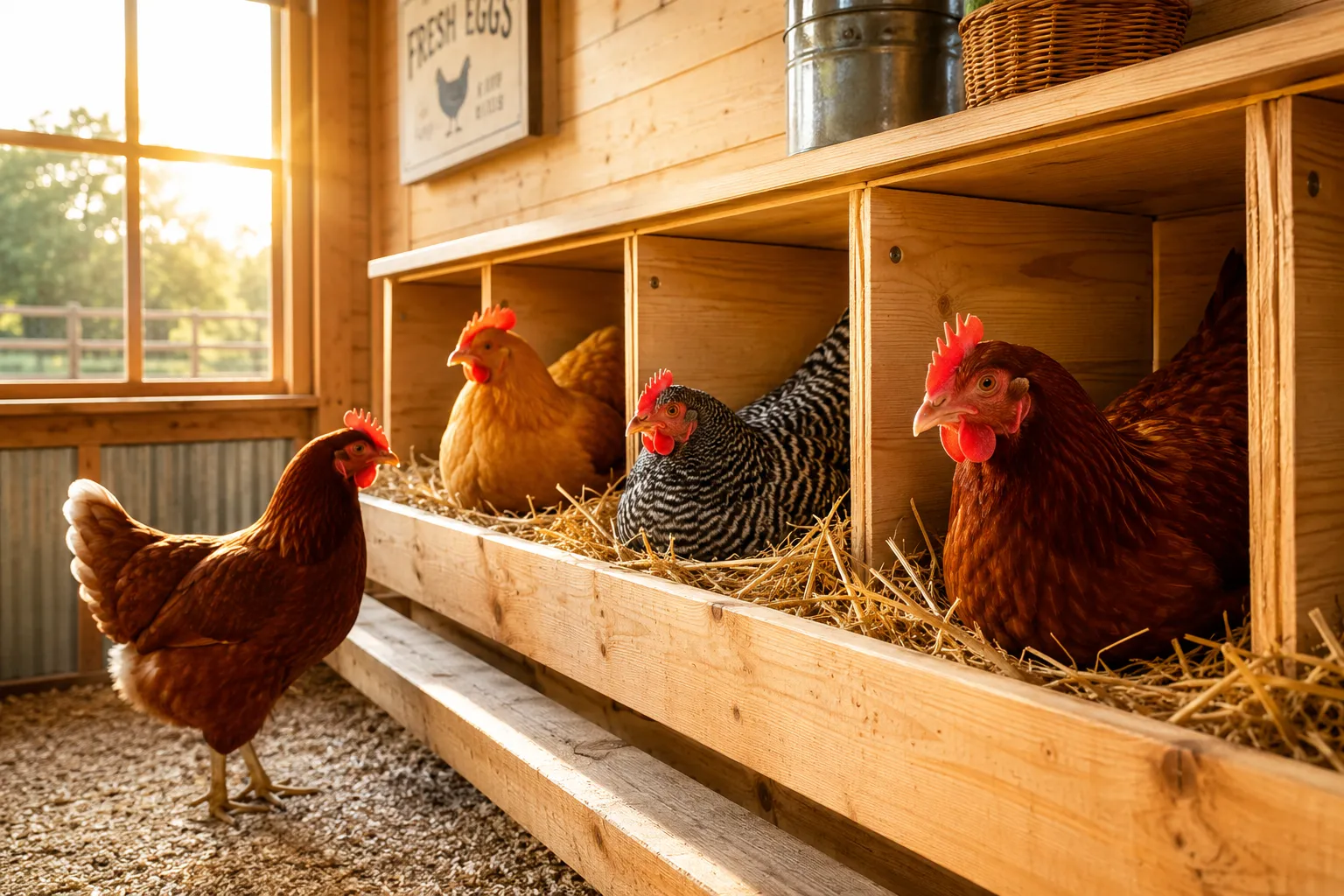
Quick Answer: The standard ratio is one nesting box for every 3-4 hens. A flock of six chickens needs two nesting boxes, while twelve hens require three to four boxes. Chickens naturally share nesting boxes and will often favor the same one or two boxes even when more are available, so you don’t need a separate box for each bird.
Key Takeaways
- Standard ratio: Provide one nesting box for every 3-4 hens in your flock
- Chickens share boxes: Hens don’t need individual boxes and will often use the same favorite spots
- Six chickens need two boxes: Small flocks of 4-6 birds do well with two nesting boxes
- Twelve chickens need 3-4 boxes: Medium flocks require three to four boxes maximum
- Size matters: Standard boxes should be 12x12x12 inches; bantams need 10x10x10 inches
- Placement is critical: Mount boxes 18-24 inches off the ground, lower than roosting bars
- Too few boxes cause problems: Insufficient boxes lead to ground eggs, broken eggs, and stressed hens
- Breed doesn’t change the ratio: Different chicken breeds can share the same boxes and follow the same 3-4 hen per box rule
- Common mistake: Don’t let chickens sleep in nesting boxes at night
What Is the Standard Ratio of Nesting Boxes to Hens?
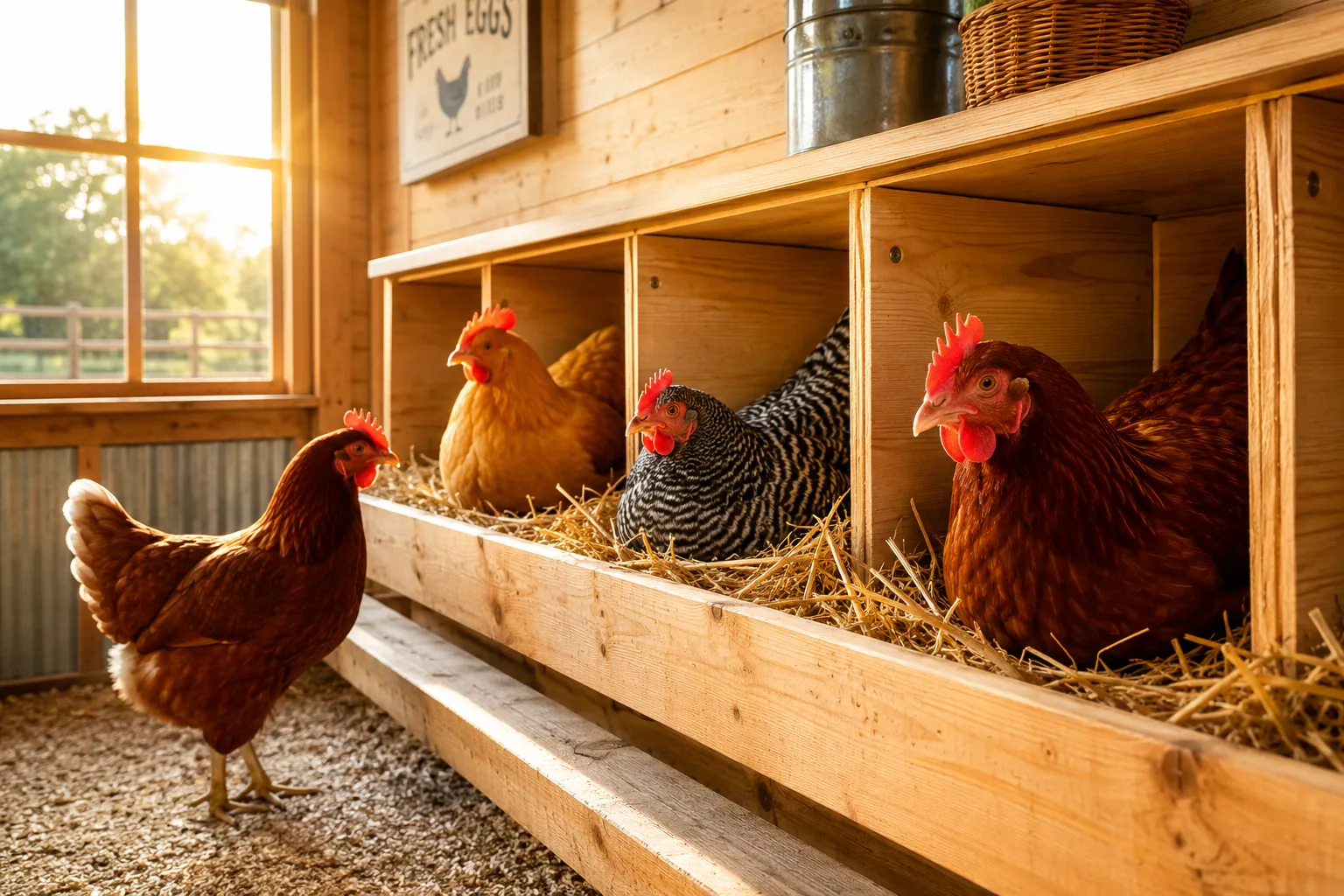
The universally accepted standard is one nesting box for every three to four hens. This ratio has been tested across commercial and backyard operations for decades and provides enough space without wasting coop real estate.
Why this ratio works:
- Hens don’t lay eggs simultaneously throughout the day
- Most laying happens in the morning hours (typically 7 AM to 11 AM)
- Chickens naturally share preferred nesting spots
- Even with more boxes available, hens gravitate to one or two favorites
Quick reference table:
| Flock Size | Minimum Boxes | Recommended Boxes |
|---|---|---|
| 3-4 hens | 1 | 2 |
| 5-8 hens | 2 | 2-3 |
| 9-12 hens | 3 | 3-4 |
| 13-16 hens | 4 | 4-5 |
| 17-20 hens | 5 | 5-6 |
The “recommended” column accounts for peak laying seasons when production is highest and gives you a small buffer.
How Many Nesting Boxes Do I Need for 6 Chickens?
For six chickens, you need two nesting boxes. This follows the 3-4 hens per box guideline and provides adequate space even during peak morning laying hours when multiple hens want to lay at the same time.
Two boxes for six hens gives you:
- Enough capacity for simultaneous layers
- A backup if one box becomes soiled or unappealing
- Room for growth if you add 1-2 more birds later
- Flexibility during broody hen situations (when one hen monopolizes a box)
Choose three boxes if: Your coop has the space and you want extra insurance during peak production, or if you plan to expand your flock to 8-10 birds within the next year.
Can Chickens Share Nesting Boxes or Does Each Hen Need Their Own?
Chickens absolutely share nesting boxes and do not need individual boxes. In fact, hens prefer to lay eggs where other hens have laid, which is why you’ll often find multiple eggs in one box while others sit empty.
This communal behavior is instinctive. In the wild, jungle fowl (chickens’ ancestors) laid eggs in shared ground nests, and modern chickens retain this preference. The presence of eggs in a box signals to other hens that it’s a safe, proven location.
What you’ll observe:
- Multiple hens waiting for the same “favorite” box
- Hens laying in boxes that already contain eggs
- Empty boxes ignored even when occupied boxes are crowded
- Hens sometimes laying while another hen is already in the box
This sharing behavior is normal and healthy. Providing one box per hen would waste space and wouldn’t change their preference for communal laying spots.
What Happens If You Don’t Have Enough Nesting Boxes for Your Chickens?
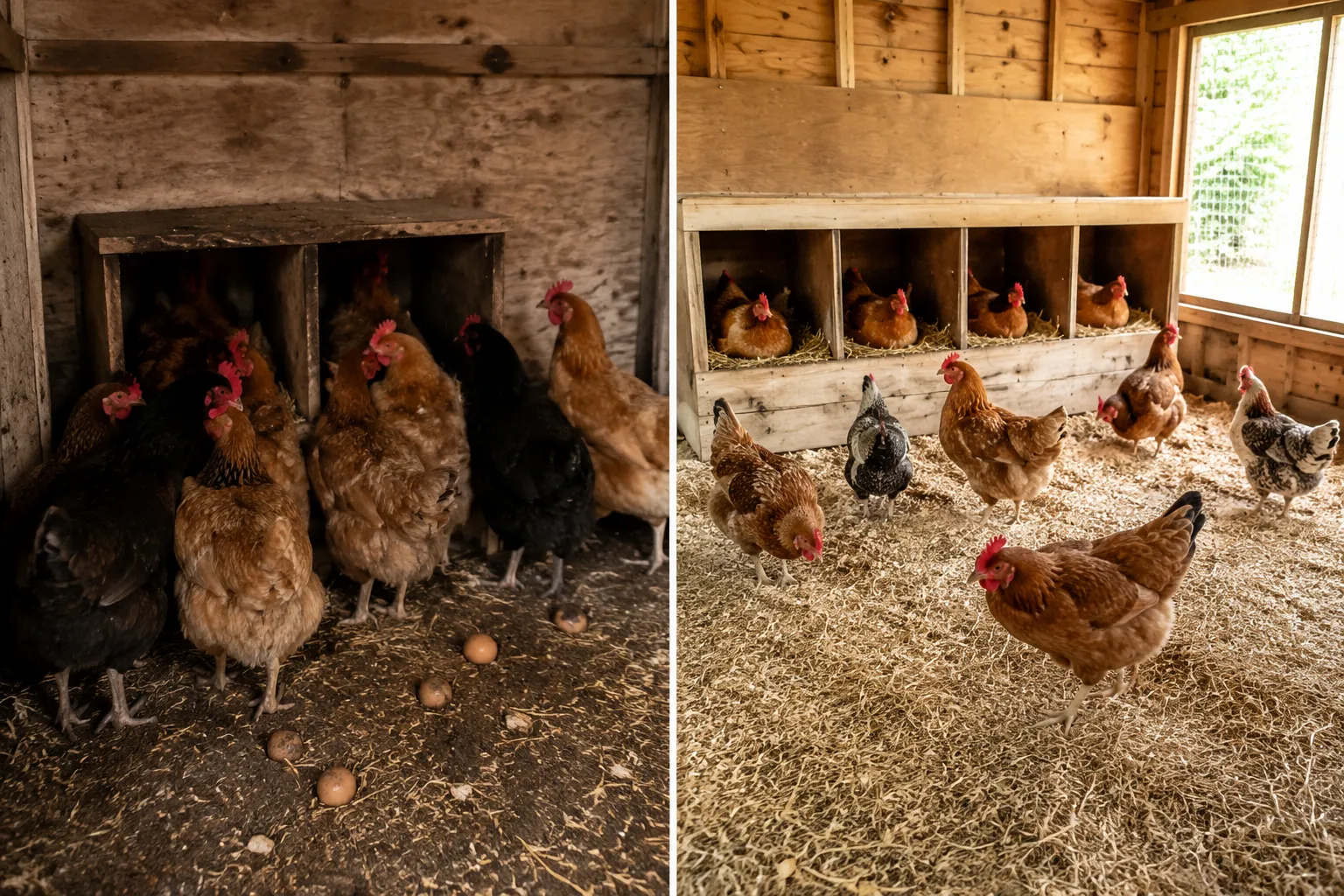
Insufficient nesting boxes create several problems: hens lay eggs on the coop floor, eggs get broken or dirty, hens become stressed waiting for boxes, and egg-eating behavior may develop.
Specific consequences:
- Floor eggs: Hens lay wherever they can, often in corners or under roosts where eggs get soiled or trampled
- Broken eggs: Crowding leads to eggs being kicked or cracked, which can trigger egg-eating habits
- Delayed laying: Hens holding eggs too long can develop health issues like egg binding
- Stress and pecking: Competition for limited boxes increases flock tension and aggressive behavior
- Hidden nests: Hens may find alternative spots outside the coop if they free-range
Common mistake: Some keepers think one box is enough for 3-4 hens because that’s the ratio. But having only one box means no backup when it’s occupied, soiled, or if a hen goes broody. Always provide at least two boxes for any flock, regardless of size.

How Many Nesting Boxes for 12 Chickens in a Backyard Coop?
Twelve chickens need three to four nesting boxes. Three boxes meet the minimum 3-4 hens per box standard, while four boxes provide extra capacity during peak laying times and give you flexibility if one box needs cleaning or a hen goes broody.
For a 12-hen flock, choose:
- Three boxes: Sufficient for most situations, good for space-limited coops
- Four boxes: Better choice for high-production breeds, easier management, allows for one box to be out of service
Decision rule: If your twelve hens are all high-production breeds (Leghorns, Rhode Island Reds, ISA Browns) that lay 5-6 eggs per week, go with four boxes. If you have a mixed flock with some ornamental or lower-production breeds, three boxes work fine.
How Big Should a Nesting Box Be for Standard Size Hens?
Standard-sized hens need nesting boxes that measure 12 inches wide by 12 inches deep by 12 inches tall. This cubic foot of space accommodates most standard breeds comfortably and allows hens to turn around and settle into their nesting position.
Size specifications by chicken type:
- Standard breeds (Rhode Island Red, Plymouth Rock, Orpington, Wyandotte): 12x12x12 inches
- Large breeds (Jersey Giant, Brahma, Cochin): 14x14x14 inches
- Bantam breeds (Silkie, Sebright, Belgian d’Uccle): 10x10x10 inches
Important dimensions:
- Entrance opening: 8-10 inches wide and 8-9 inches tall
- Lip at entrance: 4-6 inches high to keep bedding inside
- Depth of bedding: 2-4 inches of soft nesting material
Boxes that are too small cause hens to avoid them or break eggs while maneuvering. Boxes that are too large encourage multiple hens to crowd in together or, worse, tempt hens to sleep in them at night.
Do I Need More Nesting Boxes If I Have Different Chicken Breeds?
No, different chicken breeds can share the same nesting boxes, and the standard 3-4 hens per box ratio applies regardless of breed mix. Hens of various breeds coexist peacefully in nesting areas and don’t require breed-specific boxes.
What does matter:
- Size differences: If you keep bantams with standard breeds, provide boxes sized for your largest birds (12x12x12 inches). Bantams can use standard boxes without issue, but standard hens can’t fit in bantam-sized boxes.
- Flock dynamics: Aggressive breeds or dominant hens may monopolize preferred boxes, but this is a behavioral issue, not a breed-specific box requirement.
Exception: If you keep bantams exclusively, you can use smaller 10x10x10 inch boxes to save space. But mixed flocks should have standard-sized boxes for everyone.
Why Are All My Hens Using the Same Nesting Box?
Hens gravitate to the same nesting box because chickens are creatures of habit and prefer to lay where they see other eggs, which signals a safe and successful nesting spot. This behavior is completely normal and not a problem unless it causes crowding or broken eggs.
Reasons for box preference:
- Social proof: Eggs already in a box attract more hens
- Location: The preferred box may be in the darkest, quietest, or most secluded spot
- Height: Hens often prefer boxes at certain heights
- Cleanliness: The favorite box may simply be the cleanest or have the best bedding
- Habit: Once a pattern establishes, hens follow it
When to intervene:
- If eggs are getting broken due to overcrowding
- If hens are fighting over access to one box
- If waiting hens are laying floor eggs instead
Solutions: Make other boxes more appealing by adding fake eggs or golf balls, ensuring all boxes have fresh bedding, adjusting lighting to make other boxes darker, or temporarily blocking the favorite box for a few days to force new habits.
Nesting Boxes vs Roosting Bars: What’s the Difference?
Nesting boxes are enclosed spaces where hens lay eggs during the day, while roosting bars are elevated perches where chickens sleep at night. These serve completely different purposes and chickens instinctively know the difference when coops are set up correctly.
Key differences:
| Feature | Nesting Boxes | Roosting Bars |
|---|---|---|
| Purpose | Egg laying | Sleeping |
| Time of use | Daytime, mostly morning | Nighttime |
| Design | Enclosed, dark, private | Open, elevated, exposed |
| Height | 18-24 inches off ground | 2-4 feet off ground |
| Bedding | Soft material (straw, shavings) | Bare wood or minimal bedding |
| Quantity needed | 1 per 3-4 hens | 8-10 inches per bird |
Critical setup rule: Roosting bars must be higher than nesting boxes. Chickens instinctively roost at the highest available point. If nesting boxes are higher, hens will sleep in them, which leads to soiled boxes and dirty eggs.
How to Stop Chickens from Sleeping in Nesting Boxes at Night
To stop chickens from sleeping in nesting boxes, ensure roosting bars are positioned higher than the boxes, physically remove hens from boxes at dusk and place them on roosts, and consider blocking box access at night until the habit breaks.
Step-by-step solution:
- Check roost height: Roosting bars should be at least 6-12 inches higher than the top of nesting boxes
- Improve roost appeal: Make sure roosts are 2-4 feet off the ground, made of comfortable 2×4 lumber (wide side up), and have adequate space (8-10 inches per bird)
- Manual training: For 3-7 nights, physically move sleeping hens from boxes to roosts after dark when they’re docile
- Block boxes at night: Close nesting box access in the evening and reopen in the morning until hens establish proper roosting habits
- Remove bedding: Temporarily make boxes less comfortable by reducing bedding material
Why this matters: Chickens defecate heavily at night. Hens sleeping in boxes create a mess that contaminates eggs, increases cleaning work, and can spread disease. Clean nesting boxes are essential for clean eggs.
Where Should I Place Nesting Boxes in My Chicken Coop?
Place nesting boxes 18-24 inches off the ground in the darkest, quietest area of your coop, positioned lower than roosting bars and away from high-traffic zones like the coop entrance or feeding areas.
Optimal placement criteria:
- Height: 18-24 inches above floor level (high enough to feel secure, low enough to discourage roosting)
- Lighting: Darker areas are preferred; hens seek privacy for laying
- Noise level: Away from doors, windows, and activity zones
- Accessibility: Easy for you to reach for egg collection and cleaning
- Ventilation: Adequate airflow but not drafty
- Relative to roosts: At least 6-12 inches lower than roosting bars
Mounting options:
- Wall-mounted boxes save floor space in small coops
- Freestanding units work well in larger coops and are easier to clean
- External boxes (accessed from outside the coop) simplify egg collection without entering the coop
Common mistake: Placing boxes near the coop entrance where activity and light discourage use. Hens prefer secluded, cave-like spaces for laying.
Will Hens Lay Eggs on the Ground If There Aren’t Enough Boxes?
Yes, hens will lay eggs on the ground when nesting boxes are insufficient, occupied, or unappealing. Ground eggs are more likely to be dirty, broken, or eaten by chickens, which can establish bad habits that persist even after you add more boxes.
When ground laying occurs:
- All boxes are occupied during peak laying hours
- Boxes are dirty or have unpleasant odors
- A broody hen monopolizes the only available box
- Boxes are poorly positioned or difficult to access
- New hens haven’t learned where boxes are located
Problems with ground eggs:
- Contamination: Floor eggs contact droppings and dirty bedding
- Breakage: Eggs get stepped on or pecked
- Egg eating: Broken eggs teach hens to eat eggs intentionally
- Collection difficulty: You may miss hidden eggs, which can spoil or attract pests
Prevention: Maintain the 3-4 hens per box ratio, keep boxes clean and appealing, collect eggs frequently so boxes don’t fill up, and train new hens by placing fake eggs or golf balls in boxes to signal where laying should occur.
Do Bantam Chickens Need Fewer Nesting Boxes Than Regular Hens?
Bantam chickens follow the same 3-4 birds per box ratio as standard hens, but they can use smaller boxes (10x10x10 inches instead of 12x12x12 inches). The number of boxes needed is based on flock size, not chicken size.
Bantam nesting requirements:
- Box ratio: Still 1 box per 3-4 bantams
- Box size: 10x10x10 inches is adequate
- Mixed flocks: If you keep bantams with standard breeds, use standard-sized boxes that accommodate your largest birds
Example: A flock of 9 bantam hens needs 3 nesting boxes, just like 9 standard hens would. The only difference is you can use smaller boxes if your flock is exclusively bantams.
Advantage: Smaller boxes save space in compact coops designed for bantam breeds, allowing you to maximize your coop layout efficiency.
Common Mistakes When Setting Up Chicken Nesting Boxes
The most common mistakes include positioning boxes higher than roosts (causing hens to sleep in them), providing too few boxes for the flock size, using boxes that are too small, placing boxes in high-traffic areas, and neglecting regular cleaning.
Top setup errors and fixes:
Boxes too high: Keep boxes 18-24 inches off the ground, always lower than roosts
- Fix: Lower boxes or raise roosting bars
Insufficient quantity: Following a 1:1 hen-to-box ratio wastes space; going below 1:4 causes problems
- Fix: Use the 3-4 hens per box standard
Poor location: Boxes near doors, windows, or feeding areas get avoided
- Fix: Move to quiet, darker corners
Wrong size: Too small causes avoidance; too large encourages multiple hens or sleeping
- Fix: Use 12x12x12 inches for standard breeds
No entrance lip: Bedding spills out, leaving boxes uncomfortable
- Fix: Add a 4-6 inch lip at the entrance
Dirty boxes: Soiled bedding and old eggs make boxes unappealing
- Fix: Clean weekly and replace bedding regularly
Inadequate bedding: Hard surfaces discourage laying
- Fix: Maintain 2-4 inches of soft straw or pine shavings
No training for new hens: Young pullets don’t automatically know where to lay
- Fix: Place fake eggs or golf balls in boxes as visual cues
How Often Should You Clean Nesting Boxes?
Clean nesting boxes weekly by removing soiled bedding, wiping down surfaces, and adding fresh material. Spot-clean daily if you notice broken eggs or excessive droppings, and do a deep clean monthly with disinfectant to prevent mites and bacteria buildup.
Cleaning schedule:
- Daily: Collect eggs, remove any broken eggs or droppings
- Weekly: Replace bedding, wipe surfaces, check for pests
- Monthly: Deep clean with poultry-safe disinfectant, inspect for damage
- Seasonally: Consider full box replacement or major repairs
Best bedding materials:
- Pine shavings: Absorbent, comfortable, widely available
- Straw: Traditional choice, good cushioning, easy to replace
- Aspen shavings: Alternative to pine, less dusty
- Avoid: Cedar (toxic to chickens), hay (molds easily), newspaper (not absorbent)
Clean boxes encourage consistent laying in proper locations and reduce the risk of egg contamination and disease transmission.
FAQ
How many nesting boxes do I need for 4 chickens?
Four chickens need one to two nesting boxes. While one box meets the minimum 3-4 hens per box ratio, two boxes provide a backup and prevent crowding during peak laying times.
Can you have too many nesting boxes?
Yes, too many boxes waste coop space and create more cleaning work without benefit. Stick to the 3-4 hens per box guideline; extra boxes won’t increase egg production or hen happiness.
What size should a nesting box be for large breed chickens?
Large breeds like Jersey Giants and Brahmas need 14x14x14 inch boxes, slightly bigger than the standard 12x12x12 inches, to accommodate their size comfortably.
Why do my chickens lay eggs outside the nesting boxes?
Chickens lay outside boxes when boxes are dirty, occupied, poorly positioned, too small, or when hens haven’t been trained where to lay. Add more boxes, improve cleanliness, or use fake eggs to guide hens.
Should nesting boxes be in the dark?
Nesting boxes should be in the darker, quieter areas of your coop but don’t need to be pitch black. Hens prefer dim, private spaces that feel secure for laying.
How do I get my chickens to use the nesting boxes?
Place fake eggs or golf balls in boxes to signal where laying should occur, ensure boxes are clean and comfortable, position them in quiet areas, and manually place young hens in boxes during morning hours when they’re ready to lay.
Do nesting boxes need a roof?
Nesting boxes should have a roof or top to create an enclosed, cave-like feeling that hens prefer. Slanted roofs prevent chickens from roosting on top of boxes.
Can two chickens use one nesting box at the same time?
Chickens can and sometimes do share a box simultaneously, though it’s not ideal. This usually happens when there aren’t enough boxes or when hens strongly prefer one specific box.
What’s the best height for chicken nesting boxes?
The ideal height is 18-24 inches off the ground, which is high enough for hens to feel secure but low enough to discourage roosting, and always lower than your roosting bars.
How many nesting boxes for 20 chickens?
Twenty chickens need five to six nesting boxes following the standard 3-4 hens per box ratio. Five boxes meet the minimum; six provides extra capacity during peak production.
Do you need nesting boxes if chickens free range?
Yes, even free-ranging chickens need nesting boxes in their coop. Without designated boxes, hens will create hidden nests in bushes, under buildings, or other hard-to-find locations, making egg collection difficult.
Should I put food and water in nesting boxes?
Never put food or water in nesting boxes. Boxes are only for laying eggs. Food and water attract hens to spend time in boxes, increase mess, and encourage unwanted behaviors like sleeping in boxes.
Conclusion
Understanding how many nesting boxes per hen your flock needs is straightforward: provide one box for every 3-4 hens, size boxes appropriately at 12x12x12 inches for standard breeds, and position them 18-24 inches off the ground in quiet, darker areas of your coop. Remember that chickens naturally share nesting boxes and will often favor the same one or two spots regardless of how many boxes you provide.
Your action steps:
- Calculate your needs using the 3-4 hens per box ratio (six chickens need two boxes, twelve need three to four)
- Ensure boxes are properly sized and positioned lower than roosting bars
- Maintain clean boxes with fresh bedding weekly
- Monitor for ground eggs or crowding, which signal insufficient boxes
- Train new layers with fake eggs if needed
The right nesting box setup creates a calm, productive laying environment where hens feel secure and eggs stay clean. Whether you’re starting with a small backyard flock or managing a larger operation, following these guidelines ensures your chickens have exactly what they need, no more, no less.


