
Quick Answer: Hens stop laying eggs for several common reasons including age (production drops significantly after 2-3 years), seasonal molting (which redirects energy from egg production to feather regrowth), insufficient daylight (hens need 14-16 hours of light daily), stress from predators or environmental changes, nutritional deficiencies, broodiness, parasites, or underlying health issues. Most causes are temporary and fixable with proper care adjustments.
Key Takeaways
- Age is the primary factor: Hens lay most prolifically in their first 2 years, with production declining 10-20% annually thereafter
- Molting pauses laying for 8-16 weeks while hens regrow feathers, typically occurring in fall
- Light requirements are strict: Hens need 14-16 hours of daylight to maintain consistent egg production
- Stress stops laying immediately: Predator threats, flock changes, coop moves, or loud noises trigger production halts
- Nutrition matters: Layer feed with 16-18% protein plus calcium supplementation is essential for consistent laying
- Broodiness is hormonal, not illness: Broody hens deliberately stop laying to incubate eggs and can be “broken” of this behavior
- Parasites drain resources: Mites, lice, and worms steal nutrients needed for egg production
- Most causes are reversible: With proper intervention, healthy hens under 4 years typically resume laying within weeks to months
What Causes Chickens to Stop Laying Eggs Suddenly?
Sudden egg production stops usually result from acute stressors rather than gradual decline. The most common immediate triggers include predator attacks (even unsuccessful ones), sudden weather changes, flock disruption from new birds or deaths, coop relocation, loud construction noise, or abrupt diet changes. Hens have a sensitive stress response that diverts energy away from reproduction when they perceive threats.
Common sudden-stop triggers:
- Predator encounters: A fox, hawk, or dog near the coop can halt laying for 1-3 weeks even if no hen was harmed
- Flock hierarchy disruption: Adding or removing birds triggers re-establishment of pecking order
- Extreme weather events: Heat waves above 90°F or sudden cold snaps below 20°F
- Water or feed interruptions: Even 24 hours without access stops production
- Illness or injury: Respiratory infections, impacted crop, or internal laying issues
- Sudden light changes: Moving hens from outdoor to indoor housing without gradual adjustment
When to investigate immediately: If your entire flock stops laying within 24-48 hours, check for water contamination, spoiled feed, predator signs, or respiratory symptoms like sneezing and nasal discharge. A single hen stopping may simply be entering a natural pause, but flock-wide cessation signals an environmental problem.
How Old Do Hens Stop Laying Eggs Naturally?
Hens begin laying at 18-24 weeks of age and produce most prolifically during their first two years, with production declining 10-20% each year after that. Most backyard breeds lay well through year three, produce sporadically in years four and five, and largely cease by age 6-7, though individual hens may continue laying occasional eggs into their eighth year or beyond.
Age-based production timeline:
- Year 1 (pullet year): 250-300 eggs for high-production breeds, 180-220 for heritage breeds
- Year 2: 90-95% of first-year production
- Year 3: 70-80% of first-year production
- Year 4: 50-60% of first-year production
- Year 5+: Sporadic laying, often only spring/summer eggs
Breed differences matter: Commercial hybrids like ISA Browns and Golden Comets are bred for intense early production but burn out faster, often declining sharply after year two. Heritage breeds like Orpingtons, Plymouth Rocks, and Wyandottes lay fewer eggs initially but maintain production longer, often laying consistently into year four.
Choose to keep older hens if: You value them as pets, they contribute to flock dynamics, they help raise chicks, or you have space and resources. Many keepers maintain mixed-age flocks where younger hens provide eggs while older hens offer experience and stability.
Is My Hen Molting or Sick When She Stops Laying?
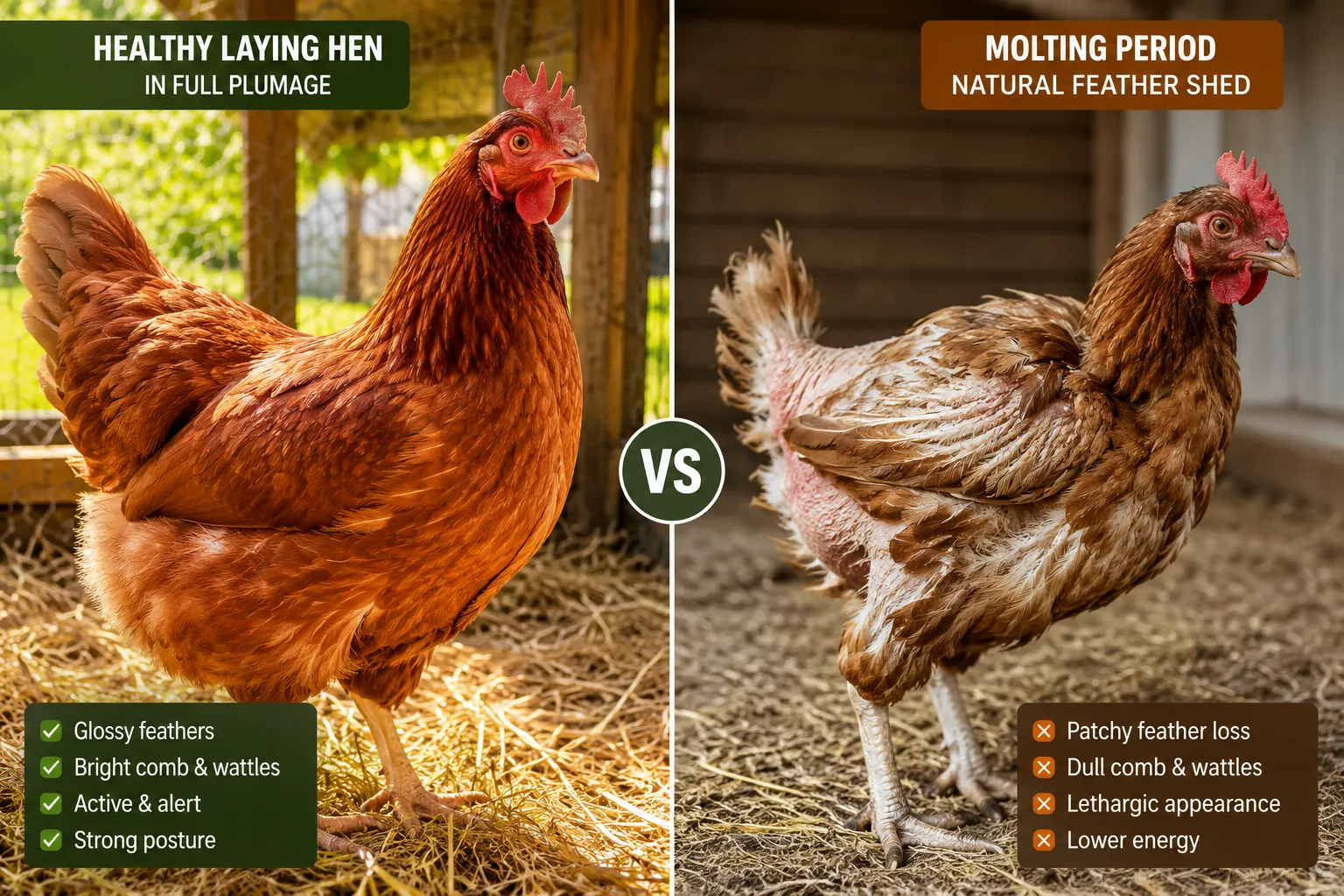
Molting is a natural annual process where hens shed and regrow feathers, typically lasting 8-16 weeks and occurring in late summer or fall. A molting hen shows obvious feather loss (especially around the neck, back, and tail), remains alert and active, maintains normal appetite, and has bright eyes and comb color. A sick hen displays lethargy, hunched posture, reduced appetite, dull or pale comb, closed eyes, labored breathing, or abnormal droppings.
Molting indicators:
- Feathers scattered around coop and run
- Visible pin feathers (new growth appearing as spiky quills)
- Patchy appearance but otherwise normal behavior
- Increased protein consumption
- Process follows predictable seasonal pattern
- Hen remains social with flock
Illness indicators:
- Lethargy and separation from flock
- Puffed-up, hunched posture
- Pale, shriveled, or discolored comb
- Discharge from eyes, nostrils, or vent
- Diarrhea, bloody stool, or no droppings
- Labored breathing or wheezing
- Sudden weight loss
The timing test: Molting almost always occurs in fall (August-November in the Northern Hemisphere) when daylight decreases. If your hen loses feathers in spring or summer, suspect parasites, feather picking, or nutritional deficiency rather than natural molt.
What’s the Difference Between Broodiness and Illness in Laying Hens?
Broodiness is a hormonal state where a hen’s instinct to incubate eggs overrides laying, causing her to sit on a nest continuously, puff up and growl when approached, and stop producing new eggs. A broody hen remains physically healthy with normal body temperature, clear eyes, and good muscle tone, though she may lose weight from infrequent eating. An ill hen shows systemic signs like fever, weakness, abnormal droppings, or respiratory symptoms and doesn’t exhibit the aggressive nesting behavior of broodiness.
Broody hen characteristics:
- Flattens herself in nesting box 23+ hours daily
- Puffed feathers and aggressive vocalizations when disturbed
- Plucks breast feathers to create bare brood patch
- Leaves nest only briefly (10-15 minutes) once daily for food and water
- Large, pungent “broody poops” from infrequent defecation
- Otherwise healthy appearance and bright eyes
Breaking broodiness (if desired):
- Remove hen from nest multiple times daily
- Place in wire-bottom “broody breaker” cage for 3-5 days (allows air circulation under body to cool her)
- Ensure cage has food and water but no bedding
- Return to flock once she stops puffing and seeking nests
- Most hens resume laying 2-4 weeks after breaking
When broodiness is useful: If you want to hatch chicks, a broody hen is an excellent natural incubator. She’ll sit on fertile eggs for 21 days and raise the chicks afterward, eliminating the need for artificial incubation.
How Much Light Do Chickens Need to Lay Eggs in Winter?
Chickens require 14-16 hours of daylight to maintain consistent egg production, but natural winter daylight in most regions drops to 9-10 hours, triggering a natural laying pause. Adding supplemental lighting to extend “daylight” to 14-16 hours can maintain winter production, though many keepers choose to allow the natural rest period for hen health and longevity.
Lighting requirements for winter laying:
- Minimum threshold: 14 hours of light daily
- Optimal duration: 15-16 hours
- Light intensity: 25-40 watts for a 10×10 coop (enough to read a newspaper)
- Timing: Add light in morning rather than evening (sudden darkness at night stresses hens)
- Gradual introduction: Increase light by 30 minutes weekly to avoid shock
Supplemental lighting setup:
- Install timer-controlled light in coop
- Set to turn on early morning (4-6 AM depending on sunrise)
- Allow natural sunset to end the light period
- Use warm white LED bulbs (energy efficient and low heat)
- Position light to illuminate feeding area without shining directly on roosts
The rest period debate: Many experienced keepers skip supplemental lighting to allow hens a natural winter break, believing it extends productive lifespan and reduces reproductive system stress. Hens given winter rest often resume laying vigorously in spring. Commercial operations prioritize year-round production, but backyard keepers can choose based on their egg needs and hen welfare philosophy.
What to Feed Hens That Stopped Laying Eggs

Hens that stopped laying need evaluation of their current diet, with most requiring layer feed containing 16-18% protein, supplemental calcium (oyster shell or crushed eggshells), and limited treats that don’t exceed 10% of daily intake. During molting, temporarily increase protein to 20-22% to support feather regrowth. Ensure constant access to clean water, as even mild dehydration immediately stops egg production.
Essential nutrition components:
- Layer feed (16-18% protein): Should comprise 90% of diet
- Calcium supplement: Free-choice oyster shell or crushed eggshells in separate container
- Clean water: 1 pint per hen daily, more in hot weather
- Grit: Insoluble granite grit if hens don’t free-range (aids digestion)
- Limited treats: Vegetables, fruits, mealworms, or scratch grains at <10% of diet
Protein boost during molt:
- Switch to grower feed (20% protein) temporarily
- Add protein-rich treats: mealworms, black soldier fly larvae, scrambled eggs, tuna
- Offer sunflower seeds (high in protein and healthy fats)
- Avoid excessive corn and scratch grains (low protein, high carbohydrate)
Common feeding mistakes that stop laying:
- Too many treats diluting nutritional balance
- Scratch grains as primary feed (only 8-10% protein)
- Stale or moldy feed (loses nutritional value and can cause illness)
- Insufficient calcium causing soft-shelled or shell-less eggs
- Shared feed with roosters or chicks (wrong protein levels)
Can Stress Make Chickens Stop Laying and How to Fix It?
Yes, stress immediately halts egg production as hens redirect energy toward survival rather than reproduction. Common stressors include predator pressure, overcrowding (less than 4 square feet per hen in coop, 10 square feet in run), aggressive flock mates, frequent handling, excessive noise, inadequate ventilation, temperature extremes, or inconsistent care routines. Reducing stress typically restores laying within 1-3 weeks once the hen feels secure.
Stress reduction strategies:
Environmental improvements:
- Ensure adequate space (4 sq ft per hen in coop, 10 sq ft in run minimum)
- Provide multiple feeding and watering stations to reduce competition
- Add hiding spots, perches at varying heights, and dust bathing areas
- Improve ventilation without creating drafts
- Secure coop against predators with hardware cloth and buried barriers
Flock management:
- Introduce new birds gradually using “see but don’t touch” separation for 1-2 weeks
- Remove aggressive hens or provide extra space to reduce bullying
- Maintain consistent daily routines for feeding, egg collection, and coop closing
- Minimize unnecessary handling and loud noises near coop
Temperature stress solutions:
- Heat (above 85°F): Provide shade, frozen treats, shallow water for wading, increased ventilation
- Cold (below 20°F): Ensure draft-free coop, provide extra bedding, use heated waterers, avoid heat lamps (fire hazard)
Recovery timeline: Most stress-induced laying pauses resolve within 2-3 weeks once the stressor is removed. If a hen doesn’t resume laying after a month of stress-free conditions, investigate other causes like age, health issues, or nutritional deficiencies.
How Long Does Molting Last Before Hens Lay Again?
Molting typically lasts 8-16 weeks from the start of feather loss until laying resumes, with the duration depending on molt speed (hard vs. soft molt), hen age, nutrition, and breed. Hard molters lose feathers rapidly and regrow them quickly, finishing in 8-10 weeks, while soft molters shed gradually over 12-16 weeks. Hens usually resume laying 2-4 weeks after completing feather regrowth.
Molt timeline stages:
- Weeks 1-2: Initial feather loss begins, laying slows or stops
- Weeks 3-6: Heavy feather loss, pin feathers emerge
- Weeks 6-10: Active feather regrowth, hen appears scruffy
- Weeks 10-12: Feather regrowth completes, hen looks glossy
- Weeks 12-16: Laying resumes gradually
Factors affecting molt duration:
- Age: Younger hens (first molt at 18 months) finish faster than older hens
- Nutrition: High-protein diet (20-22%) speeds feather regrowth
- Genetics: Some breeds and individual hens are genetically fast molters
- Health: Parasites, illness, or stress prolong molting
- Season: Molts beginning in late summer finish before winter; late-starting molts may pause until spring
Supporting hens through molt:
- Increase protein to 20-22% with grower feed or protein supplements
- Reduce stress and handling (new feathers are painful when emerging)
- Ensure adequate space so hens aren’t pecked during vulnerable period
- Provide extra calcium in anticipation of resumed laying
- Accept that no eggs during this period is normal and healthy
When Should I Worry About a Hen Not Laying Eggs?
Worry about a non-laying hen when she shows signs of illness (lethargy, abnormal droppings, respiratory symptoms, pale comb), has been non-productive for more than 6 months outside of winter or molt, displays abdominal swelling or penguin-like posture (suggesting internal laying or egg binding), or is under 2 years old with no obvious cause for the pause. A healthy hen over 3 years old not laying during winter or after molting is normal and not concerning.
Red flags requiring veterinary attention:
- Egg binding: Hen strains at vent, tail pumping, distressed vocalizations, penguin posture
- Internal laying: Swollen, fluid-filled abdomen, difficulty walking, weight gain without fat
- Reproductive tumors: Hard abdominal mass, chronic laying cessation, weight loss
- Peritonitis: Swollen abdomen, lethargy, loss of appetite, foul smell
- Prolapsed vent: Tissue protruding from vent opening
Normal non-laying scenarios (don’t worry):
- Hen over 3 years old with declining production
- Winter pause in natural lighting conditions
- 8-16 weeks during annual molt
- 2-3 weeks after stressful event
- Broody hen sitting on nest
- Pullet under 24 weeks old (hasn’t started yet)
Diagnostic steps for concerning cases:
- Observe droppings for 24 hours (note color, consistency, frequency)
- Check vent for prolapse, inflammation, or stuck egg
- Palpate abdomen gently for swelling, hardness, or fluid
- Assess body condition (keel bone prominence indicates weight loss)
- Isolate hen and monitor food/water intake
- Consult poultry veterinarian if symptoms persist beyond 48 hours
Do Older Hens Ever Start Laying Again?
Older hens (4+ years) can resume laying after winter or molt breaks, but production will be sporadic and significantly reduced compared to their peak years, typically producing 1-3 eggs weekly rather than 4-6. A hen that has completely stopped laying for 12+ consecutive months is unlikely to restart, as her reproductive system has likely ceased function. However, hens that lay occasionally in spring and summer may continue this pattern for several more years.
What to expect from older layers:
- Ages 4-5: 1-3 eggs per week during peak season (spring/summer)
- Ages 6-7: Occasional eggs, often with shell quality issues
- Ages 8+: Rare eggs, mostly in spring, often abnormal
- Shell quality: Thinner shells, irregular shapes, occasional soft shells
- Seasonal pattern: Most eggs in spring, few to none in fall/winter
Reasons to keep non-laying hens:
- Pest control: Older hens continue foraging for insects and weeds
- Flock stability: Experienced hens maintain pecking order and teach younger birds
- Companionship: Many keepers value hens as pets beyond egg production
- Brooding: Some older hens make excellent foster mothers for chicks
- Composting: All hens contribute manure for garden compost
The culling decision: This is personal and depends on your space, resources, and philosophy. Commercial operations cull at 18-24 months when production drops, but backyard keepers often maintain hens for their 8-10 year natural lifespan. Consider your goals, budget for feed, and emotional attachment when deciding.
Common Mistakes That Stop Hens From Laying Eggs
The most frequent keeper errors that halt egg production include feeding scratch grains as primary diet instead of layer feed, providing insufficient calcium supplementation, overcrowding coops and runs, allowing water to run out or become fouled, failing to control parasites, collecting eggs inconsistently (encouraging broodiness), and expecting year-round production without supplemental winter lighting. Most of these mistakes are easily corrected once identified.
Top mistakes and fixes:
| Mistake | Why It Stops Laying | Fix |
|---|---|---|
| Scratch grains as main feed | Only 8-10% protein vs. 16-18% needed | Switch to layer feed; treats <10% of diet |
| No calcium supplement | Hens deplete bone calcium for shells | Offer free-choice oyster shell |
| Overcrowding | Stress and competition for resources | Minimum 4 sq ft per hen in coop |
| Dirty or empty waterers | Dehydration stops production immediately | Check water twice daily, clean weekly |
| Uncontrolled parasites | Mites/lice drain nutrients and energy | Monthly inspections, treat with poultry dust |
| Irregular egg collection | Triggers broody behavior | Collect eggs daily, preferably twice |
| Expecting winter eggs without light | Natural photoperiod drops below 14 hours | Add supplemental lighting or accept pause |
| Stale or moldy feed | Nutritional degradation and toxins | Buy feed in quantities used within 6 weeks |
Prevention checklist:
- Feed layer pellets (16-18% protein) as 90% of diet
- Provide free-choice calcium in separate container
- Ensure 4 sq ft per hen in coop, 10 sq ft in run
- Check water twice daily, especially in heat or freezing weather
- Inspect for mites/lice monthly, especially under wings and around vent
- Collect eggs daily to prevent broodiness
- Store feed in sealed containers away from moisture and pests
Can Parasites or Mites Cause Hens to Stop Laying?
Yes, external parasites (mites, lice, fleas) and internal parasites (worms) can stop egg production by causing anemia, stress, nutrient depletion, and general poor health. Heavy mite infestations are particularly damaging, as these blood-feeding parasites attack hens at night, causing severe anemia visible as pale combs and wattles. Internal worms compete for nutrients and can cause weight loss, diarrhea, and cessation of laying.
External parasite signs:
- Pale comb and wattles (anemia from blood loss)
- Feather loss, especially around vent and under wings
- Restless behavior at night, reluctance to roost
- Scabby or irritated skin
- Tiny moving specks on skin or feathers (visible with flashlight inspection)
- Reduced egg production or complete stop
Internal parasite signs:
- Weight loss despite normal appetite
- Diarrhea or abnormal droppings
- Worms visible in droppings (looks like spaghetti or rice grains)
- Decreased activity and egg production
- Pale comb (anemia from heavy worm burden)
Treatment and prevention:
For external parasites:
- Dust hens with poultry-safe insecticide (permethrin or diatomaceous earth)
- Treat coop by removing all bedding, spraying cracks with permethrin, adding fresh bedding
- Repeat treatment in 7-10 days to kill newly hatched parasites
- Provide dust bathing area with sand and diatomaceous earth
For internal parasites:
- Administer broad-spectrum poultry wormer (fenbendazole or piperazine)
- Follow product instructions for dosage and egg withdrawal period
- Repeat treatment in 10-14 days for complete parasite lifecycle coverage
- Practice good biosecurity (quarantine new birds, prevent wild bird contact)
Prevention schedule: Inspect hens monthly for external parasites, especially in warm months. Worm hens twice yearly (spring and fall) or when fecal testing shows parasite burden.
Should I Cull a Hen That Stopped Laying or Keep Her?
The decision to cull or keep a non-laying hen depends on your goals (egg production vs. pets), available space and resources, the hen’s age and health, and your personal values. Commercial operations cull at 18-24 months when production drops below profitable levels, but backyard keepers often maintain hens for their full 8-10 year lifespan, valuing them for pest control, companionship, flock dynamics, and composting contributions beyond egg production.
Reasons to keep non-laying hens:
- You have adequate space and feed budget
- Hen contributes to flock stability and social structure
- She provides pest control and garden benefits
- You value her as a pet or companion animal
- She can serve as foster mother for future chicks
- Your primary goal is sustainable homesteading, not maximum egg production
- Hen is healthy and has good quality of life
Reasons to consider culling:
- Limited space needed for productive layers
- Feed costs exceed your budget for non-productive birds
- Hen has chronic health issues causing suffering
- You operate a small-scale egg business requiring consistent production
- Hen is aggressive and disrupts flock harmony
- You practice ethical meat production and utilize culled birds
Humane culling methods:
If you decide to cull, options include quick cervical dislocation (requires training), decapitation with sharp tools, or taking the hen to a veterinarian for euthanasia. Many keepers who cull for age process hens for meat (older hens make excellent stock or slow-cooked dishes). Never abandon hens or release them to “live free”, domestic chickens cannot survive in the wild.
The middle path: Many backyard keepers maintain mixed-age flocks where younger hens provide eggs while older hens contribute in other ways, creating a sustainable system that honors the birds’ full lifespan while still meeting egg production goals.
How to Tell If a Chicken Is Still Laying or Done for Good
You can assess whether a hen is still laying by checking physical indicators including vent size and moisture (active layers have large, moist, oval vents vs. small, dry, round vents in non-layers), pelvic bone spacing (3+ finger widths apart indicates laying vs. 1-2 fingers for non-layers), and abdomen fullness (soft and pliable in layers vs. firm and compact in non-layers). Behavioral observation over 2-3 weeks, noting nesting box visits, egg production patterns, and seasonal timing, provides the most reliable assessment.
Physical examination for laying status:
Vent inspection:
- Active layer: Large, moist, oval-shaped vent (about size of a quarter)
- Non-layer: Small, dry, round, puckered vent (about size of a dime)
Pelvic bone test:
- Feel for two pointed bones on either side of vent
- Active layer: 3-4 finger widths apart (flexible)
- Non-layer: 1-2 finger widths apart (rigid)
Abdomen assessment:
- Active layer: Soft, pliable, full abdomen
- Non-layer: Firm, compact, tight abdomen
Comb and wattle color:
- Active layer: Bright red, full, waxy texture
- Non-layer: Pale pink, shrunken, dry texture
Behavioral indicators:
- Visits nesting boxes in morning (laying typically occurs 8 AM – 2 PM)
- Sings “egg song” after laying
- Shows nesting behavior (scratching, arranging bedding)
- Remains active and engaged with flock
- Maintains healthy appetite
Seasonal considerations: A hen showing non-layer physical signs in December may simply be on winter break and will resume in spring. The same signs in July on a 2-year-old hen suggest a problem. Always consider season, age, and recent molt timing when assessing laying status.
Tracking method: Mark hens with leg bands or colored zip ties and track individual production for 2-3 weeks. This identifies exactly which hens are laying and which aren’t, allowing informed decisions about flock management.
Frequently Asked Questions
How long can a hen go without laying eggs?
Healthy hens naturally pause laying for 8-16 weeks during annual molt, 3-6 months during winter without supplemental light, and 3-4 weeks when broody. A hen under 4 years old that hasn’t laid for 6+ months outside these normal pauses likely has health issues or has permanently stopped production.
Can a hen start laying again after a year of not laying?
It’s unlikely but possible if the hen is under 5 years old and the pause was due to severe stress, illness, or nutritional deficiency that has been corrected. Hens over 6 years old that stopped for a full year have typically ceased production permanently.
Do hens need a rooster to lay eggs?
No, hens lay eggs without a rooster present. Roosters are only necessary for fertile eggs that can hatch into chicks. Unfertilized eggs from rooster-free flocks are identical in nutrition and taste to fertilized eggs.
How many hours of light do chickens need to lay eggs?
Chickens need 14-16 hours of light daily to maintain consistent egg production. Natural daylight in winter drops below this threshold in most regions, causing a natural laying pause unless supplemental lighting is provided.
What is the best feed for hens not laying?
Continue feeding layer feed (16-18% protein) with free-choice calcium for hens on temporary breaks. During molt, switch to higher protein feed (20-22%) to support feather regrowth. Avoid scratch grains as primary feed, as they lack sufficient protein and nutrients.
Can stress permanently stop a hen from laying?
Severe or chronic stress can permanently damage a hen’s reproductive system, but most stress-induced pauses are temporary. Hens typically resume laying 2-4 weeks after the stressor is removed, assuming they’re under 4 years old and otherwise healthy.
At what age do chickens stop laying eggs completely?
Most hens significantly reduce laying by age 5-6 and largely cease by age 7-8, though some individuals continue producing occasional eggs into their ninth or tenth year. Heritage breeds often lay longer than commercial hybrids.
How do I know if my hen is egg bound?
Egg-bound hens show penguin-like posture, tail pumping, straining at the vent, distressed vocalizations, lethargy, and sometimes a visible or palpable egg stuck in the vent. This is a medical emergency requiring immediate intervention, warm water soaks, lubrication, and veterinary care if the egg doesn’t pass within a few hours.
Do chickens lay eggs every day?
Peak-production hens (under 2 years old) typically lay 5-6 eggs per week, not quite daily. As hens age, frequency decreases. No hen lays 365 eggs per year; even the most productive breeds average 250-300 eggs in their first year.
Can changing feed stop egg production?
Abrupt feed changes can temporarily reduce laying for 1-2 weeks as hens adjust. Always transition feed gradually over 7-10 days by mixing increasing proportions of new feed with old. Switching from layer feed to lower-protein options will stop or reduce laying.
What time of day do chickens usually lay eggs?
Most hens lay between 8 AM and 2 PM, with peak laying occurring mid-morning. Hens rarely lay at night. Collecting eggs in late afternoon ensures you gather most of the day’s production.
Should I force molt my hens to restart laying?
Forced molting (induced through feed or light restriction) is a commercial practice that can restart laying in older hens but is stressful and controversial. Most backyard keepers allow natural molting cycles rather than forcing them, prioritizing hen welfare over production manipulation.
Conclusion
Understanding why your hen stopped laying eggs empowers you to address the issue effectively rather than worry unnecessarily. Most laying pauses are natural, temporary, and part of healthy chicken biology, whether due to seasonal changes, annual molting, age-related decline, or short-term stress. The key is distinguishing between normal pauses and genuine problems requiring intervention.
Take these action steps:
Assess the basics first: Verify your hens have layer feed (16-18% protein), free-choice calcium, clean water, adequate space, and 14-16 hours of light daily.
Consider timing and age: A 5-year-old hen not laying in December is experiencing natural winter pause, not a problem. A 1-year-old hen suddenly stopping in July requires investigation.
Look for physical signs: Check for molting (feather loss with pin feathers), broodiness (sitting on nest 23+ hours), parasites (pale comb, feather loss), or illness (lethargy, abnormal droppings).
Address fixable causes: Reduce stress, improve nutrition, treat parasites, break broodiness, or add supplemental lighting as appropriate for your situation.
Accept natural cycles: Allow hens their winter rest and molting periods rather than pushing year-round production, which can shorten their productive lifespan.
Make informed decisions: Choose whether to keep non-laying hens based on your goals, resources, and values rather than pressure to maximize production.
Remember that backyard chicken keeping offers flexibility that commercial operations don’t have. You can prioritize hen welfare, maintain mixed-age flocks, and value birds for contributions beyond eggs. Most laying pauses resolve naturally within weeks to months, and with proper care, healthy hens under 4 years old typically resume production when conditions are right.


