
Quick Answer: Standard chickens need a minimum of 3-4 square feet per bird inside the coop and 8-10 square feet per bird in an outdoor run. Bantam chickens require about half that space (2 square feet in the coop, 4-6 in the run), while larger breeds may need up to 5 square feet indoors. These minimums increase if your flock doesn’t have daily outdoor access or if you live in a climate with long winters.
Key Takeaways
- Standard chickens need 3-4 square feet per bird inside the coop and 8-10 square feet in the outdoor run
- Bantam breeds require roughly half the space of standard chickens (2 square feet in coop, 4-6 in run)
- Overcrowding leads to feather pecking, disease spread, reduced egg production, and aggressive behavior
- Free-range chickens still need adequate coop space for nighttime roosting and nesting, though run space can be smaller
- Each chicken requires 8-10 inches of roosting bar space for comfortable sleeping
- Winter conditions may require 20-30% more coop space since birds spend more time indoors
- A 6-chicken flock needs a minimum 18-24 square foot coop and 48-60 square foot run
- Most prefab coops overstate their capacity by 30-50% compared to recommended space guidelines
What Is the Minimum Square Feet Per Chicken in a Coop?
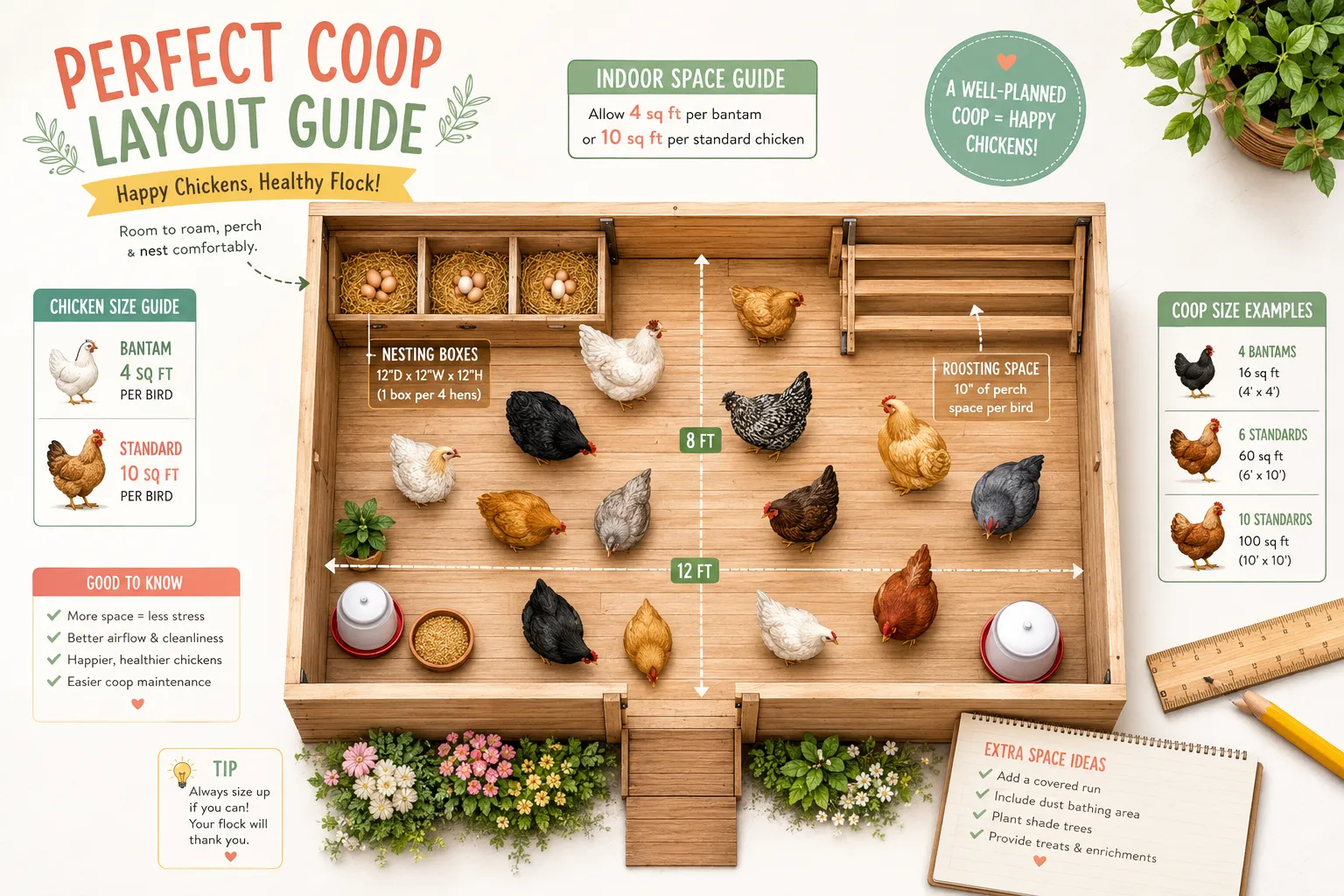
The absolute minimum space requirement is 3-4 square feet per standard chicken inside the coop structure itself. This measurement refers to the indoor sleeping and nesting area where chickens spend nights and lay eggs, not the outdoor run.
However, this minimum only works if your chickens have daily access to an outdoor run or free-range area. If your birds are confined to the coop for extended periods due to weather, predators, or local regulations, you should provide 8-10 square feet per bird indoors.
Space requirements by breed size:
- Bantam chickens: 2 square feet per bird (coop)
- Standard breeds (Rhode Island Red, Plymouth Rock, Leghorn): 3-4 square feet per bird
- Large breeds (Jersey Giant, Brahma, Cochin): 5 square feet per bird
- Meat chickens (Cornish Cross): 3-4 square feet, but they grow rapidly and need space adjusted accordingly
Choose the larger end of these ranges if you live in a cold climate where chickens spend more time indoors, if your flock includes roosters (who need extra space), or if you’re keeping particularly active or flighty breeds.
What’s the Difference Between Coop Space and Run Space for Chickens?
Coop space refers to the enclosed, sheltered structure where chickens sleep at night, lay eggs in nesting boxes, and seek shelter from weather. Run space is the attached or adjacent outdoor area where chickens spend daytime hours scratching, dust bathing, and foraging.
The distinction matters because chickens need significantly more run space than coop space. While 3-4 square feet per bird suffices indoors, each chicken needs 8-10 square feet in the outdoor run. This larger area allows natural behaviors like foraging, establishing pecking order without constant conflict, and getting exercise.
Key differences:
- Coop: Enclosed on all sides, predator-proof, contains roosting bars and nesting boxes, climate-controlled or insulated
- Run: Fenced outdoor area, may have partial roof or be fully covered, includes dirt or grass floor for scratching
- Time spent: Chickens typically use the coop 10-12 hours (nighttime) and the run 12-14 hours (daytime)
If you’re building from scratch, calculate both spaces separately. A flock of 6 chickens needs an 18-24 square foot coop plus a 48-60 square foot run at minimum.
How Much Space Do Bantam Chickens Need Compared to Standard Chickens?
Bantam chickens need approximately half the space of standard-sized chickens. Provide 2 square feet per bantam in the coop and 4-6 square feet per bird in the outdoor run.
Bantams weigh 1-2 pounds compared to 5-8 pounds for standard breeds, so their smaller body size translates directly to reduced space requirements. However, don’t cut corners too much, bantams are often more active and flighty than standard breeds, so they benefit from vertical space like perches at different heights.
Bantam-specific considerations:
- Roosting bars can be placed closer together (6-8 inches apart vs. 10-12 inches for standard birds)
- Nesting boxes can be smaller (10×10 inches vs. 12×12 inches)
- Bantams are better flyers, so coop height matters more, aim for at least 4 feet of interior height
- Mixed flocks (bantams with standard chickens) should use standard chicken spacing to prevent bullying
A common mistake is buying a “4-6 chicken” prefab coop marketed for bantams and then filling it with standard breeds. Always verify the actual square footage and calculate based on your specific birds.
What Happens If Chickens Don’t Have Enough Space in a Coop?
Overcrowded chickens experience increased stress, aggression, disease transmission, and reduced egg production. The confined space triggers territorial behavior and prevents birds from escaping conflicts, leading to a cascade of health and behavioral problems.
Specific consequences of overcrowding:
- Feather pecking and cannibalism: Stressed chickens peck at each other’s feathers, sometimes escalating to injury or death
- Disease spread: Respiratory illnesses, parasites, and bacterial infections spread rapidly in tight quarters
- Reduced egg production: Stressed hens lay fewer eggs or stop laying entirely
- Ammonia buildup: More birds in less space means faster accumulation of droppings and harmful ammonia fumes
- Aggressive pecking order: Dominant birds become bullies, preventing subordinate chickens from accessing food and water
- Poor sleep quality: Chickens crowded on roosting bars can’t settle properly, leading to exhaustion
The effects compound over time. What starts as minor feather damage can progress to serious wounds, secondary infections, and even death. Egg production may drop 20-40% in overcrowded conditions, and you’ll spend more on veterinary care and supplements trying to compensate for inadequate space.
How to Calculate Coop Size for 6 Chickens
For 6 standard chickens, you need a minimum 18-24 square foot coop (3-4 square feet per bird) and a 48-60 square foot run (8-10 square feet per bird). This assumes daily outdoor access and moderate climate conditions.
Step-by-step calculation:
- Count your birds: 6 chickens
- Multiply by minimum coop space: 6 birds × 3 sq ft = 18 sq ft (tight) or 6 × 4 sq ft = 24 sq ft (comfortable)
- Multiply by minimum run space: 6 birds × 8 sq ft = 48 sq ft (tight) or 6 × 10 sq ft = 60 sq ft (comfortable)
- Add 20-30% if applicable: Cold climate, no free-range time, or aggressive breeds
Example coop dimensions for 6 chickens:
- 4 feet × 6 feet = 24 square feet (good size)
- 3 feet × 8 feet = 24 square feet (narrow but workable)
- 5 feet × 5 feet = 25 square feet (square layout)
Example run dimensions:
- 6 feet × 10 feet = 60 square feet
- 8 feet × 8 feet = 64 square feet
Always round up rather than down. It’s easier to house fewer chickens in a larger coop than to expand a too-small structure later. If you plan to expand your flock in the future, build for your target number now.

Do Free Range Chickens Need Less Coop Space?
Free-range chickens still need the same coop space for nighttime roosting and nesting (3-4 square feet per bird), but they can manage with a smaller or even no dedicated run since they forage freely during the day.
The coop remains essential because chickens instinctively return to a secure shelter at dusk to roost and sleep. Even birds with acres to roam need a predator-proof coop with adequate roosting bars and nesting boxes. However, you can reduce or eliminate the enclosed run if your property is fenced and you’re home to supervise during free-range hours.
Free-range considerations:
- Coop space stays the same: 3-4 sq ft per bird indoors
- Run space can be reduced to 4-6 sq ft per bird or eliminated entirely
- Chickens need safe outdoor access during daylight hours (minimum 6-8 hours daily)
- Predator protection becomes your responsibility during free-range time
- Local ordinances may restrict free-ranging in residential areas
A common mistake is thinking free-range chickens don’t need a proper coop at all. They absolutely do, for sleeping, laying eggs, and shelter during extreme weather. The difference is they don’t need as much enclosed run space since they’re getting exercise and enrichment in your yard.
What’s the Best Coop Size for Beginners with Backyard Chickens?
Beginners should start with a coop sized for 4-6 chickens, which translates to 16-24 square feet of coop space and 32-60 square feet of run space. This size is manageable for maintenance, affordable to build or buy, and provides enough eggs for a typical household without overwhelming a first-time keeper.
A 4-6 bird flock produces approximately 20-35 eggs per week (depending on breed and season), which suits most families. The coop is small enough to clean in 15-20 minutes weekly but large enough that minor mistakes in management won’t immediately cause problems.
Beginner-friendly coop features:
- Walk-in design (at least 5-6 feet tall) makes cleaning and egg collection easier
- External nesting boxes with hinged lids for egg collection without entering the coop
- Removable dropping boards under roosting bars for quick daily cleaning
- Adequate ventilation (1 sq ft of vent space per 10 sq ft of floor space)
- Predator-proof construction with hardware cloth (not chicken wire) and buried fencing
Choose a slightly larger coop than your initial flock requires. Many beginners catch “chicken math” and want to add more birds within the first year. Building a 24 square foot coop for 4 chickens gives you room to expand to 6 without construction projects.
Common Mistakes When Building a Chicken Coop Too Small
The most common mistake is trusting prefab coop marketing claims that drastically overstate capacity. A coop advertised for “8-10 chickens” often provides only 20-24 square feet of space, which is adequate for just 5-6 birds by proper standards.
Other frequent sizing errors:
- Forgetting to measure interior space: Walls, nesting boxes, and feeders reduce usable floor space by 20-30%
- Ignoring vertical space: Low ceilings prevent proper roosting bar placement and make cleaning difficult
- Skipping the run calculation: Focusing only on coop size while providing inadequate outdoor space
- Not planning for growth: Starting with chicks and failing to account for adult bird size
- Mixing breeds without adjustment: Combining bantams and standard birds without using standard spacing
- Underestimating winter needs: Building for summer conditions in climates with harsh winters
The “just one more chicken” temptation causes many overcrowding problems. Each additional bird beyond capacity increases problems exponentially, not linearly. Six chickens in a 15-square-foot coop aren’t just slightly cramped, they’re in a stress situation that will cause behavioral and health issues.
If you’ve already built too small, your options are expanding the structure, reducing flock size, or providing significantly more free-range time to compensate.
Can You Add More Chickens to an Existing Coop Without Expanding?
You can only add more chickens if your current coop has unused capacity based on the 3-4 square feet per bird standard. Measure your coop’s interior floor space, subtract 20-30% for nesting boxes and equipment, then divide by 4 to find your true maximum capacity.
Calculation example:
- Coop interior: 6 feet × 8 feet = 48 square feet
- Minus nesting boxes and feeders: 48 – 10 = 38 usable square feet
- Divided by 4 sq ft per bird: 38 ÷ 4 = 9.5 chickens maximum
- Current flock: 6 chickens
- Available capacity: 3 additional birds
If your coop is already at or above capacity, adding more birds will cause overcrowding problems. Don’t rely on “they seem fine” as a measure, stress and health issues from overcrowding develop gradually over weeks and months.
Before adding birds, verify you also have:
- Adequate roosting bar length (8-10 inches per bird)
- Sufficient nesting boxes (1 box per 3-4 hens)
- Enough run space (8-10 sq ft per bird outdoors)
- Properly sized feeders and waterers for the larger flock
Introducing new chickens to an established flock requires quarantine and gradual integration regardless of space, but adequate room makes the process much smoother and reduces aggression.
How Much Roosting Bar Space Does Each Chicken Need?
Each chicken needs 8-10 inches of horizontal roosting bar space for comfortable sleeping. Standard breeds do well with 8 inches, while larger breeds like Brahmas or Jersey Giants need the full 10 inches. Bantams can manage with 6 inches each.
Roosting bars should be positioned 2-4 feet off the ground, made from 2×4 lumber placed with the wide side up (not rounded dowels, which are hard on chicken feet). If you need multiple bars due to space constraints, place them at the same height rather than ladder-style to prevent dominant birds from claiming the highest perch and defecating on birds below.
Roosting bar setup for 6 chickens:
- Total length needed: 48-60 inches (6 birds × 8-10 inches each)
- Can use one 5-foot bar or two 2.5-foot bars at the same height
- Position 12-18 inches from the wall
- Install 2-4 feet above the floor
- Place dropping boards underneath for easier cleaning
A common mistake is installing roosting bars too close together (less than 12 inches apart horizontally) or at different heights that create a pecking order battleground. Chickens should be able to roost side-by-side without touching, and all bars should be equally desirable to prevent fighting.
Do Meat Chickens Need Different Coop Space Than Laying Hens?
Meat chickens (broilers) need the same 3-4 square feet per bird as laying hens, but their rapid growth rate and shorter lifespan create different practical considerations. Cornish Cross broilers reach processing weight in 8-10 weeks, so many farmers use temporary housing or tractors rather than permanent coops.
The main difference is that meat chickens are less active than layers and spend more time eating and resting. They don’t need elaborate roosting setups (many broilers are too heavy to roost comfortably) or nesting boxes since they’re processed before laying age.
Meat chicken housing differences:
- Roosting bars: Optional or lower to the ground (many broilers prefer floor sleeping)
- Nesting boxes: Not needed
- Run space: Can be reduced to 6-8 sq ft per bird since they’re less active
- Flooring: Deep litter or frequent bedding changes due to rapid waste accumulation
- Duration: Temporary 8-12 week housing vs. 2-4 year housing for layers
If you’re raising both meat birds and layers, keep them separated. Broilers grow so quickly that they can accidentally injure smaller or younger laying breeds, and their different nutritional needs require separate feed.
Heritage meat breeds (like Freedom Rangers or Red Rangers) are more active than Cornish Cross and should be housed more like laying hens with full roosting bars and larger run space.
Signs Your Chicken Coop Is Overcrowded
Feather loss, aggressive pecking, reduced egg production, and strong ammonia smell are the primary signs of an overcrowded coop. These symptoms often appear gradually, so regular observation is essential.
Behavioral signs:
- Chickens pecking at each other’s feathers, especially on backs and tails
- Birds sleeping on the floor because roosting bars are full
- Fighting over nesting boxes or multiple hens trying to use one box simultaneously
- Subordinate chickens unable to access food or water due to bullying
- Increased noise and agitation, especially at roosting time
Physical and environmental signs:
- Bare patches or wounds on multiple birds
- Dirty, matted feathers from inability to dust bathe properly
- Strong ammonia odor even shortly after cleaning
- Wet, compacted bedding that doesn’t dry between cleanings
- Respiratory issues (sneezing, wheezing, nasal discharge) in multiple birds
Production signs:
- Egg production drops 20% or more without other explanation
- Increased number of broken or dirty eggs
- Hens laying eggs outside the coop to avoid crowded nesting boxes
If you notice multiple signs, calculate your actual space per bird immediately. The solution is either reducing flock size, expanding the coop, or providing significantly more outdoor time. Overcrowding problems don’t resolve on their own and typically worsen over time.
Winter Coop Space Requirements vs. Summer
Chickens need 20-30% more coop space in winter climates where they spend extended periods indoors due to snow, ice, or extreme cold. In regions with mild winters, standard spacing remains adequate year-round.
During winter, chickens may stay inside the coop for days or weeks at a time rather than venturing into cold or snowy runs. This extended confinement means the coop must function as both sleeping quarters and daytime living space. What works as a nighttime-only shelter in summer becomes inadequate when birds are cooped up 24/7.
Winter spacing adjustments:
- Cold climates (regular snow, temps below 20°F): Increase to 5-6 sq ft per bird in coop
- Moderate climates (occasional snow, temps 20-40°F): Standard 3-4 sq ft usually sufficient
- Mild climates (rare freezing, temps above 40°F): Standard spacing works fine
Additional winter considerations:
- Increase ventilation to prevent moisture buildup and frostbite (paradoxically, cold coops need more airflow, not less)
- Provide entertainment like hanging cabbage or scratch grains to reduce boredom and pecking
- Use deep litter method to generate warmth and give chickens something to scratch through
- Ensure water doesn’t freeze, which can effectively reduce coop capacity if birds cluster around one heated waterer
If you’re planning a coop in a northern climate, build for winter capacity from the start. A 6-chicken flock needs 30-36 square feet rather than the standard 18-24 square feet.
Prefab Chicken Coop Sizes and How Many Birds They Hold
Most prefab coops overstate their capacity by 30-50% compared to recommended space guidelines. A coop marketed for “6-8 chickens” typically provides only 16-20 square feet of interior space, which comfortably houses just 4-5 standard birds.
How to evaluate prefab coop claims:
- Find the actual interior dimensions (length × width)
- Calculate square footage
- Subtract 20-30% for nesting boxes, feeders, and unusable corners
- Divide remaining space by 4 sq ft per bird
- That’s your realistic capacity, usually 40-60% of the advertised number
Common prefab coop sizes and realistic capacity:
| Advertised Capacity | Typical Interior Size | Actual Square Feet | Realistic Bird Count |
|---|---|---|---|
| 3-4 chickens | 3′ × 4′ | 12 sq ft | 2-3 birds |
| 4-6 chickens | 4′ × 4′ | 16 sq ft | 3-4 birds |
| 6-8 chickens | 4′ × 5′ | 20 sq ft | 4-5 birds |
| 8-10 chickens | 4′ × 6′ | 24 sq ft | 5-6 birds |
| 10-12 chickens | 5′ × 6′ | 30 sq ft | 6-7 birds |
The marketing inflation happens because manufacturers calculate capacity using 2 square feet per bird (an outdated standard) or include run space in their total, which is misleading since coop and run serve different functions.
Red flags when shopping for prefab coops:
- No interior dimensions listed, only exterior measurements
- “Holds up to X chickens” without specifying breed size
- Run space included in total square footage claims
- Interior height less than 3 feet (makes cleaning impossible)
- Nesting boxes that protrude into interior space
If you’re buying prefab, always calculate the actual interior square footage yourself and plan for 50-60% of the advertised capacity. Better yet, look for coops marketed by square footage rather than bird count, which tends to indicate a more honest manufacturer.
Frequently Asked Questions
How much space do 4 chickens need in a coop?
Four standard chickens need a minimum 12-16 square feet of coop space (3-4 sq ft per bird) and 32-40 square feet of run space. A 4×4 foot coop (16 sq ft) with an 8×5 foot run (40 sq ft) provides comfortable housing for four birds.
Can chickens have too much space in a coop?
No, chickens cannot have too much space. Larger coops are easier to keep clean, provide better air quality, reduce stress and aggression, and give you flexibility to expand your flock. The only downside is higher construction cost and more area to heat in extreme climates.
How many nesting boxes do I need for 6 chickens?
You need 2 nesting boxes for 6 chickens. The standard ratio is one nesting box per 3-4 hens. Chickens often share favorite boxes regardless of how many you provide, so having 2-3 boxes for a small flock is sufficient.
Do chickens need a run if they free range?
Chickens don’t need a dedicated run if they truly free range for 6-8 hours daily, but a small secure run (4-6 sq ft per bird) is useful for times when you can’t supervise, during bad weather, or when predator activity is high. It provides a safe outdoor option without requiring your presence.
How tall should a chicken coop be inside?
A chicken coop should be at least 3-4 feet tall for small coops and 6-7 feet for walk-in designs. Roosting bars need to be 2-4 feet off the ground, and you need clearance above them. Walk-in coops make daily maintenance much easier and are worth the extra construction cost.
What happens if I have 8 chickens in a coop built for 6?
Eight chickens in a 6-bird coop (24 sq ft) means each bird has only 3 square feet instead of the recommended 4. You’ll likely see increased feather pecking, more frequent illness, reduced egg production, and faster bedding deterioration. Reduce to 6 birds or expand the coop by 8 square feet.
How much space do Silkie chickens need?
Silkie chickens are bantam-sized and need approximately 2 square feet per bird in the coop and 4-6 square feet in the run. However, Silkies can’t fly well and need lower roosting bars (12-18 inches high) and protection from more aggressive breeds if kept in a mixed flock.
Should I count nesting box space in my coop square footage?
No, don’t count nesting boxes, feeders, waterers, or other equipment in your usable square footage calculation. Measure the total interior floor space, then subtract 20-30% for these fixtures to find the actual space available for chickens to move around.
How much space do chickens need in a mobile coop or tractor?
Chickens in mobile coops need the same 3-4 square feet per bird inside the shelter portion, but the run can be smaller (4-6 sq ft per bird) since you’re moving the tractor daily to fresh ground. The frequent moves provide new foraging area, compensating for the smaller enclosed run.
Can I use vertical space to compensate for small floor space?
No, vertical space doesn’t substitute for floor space. While chickens use roosting bars and enjoy perches at different heights, they need adequate floor area for moving around, dust bathing, eating, and establishing pecking order. A tall but narrow coop still causes overcrowding problems.
How much space do baby chicks need before moving to the coop?
Baby chicks need 2-3 square feet per bird in a brooder for the first 6-8 weeks. They can move to the coop when fully feathered (usually 6-8 weeks old) and when nighttime temperatures stay above 50°F. Calculate coop space based on their adult size, not chick size.
What’s the minimum coop size required by law?
Coop size regulations vary by location. Some cities specify minimum square footage per bird (often 2-4 sq ft), while others regulate only setbacks from property lines and total flock size. Check your local zoning ordinances, homeowners association rules, and state agricultural regulations before building.
Conclusion
Understanding how much space chickens need in a coop is fundamental to keeping a healthy, productive flock. Standard chickens require 3-4 square feet per bird inside the coop and 8-10 square feet in the outdoor run, with adjustments for breed size, climate, and whether your birds free range. Bantams need about half that space, while larger breeds may need up to 5 square feet indoors.
The consequences of overcrowding, feather pecking, disease, reduced egg production, and aggressive behavior, far outweigh the cost of building adequate space from the start. When in doubt, build bigger. You’ll never regret having extra room, but you’ll definitely regret a too-small coop once problems emerge.
Your next steps:
- Measure your current coop (or planned coop) interior dimensions and calculate actual square footage
- Determine your flock size and multiply by 4 square feet per bird to find your minimum coop size
- Calculate run space at 8-10 square feet per bird, or reduce if your chickens free range daily
- Add 20-30% extra space if you live in a cold climate or plan to expand your flock
- Verify roosting bar length (8-10 inches per bird) and nesting box quantity (1 per 3-4 hens)
If you’re shopping for a prefab coop, ignore the advertised bird capacity and calculate the actual interior square footage yourself. Plan for 50-60% of the manufacturer’s claimed capacity to ensure your chickens have adequate space.
Building or buying the right-sized coop from the beginning saves money, time, and stress compared to dealing with overcrowding problems or expanding a too-small structure later. Your chickens will reward proper spacing with better health, more eggs, and fewer behavioral issues.


