
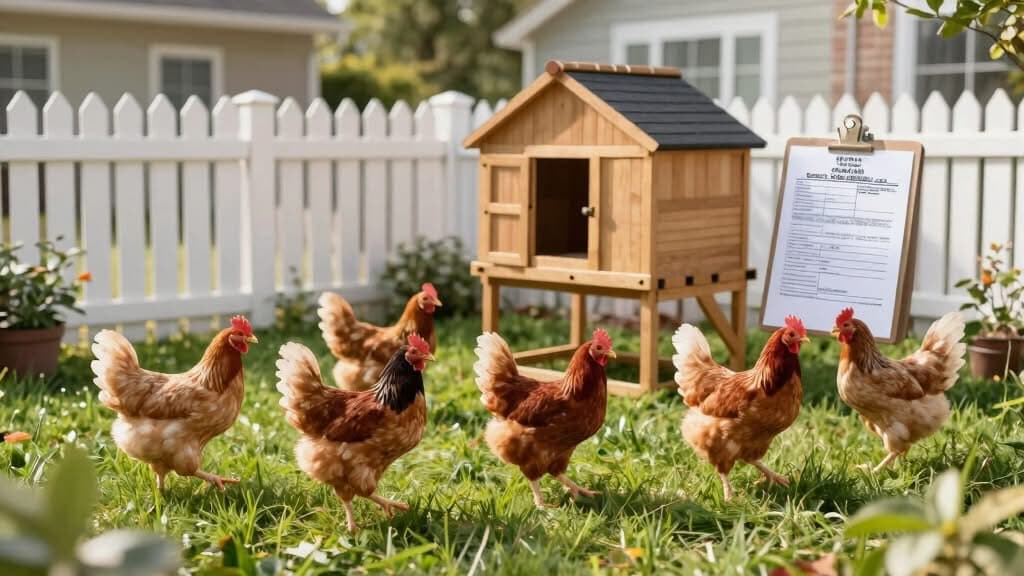
More than 13 million American households now keep backyard chickens, yet most new chicken keepers discover permit requirements only after building their coop. Whether you need a permit for backyard chickens depends entirely on your city, county, and neighborhood rules, some municipalities require formal permits with inspections and fees, others ask only for simple registration, and many ban chickens outright in residential zones.
Key Takeaways
- Permit requirements vary drastically by location: some cities require paid permits and inspections, others need only registration, and many prohibit chickens entirely in residential areas
- Most urban areas cap flock size at 4-6 hens without a permit, and nearly all ban roosters in residential zones regardless of permit status
- Permit costs typically range from $0 (free registration) to $150 for initial application, with some jurisdictions charging annual renewal fees
- Keeping chickens without required permits can result in fines from $50 to $500+ per day, forced removal of your flock, and legal action from neighbors
- HOA rules often override city permits: even if your municipality allows chickens, your homeowners association may prohibit them through covenant restrictions
- Renters must obtain written landlord permission before applying for any chicken permit, as property owner consent is required in most jurisdictions
- Coop placement and construction standards (setback distances, square footage, height limits) are usually specified in permit conditions
- Approval timelines range from immediate registration to 30-60 day review periods depending on whether inspections are required
- Zoning classifications matter: agricultural and rural-residential zones typically allow chickens by right, while urban residential zones impose strict limits or bans
What Is a Backyard Chicken Permit?
A backyard chicken permit is an official authorization from your local government allowing you to keep a specified number of chickens on residential property. The permit documents that you’ve met local zoning requirements, coop construction standards, and flock size limits.
Permits typically specify:
- Maximum number of hens allowed (usually 4-8 birds)
- Prohibition of roosters in most residential zones
- Coop placement requirements (minimum distances from property lines and dwellings)
- Sanitation and maintenance standards to prevent nuisance complaints
- Inspection requirements before approval or during annual renewals
Some jurisdictions use the term “license” or “registration” instead of permit, but the function is the same: official permission to keep poultry within city limits. The permit process ensures your chicken-keeping operation won’t create health hazards, noise complaints, or conflicts with neighbors.
Common mistake: Assuming a permit is a one-time approval. Many cities require annual renewals with re-inspection, and permits can be revoked if you violate conditions or generate valid complaints.
How Do I Find Out If My City Allows Backyard Chickens?
Start by contacting your city’s planning or zoning department directly, they maintain the official ordinances that govern backyard livestock. Most municipalities now publish zoning codes online, searchable by address or parcel number.
Step-by-step research process:
- Check your city’s official website: search for “backyard chickens,” “urban agriculture,” or “poultry ordinance” in the municipal code section
- Call the planning/zoning department: ask specifically about residential poultry keeping in your zoning classification
- Review your property’s zoning designation: residential zones (R-1, R-2, etc.) have different rules than agricultural or mixed-use zones
- Verify county regulations: if you live in unincorporated areas, county rules apply instead of city ordinances
- Check HOA covenants: request a copy of your homeowners association’s CC&Rs (Covenants, Conditions & Restrictions)
Many cities maintain a “chicken-friendly” or “urban agriculture” webpage with permit applications, fee schedules, and coop design guidelines. If your city doesn’t explicitly address chickens in the code, they may be prohibited by default under “livestock” or “farm animal” restrictions.
Choose this approach if: You want definitive answers before investing in coops and birds. Official sources prevent costly mistakes based on outdated neighborhood rumors or Facebook group advice.
Do I Need a Permit for Chickens in My Backyard or Just Register Them?
The distinction between permits and registration depends on your jurisdiction’s regulatory approach. Permits typically require formal application, fee payment, coop inspections, and approval before you can legally keep chickens. Registration is usually a simpler notification process, you inform the city you’re keeping chickens, provide basic information, and receive confirmation without pre-approval or inspection.
Permit jurisdictions (more restrictive):
- Require application submission with site plans and coop specifications
- Charge application and annual renewal fees
- Conduct pre-approval inspections of coop construction and placement
- Issue formal permits with conditions and expiration dates
- Examples: Portland (Oregon), Seattle, Minneapolis
Registration jurisdictions (less restrictive):
- Require only notification to the city or county
- May charge minimal or no fees
- Rarely conduct inspections unless complaints arise
- Provide registration confirmation rather than formal permits
- Examples: Austin (Texas), Denver, Madison (Wisconsin)
No-permit jurisdictions fall into two categories: rural areas where chickens are allowed by right without any paperwork, and urban areas where chickens are completely prohibited regardless of permit applications.
Edge case: Some cities require permits only above a certain flock size (e.g., 4 hens or fewer need only registration, 5-8 require a permit).
How Much Does a Backyard Chicken Permit Cost?
Permit fees range from free registration to $150+ for initial applications, with many jurisdictions charging annual renewal fees between $15 and $50. The total cost depends on your city’s fee structure, inspection requirements, and whether you need variances for non-compliant coop placement.
Typical fee structures:
| Fee Type | Cost Range | When Applied |
|---|---|---|
| Initial application | $0 – $150 | One-time at first application |
| Annual renewal | $15 – $50 | Yearly to maintain permit |
| Inspection fee | $25 – $75 | If separate from application fee |
| Variance/appeal | $100 – $500+ | If requesting exception to rules |
| Late renewal penalty | $25 – $100 | If permit expires before renewal |
Examples from major cities (2026 rates):
- Portland, Oregon: $42 initial permit, $21 annual renewal
- Seattle, Washington: $60 initial permit, no renewal fee
- Minneapolis, Minnesota: $50 annual permit (no separate initial fee)
- Austin, Texas: Free registration, no fees
- Denver, Colorado: $16 annual registration
Additional costs beyond the permit itself include coop construction ($200-$2,000+), initial flock purchase ($20-$50 per bird), and ongoing feed and maintenance expenses.
Money-saving tip: Some cities waive fees for low-income applicants or offer reduced rates for urban agriculture participants. Ask about fee waivers when applying.
What Happens If I Keep Chickens Without a Permit?
Operating without required permits exposes you to escalating fines, forced removal of your flock, and potential legal action from neighbors or the city. Most violations begin with a warning notice giving you 7-30 days to obtain a permit or remove the birds, but repeat violations trigger financial penalties.
Typical enforcement progression:
- Initial warning: Notice of violation with 14-30 day compliance deadline
- First citation: Fines of $50-$250 for failure to comply
- Daily penalties: Continuing violations accrue $25-$100 per day in some jurisdictions
- Forced removal: Animal control may confiscate birds after repeated violations
- Court action: Cities can file misdemeanor charges or civil suits for persistent violations
Real consequences:
- Fines accumulate quickly: A $75/day penalty reaches $2,250 in just one month
- Neighbor complaints trigger investigations: Even if the city hasn’t proactively enforced rules, one complaint launches an inspection
- Property liens: Unpaid fines can result in liens against your property
- Difficulty selling your home: Unpermitted structures (coops) must be disclosed and can complicate real estate transactions
Common scenario: Many chicken keepers operate without permits for months or years without issue, then face enforcement after a neighbor complains about noise, odor, or escaped birds. The violation history makes it harder to obtain a retroactive permit.
Choose compliance if: You value long-term stability over short-term savings. The permit cost is minimal compared to potential fines and the stress of forced flock removal.
Can I Have Chickens in My Backyard in a Residential Area?
Most residential areas now allow backyard chickens with restrictions, but permission depends on your specific zoning classification and local ordinances. Single-family residential zones (R-1, RS, etc.) increasingly permit small flocks of hens, while multi-family and high-density zones often maintain prohibition.
Residential zoning categories and typical chicken rules:
- Single-family residential (R-1, RS): Usually allows 4-8 hens with permit, no roosters, minimum lot size requirements (often 5,000-7,000 sq ft)
- Multi-family residential (R-2, R-3): Often prohibits chickens entirely or allows only with special use permits
- Urban residential (high-density): Typically prohibits all poultry due to lot size and density concerns
- Rural-residential (RR, A-1): Generally allows chickens by right without permits, higher flock limits
Factors that determine residential chicken legality:
- Lot size minimums: Many ordinances require at least 5,000-10,000 square feet to keep chickens
- Setback requirements: Coops must be 10-25 feet from property lines and 20-50 feet from neighboring dwellings
- Density restrictions: Some cities prohibit chickens on lots smaller than 1/4 acre
- Neighborhood type: Historic districts and planned communities may have additional restrictions
Edge case: Some cities allow chickens in residential areas but only with written consent from all adjacent property owners, a requirement that effectively gives neighbors veto power over your flock.
How Many Chickens Can I Have Without a Permit?
Most jurisdictions that allow backyard chickens without permits cap flock size at zero, meaning any number of birds requires at least registration. However, some rural and agricultural zones allow small flocks (typically 4-6 hens) by right without any paperwork.
Common flock size regulations:
- Urban permit jurisdictions: 0 chickens allowed without permit; 4-8 hens allowed with permit
- Urban registration jurisdictions: 0 chickens without registration; 4-10 hens allowed after registration
- Rural/agricultural zones: Often 6-12 chickens allowed by right; higher numbers may require permits
- Suburban mixed-use: Varies widely; some allow 3-4 hens without permits, others require permits for any number
Typical permit-based flock limits:
- 4-6 hens: Most common urban limit
- 8-10 hens: Larger suburban lots
- 12-25 hens: Rural-residential zones
- 25+ hens: Requires commercial poultry operation permits
Important distinction: “Without a permit” usually means “prohibited entirely” in urban areas, not “allowed in small numbers.” The phrase “permit-free chicken keeping” typically applies only to agricultural zones where poultry is an allowed use by right.
Common mistake: Assuming you can keep “just a few” chickens without checking local rules. Even one hen requires compliance with local ordinances in most residential areas.
Do You Need a Permit for Backyard Chickens in HOA Neighborhoods?
HOA rules can prohibit chickens even when city permits are available, homeowners association covenants are private contracts that often impose stricter restrictions than municipal codes. You must comply with both city regulations AND HOA rules, and HOA prohibition typically overrides city permission.
HOA authority over chickens:
- CC&Rs (Covenants, Conditions & Restrictions) are legally binding contracts you agreed to when purchasing property
- HOAs can prohibit chickens entirely through “no livestock” or “no farm animals” clauses
- HOA rules take precedence over city permits in most cases, having a city permit doesn’t override HOA prohibition
- Violations trigger HOA enforcement: fines, liens, and potential foreclosure for persistent violations
Steps to navigate HOA restrictions:
- Review your CC&Rs carefully: search for terms like “poultry,” “livestock,” “farm animals,” and “nuisance animals”
- Check HOA bylaws and architectural guidelines: some HOAs regulate chickens through design standards rather than outright bans
- Request formal interpretation: ask the HOA board in writing whether chickens are permitted
- Propose rule amendments: gather neighbor support and petition the board to modify restrictions
- Seek variances: some HOAs grant exceptions for well-designed coops that don’t impact neighbors
Success factors for HOA approval:
- Neighbor support: Letters from adjacent property owners endorsing your plan
- Professional coop design: Attractive structures that blend with neighborhood aesthetics
- Proactive communication: Presenting plans before purchasing birds demonstrates responsibility
- Pilot programs: Offering a trial period with conditions can overcome board hesitation
Choose this path if: Your HOA documents are silent on chickens or use ambiguous language. Explicit prohibition is harder to overcome, but vague “nuisance” clauses may allow well-managed flocks.
Are Roosters Allowed with a Backyard Chicken Permit?
Nearly all urban and suburban chicken permits prohibit roosters due to noise complaints, allowing only hens regardless of permit status. Rooster prohibition is the most consistent rule across jurisdictions, even cities with permissive chicken policies ban roosters in residential zones.
Why roosters are prohibited:
- Noise ordinances: Roosters crow at dawn (and throughout the day), generating 90+ decibels, loud enough to violate most residential noise limits
- Neighbor complaints: Rooster noise is the primary reason cities restrict or ban backyard chickens
- No egg production benefit: Hens lay eggs without roosters present; roosters serve only breeding purposes
- Aggression concerns: Roosters can be territorial and aggressive toward people, especially children
Rare exceptions where roosters may be allowed:
- Agricultural zones: Rural and farm-zoned properties typically allow roosters without restriction
- Large lot minimums: Some jurisdictions allow roosters on properties exceeding 1-2 acres with special permits
- Distance requirements: A few cities permit roosters if the coop is 200+ feet from neighboring dwellings
- Temporary permits: Some areas allow roosters for limited periods (e.g., 4-H projects, breeding programs)
Enforcement reality: Rooster prohibition is strictly enforced because noise complaints are objective and easy to verify. Cities respond quickly to rooster complaints, often requiring removal within 24-48 hours.
Common mistake: Purchasing “pullet” chicks that turn out to be roosters. Sexing errors occur in 5-10% of chick purchases, and you must rehome or cull roosters even if you didn’t intend to keep them.
What Are the Zoning Laws for Backyard Chickens?
Zoning laws classify land uses and determine whether chickens are permitted, conditionally allowed, or prohibited on your property. Backyard chickens fall under “urban agriculture,” “accessory use,” or “animal keeping” categories depending on your jurisdiction’s zoning code structure.
Zoning classifications and chicken rules:
- Agricultural (A, AG, A-1): Chickens allowed by right, no flock limits, roosters permitted
- Rural-Residential (RR, RA): Chickens usually allowed, moderate flock limits (12-25 birds), roosters often permitted
- Single-Family Residential (R-1, RS): Chickens conditionally allowed with permits, strict flock limits (4-8 hens), no roosters
- Multi-Family Residential (R-2, R-3, RM): Chickens usually prohibited or require special use permits
- Commercial/Industrial (C, I): Chickens prohibited except for agricultural businesses
Key zoning considerations:
- Accessory use vs. primary use: Chickens must be accessory to residential use (for personal consumption), not a commercial operation
- Lot size minimums: Many residential zones require 5,000-10,000 sq ft minimum lot size for chicken keeping
- Setback requirements: Coops must maintain specific distances from property lines (10-25 ft) and structures (20-50 ft)
- Conditional use permits: Some zones allow chickens only with special permits requiring neighbor notification and hearings
Variance process: If your property doesn’t meet zoning requirements (e.g., lot too small, setbacks impossible), you can apply for a variance, a formal exception requiring public hearings and board approval. Variance applications cost $200-$1,000+ and take 60-90 days.
Choose variances if: Your property is borderline non-compliant but you have strong neighbor support and can demonstrate hardship (e.g., irregular lot shape makes standard setbacks impossible).
Common Mistakes When Applying for a Chicken Permit
The most frequent permit application errors include incomplete site plans, non-compliant coop designs, and failure to obtain HOA approval before applying. These mistakes delay approval by weeks or months and can result in application denial.
Top permit application mistakes:
- Submitting applications before building the coop: Many cities require inspection of completed coops, but some want pre-approval of plans before construction
- Inadequate site plans: Failing to show accurate measurements of setbacks, property lines, and neighboring structures
- Non-compliant coop specifications: Designs that violate height limits, square footage requirements, or construction standards
- Ignoring HOA requirements: Applying for city permits without first confirming HOA approval
- Incomplete neighbor notification: Some jurisdictions require written notice to adjacent property owners; missing signatures delay approval
- Wrong zoning information: Listing incorrect zoning classification or lot size on applications
- Missing landlord consent: Renters applying without written property owner permission
- Inadequate waste management plans: Failing to describe manure disposal and odor control methods
Application best practices:
- Pre-application consultation: Schedule a meeting with planning staff to review requirements before submitting
- Professional site plans: Hire a surveyor if property boundaries are unclear
- Photo documentation: Include pictures of proposed coop location and existing conditions
- Neighbor outreach: Inform neighbors before applying, even if not required, prevents surprise opposition
- Complete applications: Submit all required documents at once to avoid processing delays
Timeline expectations: Simple registration takes 1-7 days; permit applications with inspections take 14-60 days depending on department workload and whether revisions are needed.
Do Renters Need Landlord Permission for Backyard Chickens?
Yes, renters must obtain written landlord permission before applying for chicken permits, property owner consent is a universal requirement in permit applications. Even if your city allows chickens, your lease agreement and landlord’s property rules take precedence.
Landlord permission requirements:
- Written consent required: Verbal permission isn’t sufficient for permit applications; get landlord approval in writing
- Lease modifications: Add chicken-keeping terms to your lease as an addendum specifying responsibilities
- Property damage liability: Clarify who pays for coop removal and yard restoration when you move
- Insurance considerations: Some landlord policies exclude coverage for tenant-owned livestock
Convincing your landlord to allow chickens:
- Offer increased security deposit: Additional $200-$500 deposit covers potential damage
- Provide coop removal plan: Commit to removing structures and restoring landscaping at move-out
- Share maintenance plan: Demonstrate you’ll prevent odor, pests, and property damage
- Highlight benefits: Chickens control pests, provide fertilizer, and improve yard health when managed properly
- Offer trial period: Request 6-month trial with option to terminate if problems arise
Lease clauses to negotiate:
- Flock size limits: Agree to specific number of hens (usually 3-4 for rentals)
- Coop specifications: Portable coops are preferable to permanent structures
- Maintenance standards: Weekly coop cleaning, daily egg collection, proper waste disposal
- Termination conditions: Landlord can require removal if neighbors complain or property damage occurs
Common mistake: Keeping chickens without landlord knowledge, then facing eviction when discovered. Lease violations related to unauthorized animals are grounds for immediate termination in most jurisdictions.
How Long Does It Take to Get Approved for a Chicken Permit?
Approval timelines range from immediate registration (same day) to 60+ days for permit applications requiring inspections, neighbor notification, and board review. Simple registration systems provide instant or next-day confirmation, while formal permit processes involve multiple review stages.
Typical approval timelines by jurisdiction type:
- Registration-only cities: 1-7 days (often same-day online registration)
- Permit with staff review: 14-30 days (planning staff reviews application and conducts inspection)
- Permit with neighbor notification: 30-45 days (includes 14-21 day comment period for adjacent property owners)
- Conditional use permits: 60-90 days (requires public hearings and board approval)
- Variance applications: 60-120 days (includes hearings, appeals periods, and board decisions)
Factors that extend approval time:
- Incomplete applications: Missing documents restart the review clock
- Inspection scheduling: Delays waiting for inspector availability
- Revision requests: Non-compliant coop designs require resubmission
- Neighbor opposition: Complaints trigger additional review and possible hearings
- Holiday periods: Applications submitted before holidays face processing delays
Expediting your application:
- Submit complete applications: Include all required documents, fees, and signatures
- Pre-application meetings: Confirm requirements with staff before formal submission
- Flexible inspection scheduling: Offer multiple dates for inspector availability
- Proactive neighbor outreach: Address concerns before formal comment periods
- Follow up regularly: Contact planning staff weekly for status updates
Edge case: Some cities have “deemed approved” rules, if the city doesn’t respond within a specified timeframe (e.g., 30 days), your application is automatically approved. Check your local ordinance for automatic approval provisions.
What Are the Coop Requirements for a Backyard Chicken Permit?
Coop requirements typically specify minimum square footage per bird, setback distances from property lines and structures, maximum height limits, and construction standards for sanitation and predator protection. These requirements ensure coops don’t create nuisances or health hazards.
Standard coop requirements:
Size and space:
- Indoor coop space: 2-4 square feet per bird minimum
- Outdoor run space: 8-10 square feet per bird minimum
- Total structure size: Often capped at 80-120 square feet for residential permits
Placement and setbacks:
- Property line setback: 10-25 feet from side and rear property lines
- Dwelling setback: 20-50 feet from neighboring homes
- Front yard prohibition: Coops must be in side or rear yards, not visible from street
- Easement restrictions: No coops in utility easements or drainage areas
Construction standards:
- Predator-proof design: Hardware cloth (not chicken wire), secure latches, buried wire skirts
- Weather protection: Waterproof roofing, ventilation, insulation in cold climates
- Sanitation features: Removable dropping boards, easy-clean flooring, proper drainage
- Height limits: Maximum 8-12 feet tall (often must be lower than primary dwelling)
Maintenance requirements:
- Weekly cleaning: Manure removal and bedding replacement
- Odor control: Proper composting or disposal of waste
- Pest prevention: Secure feed storage, regular cleaning to prevent rodents
- Noise mitigation: Enclosed coops to minimize hen sounds
Common permit conditions:
| Requirement | Typical Standard | Purpose |
|---|---|---|
| Coop square footage | 2-4 sq ft per bird | Prevent overcrowding |
| Run square footage | 8-10 sq ft per bird | Allow adequate exercise |
| Property line setback | 10-25 feet | Minimize neighbor impact |
| Maximum height | 8-12 feet | Maintain residential character |
| Roofing material | Weather-resistant | Prevent deterioration |
| Waste management | Weekly removal | Control odor and pests |
Design tip: Build coops that exceed minimum standards, generous space reduces odor, improves bird health, and prevents neighbor complaints that could jeopardize your permit.
Frequently Asked Questions
Can I get a chicken permit if my neighbor objects?
Most cities don’t require neighbor approval for chicken permits, but neighbor opposition can complicate the process. If your jurisdiction requires neighbor notification, objections may trigger a hearing where you must address concerns. Strong opposition rarely blocks permits unless you violate setback or nuisance standards, but proactive neighbor communication prevents conflicts.
Do chicken permits transfer to new property owners?
Permits typically transfer with property ownership if the new owner applies for continuation, but they’re not automatically inherited. When selling a home with chickens, inform buyers about permit requirements and transfer procedures. Some cities require new owners to reapply rather than simply transferring existing permits.
Can I keep chickens temporarily without a permit for a school project?
Temporary chicken keeping usually requires the same permits as permanent flocks, cities rarely grant short-term exceptions. Some jurisdictions offer educational permits for 4-H or FFA projects with modified requirements, but you must apply in advance. Keeping chickens without permits, even briefly, risks fines and forced removal.
What happens to my permit if I move within the same city?
Permits are property-specific, not owner-specific, so moving requires a new permit application for your new address. Your previous permit doesn’t transfer to a different property even within the same jurisdiction. Check whether your new property’s zoning and lot size allow chickens before moving your flock.
Do I need separate permits for ducks or other poultry?
Most chicken permits cover all poultry species (ducks, geese, turkeys) under the same flock limits, but some cities regulate them separately. Ducks and geese often have stricter restrictions due to water requirements and waste production. Check whether your permit language specifies “chickens” or “poultry” to determine coverage.
Can I appeal a denied chicken permit?
Yes, most jurisdictions allow appeals of permit denials through planning commissions or zoning boards. Appeals require filing within 10-30 days of denial, paying appeal fees ($100-$500), and presenting your case at a public hearing. Successful appeals typically require demonstrating that denial was arbitrary or that you meet all objective standards.
Do I need a permit renewal if I reduce my flock size?
Permit renewals are required regardless of flock size changes, but you should notify the city if you reduce birds below permitted numbers. Some jurisdictions charge lower renewal fees for smaller flocks. Failing to renew permits on schedule can result in penalties even if you’re keeping fewer birds than originally approved.
Are there tax benefits for having a chicken permit?
Backyard chicken permits rarely qualify for tax deductions unless you operate a commercial egg business. Hobby flocks are personal expenses, not business activities, so coop costs and feed aren’t deductible. Some rural properties with agricultural zoning may qualify for property tax reductions, but residential chicken permits don’t typically provide tax benefits.
Can I get a permit for meat chickens or just egg layers?
Most residential permits don’t distinguish between egg layers and meat birds, flock limits apply to total birds regardless of purpose. However, some cities prohibit on-site slaughter even if you have a valid permit. Check whether your ordinance addresses processing and butchering before raising meat chickens.
Do chicken permits expire if I temporarily don’t have birds?
Permit expiration depends on your jurisdiction’s rules, some require continuous bird ownership, others allow gaps. If you plan to be without chickens temporarily (e.g., during coop renovation), notify the city and ask whether your permit remains valid. Letting permits lapse may require reapplication and new fees when you’re ready to resume chicken keeping.
Can I get a permit for chickens in a mobile home park?
Mobile home parks are private property with their own rules that typically prohibit chickens regardless of city permits. Park management has authority to ban chickens even in cities with permissive ordinances. Check your park’s rules and lease agreement before pursuing a city permit, park prohibition overrides municipal permission.
What if my city doesn’t have a formal chicken permit process?
If your city lacks a specific chicken permit system, chickens may be allowed by right (no permit needed), prohibited entirely, or regulated under general animal keeping ordinances. Contact the planning department to determine whether chickens are allowed and what documentation, if any, is required. Absence of a permit process doesn’t automatically mean chickens are legal.
Conclusion
Understanding whether you need a permit for backyard chickens requires researching your specific city ordinances, county regulations, HOA rules, and zoning classification. Most urban and suburban areas now allow small flocks of hens with proper permits or registration, but requirements vary dramatically by location, from free same-day registration to $150 permits with inspections and annual renewals.
Take these steps before bringing chickens home:
- Contact your city’s planning department to confirm chicken legality and permit requirements in your zoning district
- Review your HOA covenants if you live in a planned community, HOA prohibition overrides city permits
- Obtain written landlord permission if you rent, and add chicken-keeping terms to your lease
- Calculate total costs including permit fees, coop construction, and ongoing maintenance before committing
- Design compliant coops that meet setback, size, and construction standards to avoid permit denial
- Communicate with neighbors proactively to address concerns and build support before applying
- Submit complete applications with all required documents, site plans, and fees to avoid processing delays
The investment in proper permits protects your flock from forced removal, shields you from escalating fines, and establishes your chicken-keeping operation as a legitimate, legal use of your property. Cities increasingly support urban agriculture, but compliance with local rules is essential for long-term success.
Start your research today, most planning departments provide free pre-application consultations that clarify requirements and prevent costly mistakes. With proper permits and well-designed coops, backyard chicken keeping can be a rewarding, legal addition to your home.