
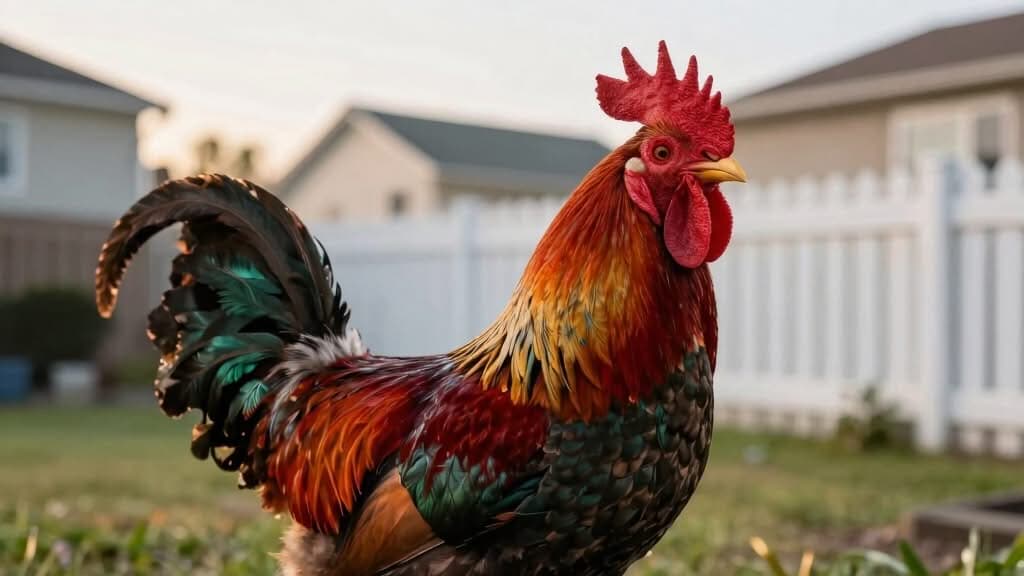
Quick Answer: Rooster legality in residential areas varies dramatically by location. Most suburban municipalities allow backyard hens but specifically prohibit roosters due to noise ordinances, while rural and some urban areas permit them with restrictions on flock size, property setbacks, or permits. You must check your city’s municipal code, county regulations, and homeowners association rules before bringing a rooster home.
Key Takeaways
- Most suburbs ban roosters but allow hens, primarily because of noise complaints and early-morning crowing
- City ordinances trump county rules, so always check your specific municipality’s code first
- HOA restrictions often prohibit roosters even when city law allows them
- Fines range from $50 to $500+ per violation, with repeat offenses escalating quickly
- Permit requirements exist in some cities that do allow roosters, often tied to minimum lot sizes
- Noise ordinances typically measure decibel levels during specific hours, and roosters regularly exceed residential limits
- Roosters are often classified as livestock, not pets, which triggers different zoning rules
- No truly “quiet” rooster breeds exist, though some crow less frequently than others
- Neighbor complaints are the primary enforcement trigger for rooster violations
- Rehoming options include farm sanctuaries, rural homesteads, and breed-specific rescue networks
What Is the Difference Between Rooster Laws and Chicken Laws?
Rooster laws and chicken laws differ primarily in how municipalities regulate noise and breeding. Most residential zoning codes permit hens (female chickens) because they produce eggs quietly, while specifically banning roosters (male chickens) due to their loud, repetitive crowing that can start before dawn and continue throughout the day.
The legal distinction exists because:
- Hens serve a practical purpose in residential settings (egg production) without significant noise
- Roosters are considered unnecessary for egg-laying and primarily useful for breeding or flock protection
- Noise ordinances typically set decibel limits during early morning hours (6 AM to 7 AM) that roosters routinely violate
- Breeding concerns lead some cities to ban roosters to prevent uncontrolled chicken population growth
Many municipal codes use language like “female chickens only” or “hens permitted, roosters prohibited.” Some cities allow a maximum number of hens (commonly 4-6) without mentioning roosters at all, which legally means roosters fall under general livestock prohibitions.
Common mistake: Assuming that if chickens are allowed, roosters must be too. Always read the specific ordinance language, because the default assumption in most residential zones is that roosters are prohibited unless explicitly permitted.
How to Find Out If Roosters Are Allowed in My City
Check your city’s municipal code first, then layer in county regulations and HOA restrictions. Start by visiting your city’s official website and searching for “chicken ordinance,” “backyard poultry,” or “urban agriculture” in the municipal code section, typically found under zoning, animal control, or public health chapters.
Step-by-step research process:
- Search your city’s municipal code online – most cities publish codes at municode.com or on their official website
- Call your city’s planning or zoning department – ask specifically about roosters, not just chickens
- Check your county’s animal control regulations – these apply in unincorporated areas or as a baseline
- Review your HOA covenants if you live in a planned community – these often override city permissions
- Visit your local extension office – they maintain current lists of poultry regulations by jurisdiction
Key search terms to use:
- “Roosters” or “male chickens”
- “Backyard poultry” or “urban chickens”
- “Livestock” in residential zones
- “Animal noise ordinances”
- Specific code sections like “Title 6” (animals) or “Title 17” (zoning)
Choose this approach if: You want definitive legal standing before acquiring a rooster. Verbal assurances from neighbors or anecdotal reports aren’t sufficient if you face enforcement action later.
Are Roosters Considered Livestock or Pets?
Roosters are legally classified as livestock in most jurisdictions, not pets, which subjects them to agricultural zoning rules rather than companion animal regulations. This classification matters because residential zones typically prohibit livestock while allowing common household pets like dogs and cats.
The livestock designation means:
- Zoning restrictions apply that don’t affect traditional pets
- Setback requirements may mandate coops be a certain distance from property lines (often 10-50 feet)
- Minimum lot sizes sometimes apply (quarter-acre or half-acre minimums are common)
- Agricultural exemptions in rural areas may allow unlimited roosters
Some progressive cities have created a third category called “urban agriculture” or “backyard poultry” that treats chickens differently from traditional livestock, allowing hens in residential zones with specific limitations. However, even in these jurisdictions, roosters often remain prohibited or heavily restricted.
Legal implication: If your city bans “livestock” in residential zones without specifically addressing poultry, roosters are almost certainly prohibited. If the code creates a special exception for “backyard chickens,” read carefully to see whether that exception includes roosters or only hens.
Can I Get Fined for Having a Rooster in My Backyard?
Yes, you can face fines ranging from $50 to $500 or more per violation if you keep a rooster in violation of local ordinances. Penalties typically escalate with repeat offenses, and some jurisdictions impose daily fines until you remove the rooster or come into compliance.
Typical enforcement progression:
- Warning notice – first contact is usually a written warning giving you 7-14 days to remove the rooster
- Initial citation – $50-$150 fine if you don’t comply within the warning period
- Repeat violations – fines double or triple ($200-$500) for subsequent offenses
- Daily penalties – some cities assess per-day fines ($25-$100/day) until compliance
- Court summons – chronic violations can result in misdemeanor charges in some jurisdictions
Enforcement triggers:
- Neighbor complaints are by far the most common reason for enforcement action
- Random inspections are rare but can occur during property assessments or other city business
- Social media posts have led to enforcement when residents publicly share rooster photos
Real-world example: A homeowner in Portland, Oregon, faced $250 in fines after neighbors complained about a rooster’s 5 AM crowing. The city gave 10 days to rehome the bird before assessing additional daily penalties.
Mistake to avoid: Thinking you can keep a rooster “under the radar.” Roosters crow loudly and predictably, making them nearly impossible to hide from neighbors or enforcement officers.
Are Hens Legal but Roosters Illegal in Suburbs?
Yes, this is the most common regulatory pattern in suburban areas across the United States. Approximately 70-80% of municipalities that allow backyard chickens specifically permit hens while prohibiting roosters, creating a “hens only” policy designed to balance urban agriculture with noise control.
Why suburbs allow hens but ban roosters:
- Egg production benefits – hens provide fresh eggs without requiring a rooster
- Noise differential – hens make soft clucking sounds (60-70 decibels) while roosters crow at 90+ decibels
- Timing of noise – roosters crow starting at dawn (4-6 AM), violating quiet hours in most residential zones
- Frequency – roosters can crow 12-15 times per hour throughout the day, not just at sunrise
Typical suburban hen regulations:
- Maximum of 4-6 hens per property
- No roosters allowed under any circumstances
- Coop setback requirements (10-25 feet from property lines)
- Permit or registration required (often $0-$50 annually)
- Slaughter and sales prohibited
Choose hens if: You want eggs, enjoy quieter birds, and live in a typical suburban neighborhood. Hens lay eggs reliably without a rooster present (the eggs are simply unfertilized).
How Loud Are Roosters and What Are Noise Ordinance Limits?
Roosters crow at 90-130 decibels measured at close range, comparable to a lawnmower or motorcycle, while most residential noise ordinances limit sounds to 55-65 decibels during nighttime hours (typically 10 PM to 7 AM) and 65-75 decibels during daytime.
Rooster noise characteristics:
- Peak volume: 90-130 dB at 3-5 feet from the bird
- Frequency: 12-15 crows per hour on average, sometimes more
- Duration: Each crow lasts 2-4 seconds
- Timing: Begins at first light (4-6 AM depending on season) and continues throughout the day
- Distance attenuation: Still 60-80 dB at 50 feet, easily audible to neighbors
Typical residential noise limits:
- Nighttime (10 PM – 7 AM): 55-65 dB maximum
- Daytime (7 AM – 10 PM): 65-75 dB maximum
- Property line measurement: Limits apply at the property boundary, not at the source
Roosters violate nighttime noise limits in virtually all residential settings because they begin crowing well before 7 AM and exceed 55-65 dB at neighboring properties. Even during permitted daytime hours, frequent crowing can trigger nuisance complaints under “unreasonable noise” provisions that don’t specify exact decibel levels.
Important distinction: Some ordinances exempt “agricultural activities” from noise limits, but this exemption rarely applies in residential zones and almost never protects roosters kept as pets or for small-scale egg production.
Do I Need a Permit to Keep a Rooster at Home?
Permit requirements vary widely, but in jurisdictions that allow roosters, you typically need either a general backyard poultry permit or a specific variance for roosters. Many cities that permit hens with a simple registration prohibit roosters entirely, making a permit impossible to obtain.
Three regulatory scenarios:
- Roosters prohibited – no permit available (most common in suburbs)
- Roosters allowed with standard poultry permit – same permit covers hens and roosters (common in rural areas)
- Roosters require special variance – additional approval beyond basic hen permit (rare, typically requires larger lots)
Typical permit requirements when roosters are allowed:
- Minimum lot size: Often 1/4 acre to 1 acre
- Setback distances: Coop must be 25-100 feet from neighboring residences
- Maximum number: Usually 1-2 roosters maximum, regardless of flock size
- Neighbor notification: Some cities require adjacent property owners to be notified or consent
- Annual renewal: Permits typically cost $25-$100 and renew yearly
- Inspection: Initial site inspection to verify coop placement and construction
Application process:
- Contact your city’s planning or animal control department
- Submit site plan showing coop location and distances to property lines
- Pay permit fee
- Pass inspection if required
- Receive permit before acquiring rooster
Mistake to avoid: Assuming you can get “forgiveness rather than permission.” Unpermitted roosters discovered during enforcement almost never result in retroactive permits, only fines and removal orders.
What Happens If My Neighbor Complains About My Rooster?
When a neighbor complains about your rooster, animal control or code enforcement will typically investigate within 2-7 days, verify the violation, and issue a written notice requiring you to remove the rooster within 7-14 days or face fines. Neighbor complaints are the primary enforcement mechanism for rooster violations, and cities take noise complaints seriously.
Typical complaint process:
- Neighbor files complaint with animal control, code enforcement, or police non-emergency line
- Investigation – officer visits your property and/or neighbor’s property to verify the rooster and assess noise
- Violation notice – if roosters are prohibited, you receive written notice to remove the bird within 7-14 days
- Compliance deadline – you must rehome the rooster or face fines
- Follow-up inspection – officer returns after deadline to verify compliance
- Citation and fines – if rooster remains, you receive a citation with fines starting at $50-$150
Your options after a complaint:
- Rehome the rooster immediately – avoids fines and maintains good neighbor relations
- Apply for a variance – only viable if your city allows roosters with special permission
- Challenge the complaint – rarely successful if roosters are clearly prohibited in your code
- Negotiate with neighbor – sometimes complaints can be resolved by improving coop placement or soundproofing
Factors that influence enforcement:
- Clear code violation – if roosters are explicitly banned, enforcement is straightforward
- Noise documentation – neighbors who document times and frequency strengthen their case
- Multiple complainants – complaints from several neighbors trigger faster action
- Repeat complaints – ongoing issues lead to escalated penalties
Best practice: If you receive a complaint, take it seriously and act quickly. Attempting to hide the rooster or delay compliance typically results in higher fines and damaged relationships with neighbors and city officials.
Are There Quiet Rooster Breeds for Residential Areas?
No rooster breed is truly quiet enough for typical residential areas, though some breeds crow less frequently or at slightly lower volumes. All roosters are biologically driven to crow to establish territory and communicate with their flock, making them fundamentally incompatible with noise-sensitive suburban environments.
Breeds sometimes marketed as “quieter”:
- Sebright – smaller body size produces slightly lower volume (still 80-90 dB)
- Silkie – gentle temperament, may crow less frequently but still regularly
- Japanese Bantam – smaller size, but crow volume remains problematic for close neighbors
- Brahma – calmer disposition, but large size can mean louder crows
Reality check on “quiet” roosters:
- Even “quiet” breeds crow at 80-90+ decibels
- Frequency may be slightly lower (8-10 crows/hour vs. 12-15) but still disruptive
- Individual personality matters more than breed
- Crowing starts at dawn regardless of breed
- No breed modification eliminates the biological drive to crow
Alternatives to keeping a rooster:
- Keep hens only – you’ll still get eggs without the noise
- Visit roosters at farms – satisfy your interest without the legal and neighbor issues
- Volunteer at sanctuaries – work with roosters in appropriate settings
- Move to rural property – if rooster keeping is a priority, choose a location where it’s legal and practical
Mistake to avoid: Purchasing a “quiet” rooster breed thinking it will solve legal or neighbor issues. Even reduced crowing frequency violates most residential noise ordinances and will likely still generate complaints.
Can I Keep a Rooster If I Have Enough Land?
Larger lot sizes increase the likelihood that roosters are permitted, but land area alone doesn’t override municipal prohibitions. Many cities allow roosters only on properties of 1/2 acre or larger, while others ban them in residential zones regardless of lot size.
Common lot-size thresholds:
- Under 1/4 acre – roosters almost never permitted in residential zones
- 1/4 to 1/2 acre – some cities allow roosters with special permits
- 1/2 to 1 acre – roosters more commonly allowed, often with setback requirements
- Over 1 acre – roosters typically permitted in rural or agricultural zones
Setback requirements matter as much as lot size:
- Coops must often be 25-100 feet from neighboring residences
- On a 1/2-acre lot, setback requirements may make rooster keeping impractical
- Corner lots or properties with open space on one side have more flexibility
- Distance to neighbors matters more than total acreage
Zoning classifications:
- Residential (R-1, R-2) – roosters usually prohibited regardless of lot size
- Agricultural residential (AR) – roosters typically allowed with minimum acreage
- Rural (RR) – roosters generally permitted
- Urban agriculture overlay – special districts may allow roosters with conditions
Choose roosters if: You have at least 1/2 acre, your property is zoned agricultural or rural, setback requirements are achievable, and your municipal code explicitly permits roosters. Verify all three conditions before acquiring a bird.
Mistakes People Make When Getting Backyard Roosters
The most common mistake is acquiring a rooster without researching local laws, leading to forced rehoming, fines, and neighbor conflicts. Many backyard chicken keepers accidentally end up with roosters when purchasing “sexed” chicks that were misidentified, then face legal consequences when the birds mature and begin crowing.
Top mistakes and how to avoid them:
1. Assuming chickens = roosters allowed
- Mistake: Thinking that if hens are legal, roosters must be too
- Reality: Most suburban codes explicitly separate hens (allowed) from roosters (prohibited)
- Solution: Read the exact ordinance language before acquiring any birds
2. Buying “straight run” chicks
- Mistake: Purchasing unsexed chicks and hoping for all females
- Reality: Straight run chicks are 50% male, and sexing accuracy is only 90-95% even for professionals
- Solution: Buy sexed pullets from reputable hatcheries with sexing guarantees, or purchase point-of-lay hens
3. Believing roosters only crow at sunrise
- Mistake: Thinking you can tolerate one crow per day at dawn
- Reality: Roosters crow 12-15+ times per hour throughout the day
- Solution: Spend time around roosters before committing to ownership
4. Ignoring HOA rules
- Mistake: Checking city codes but not HOA covenants
- Reality: HOAs can prohibit roosters even when city law allows them, and violations can result in fines and liens
- Solution: Review your HOA’s CC&Rs (covenants, conditions, and restrictions) before acquiring poultry
5. Thinking soundproofing will solve the problem
- Mistake: Believing insulated coops or “rooster collars” will reduce noise enough for residential areas
- Reality: Roosters spend most of their time outdoors, and even muffled crowing exceeds residential noise limits
- Solution: Accept that roosters are incompatible with most residential settings
6. Waiting until after a complaint to research laws
- Mistake: Keeping a rooster until neighbors complain, then discovering it’s illegal
- Reality: By the time you receive a complaint, you’re already facing fines and a tight rehoming deadline
- Solution: Research laws before acquiring any poultry, not after problems arise
Are Roosters Allowed in HOA Communities?
Most HOA communities prohibit roosters even when city ordinances permit them, because HOA covenants typically include broad restrictions on livestock, noise, and nuisances. HOA rules are private contracts that can be more restrictive than municipal codes, and violations can result in fines, legal action, and liens against your property.
How HOA restrictions work:
- CC&Rs (covenants, conditions, and restrictions) are the governing documents that list prohibited activities
- Common language: “No livestock,” “no farm animals,” or specific prohibitions on roosters
- Enforcement: HOA boards can fine residents, demand removal, and place liens on properties for non-compliance
- Hierarchy: HOA rules apply in addition to city codes, not instead of them
Typical HOA poultry policies:
- Complete prohibition – no chickens of any kind (most common in urban HOAs)
- Hens only – limited number of hens allowed, roosters explicitly banned
- Case-by-case approval – architectural review committee must approve coop plans
- Blanket livestock ban – roosters fall under general livestock prohibition
Steps to verify HOA rules:
- Review your CC&Rs – check the section on animals, livestock, or nuisances
- Check architectural guidelines – some HOAs address coops in design standards
- Contact your HOA board – ask specifically about roosters in writing
- Review meeting minutes – past enforcement actions indicate how strictly rules are applied
- Request a variance – some HOAs allow exceptions with board approval
Important: Even if your HOA doesn’t explicitly mention roosters, general noise and nuisance provisions almost always provide grounds for enforcement. Roosters crowing at dawn violate typical “quiet enjoyment” clauses in HOA documents.
Mistake to avoid: Assuming that because a neighbor has chickens, roosters must be allowed. Hens and roosters are treated differently in most HOA policies.
How to Rehome a Rooster If They Become Illegal
Rehoming a rooster requires finding a legal, rural placement through farm networks, sanctuaries, or breed clubs, ideally starting your search 2-4 weeks before any enforcement deadline. Quick rehoming is often necessary when you discover local laws prohibit roosters or when you receive a violation notice.
Best rehoming options:
1. Farm and rural homesteads
- Where to find: Craigslist farm & garden section, Facebook rural community groups, local feed stores
- Pros: Roosters serve a purpose in breeding flocks and flock protection
- Cons: Must verify the placement isn’t for meat processing if that concerns you
2. Animal sanctuaries and rescues
- Where to find: Farm animal sanctuaries, poultry-specific rescues, humane societies with farm programs
- Pros: Lifetime care in appropriate settings
- Cons: Many sanctuaries are full and have waitlists; some charge surrender fees ($25-$100)
3. Breed clubs and enthusiast groups
- Where to find: American Poultry Association, breed-specific clubs, poultry show networks
- Pros: Breeders often want quality roosters for their programs
- Cons: Only works for purebred or rare breed roosters
4. 4-H and agricultural education programs
- Where to find: County extension offices, FFA chapters, school farm programs
- Pros: Educational settings provide good care
- Cons: Limited capacity and specific breed needs
Rehoming process:
- Start early – begin searching as soon as you know you need to rehome
- Be honest – disclose the rooster’s age, temperament, and breed
- Screen placements – ask about flock size, predator protection, and long-term plans
- Provide supplies – offering feed or a small rehoming fee can help find placement faster
- Get confirmation – verify the new owner’s property allows roosters legally
What NOT to do:
- Don’t release roosters – abandoned roosters suffer and rarely survive
- Don’t lie about sex – advertising a rooster as a hen creates problems for the new owner
- Don’t wait until the last day – enforcement deadlines are firm, and rushed placements often fail
Timeline: Plan for 2-4 weeks to find appropriate placement. If you’re facing a violation notice, start immediately and communicate with enforcement officers about your good-faith rehoming efforts.
Frequently Asked Questions
Can I keep a rooster if it doesn’t crow much?
No, because even infrequent crowing violates most residential noise ordinances, and you cannot reliably predict or control a rooster’s crowing behavior. All roosters crow as a biological imperative, and even “quiet” individuals will crow enough to generate neighbor complaints and code violations.
What’s the fine for keeping an illegal rooster?
Fines typically range from $50-$150 for a first offense, escalating to $200-$500 for repeat violations, with some jurisdictions assessing daily penalties of $25-$100 until you achieve compliance. The exact amount depends on your local ordinance and enforcement history.
Do I need a permit for just one rooster?
If your city allows roosters at all, you typically need the same permit required for backyard poultry generally, which may cost $25-$100 annually. However, most suburban areas prohibit roosters entirely, making permits unavailable regardless of how many you want to keep.
Can my neighbor force me to get rid of my rooster?
Yes, if roosters are prohibited in your area or if the rooster violates noise ordinances, your neighbor can file a complaint that triggers enforcement action requiring you to remove the bird within 7-14 days or face fines. Neighbor complaints are the primary enforcement mechanism for rooster violations.
Are roosters legal in cities but not suburbs?
Rooster legality doesn’t follow a simple urban/suburban divide. Some progressive cities allow roosters with restrictions, while many suburbs prohibit them entirely. Rural areas most consistently permit roosters. You must check your specific municipality’s code regardless of whether you consider your area urban, suburban, or rural.
How far away do neighbors need to be for a rooster to be legal?
Distance requirements vary by jurisdiction, but common setback rules require coops to be 25-100 feet from neighboring residences. However, rooster noise carries much farther than setback distances, so even compliant placement may generate complaints. Some cities require 1/4 to 1 acre minimum lot sizes specifically to ensure adequate distance.
Can I get a variance to keep a rooster in a residential area?
Variances are possible in some jurisdictions but rarely granted for roosters in residential zones because noise impacts neighbors regardless of your individual circumstances. Your best chance for a variance requires unanimous neighbor consent, significant lot size, and a city code that allows discretionary exceptions.
What happens to roosters that are confiscated?
Confiscated roosters are typically taken to animal control facilities, where they may be adopted to legal rural homes, transferred to farm sanctuaries, or euthanized if no placement is available within a holding period (usually 3-7 days). Outcomes vary by jurisdiction and available resources.
Is it legal to keep a rooster indoors?
Keeping a rooster indoors doesn’t change its legal status. If roosters are prohibited in your area, housing location is irrelevant. Additionally, indoor roosters still crow loudly, creating noise issues, and keeping poultry indoors long-term raises animal welfare and health concerns.
Do roosters need to be registered like dogs?
Registration requirements vary by city. Some municipalities require backyard poultry permits or registration for all chickens (including roosters where legal), while others have no registration system. Check your local animal control department for specific requirements.
Can I keep a rooster if I have 5 acres?
Larger acreage increases the likelihood that roosters are permitted, but you must still verify your property’s zoning classification and municipal code. Five acres in a residential zone may still prohibit roosters, while five acres in an agricultural zone typically allows them. Lot size alone doesn’t determine legality.
Are there rooster breeds that don’t crow?
No, all rooster breeds crow. Crowing is a biological behavior driven by hormones and territorial instincts that cannot be bred out. Claims about “non-crowing” or “silent” roosters are false, though individual roosters may crow less frequently than average.
Conclusion
Are roosters legal in residential areas? The answer depends entirely on your specific location, with most suburban municipalities prohibiting roosters while allowing hens, primarily due to noise concerns. Before bringing a rooster home, you must research three layers of regulation: your city’s municipal code, county ordinances, and any HOA restrictions that apply to your property.
The reality is that roosters and typical residential neighborhoods are fundamentally incompatible. Roosters crow at 90-130 decibels starting before dawn and continuing throughout the day, violating noise ordinances in virtually all suburban settings. Even in jurisdictions that technically allow roosters, neighbor complaints often make keeping them impractical.
Your action steps:
- Research first, acquire birds second – check your municipal code, county regulations, and HOA rules before getting any poultry
- Contact your city directly – call the planning or animal control department and ask specifically about roosters
- Consider hens instead – you’ll get fresh eggs without legal complications or neighbor conflicts
- Plan for rehoming – if you accidentally end up with a rooster (common with sexing errors), start looking for rural placement immediately
- Be a good neighbor – even if roosters are technically legal on your property, consider whether the noise impact justifies keeping one
If rooster keeping is important to you, the most reliable path forward is choosing a rural property in an agricultural zone where roosters are clearly permitted and neighbors are far enough away that noise isn’t an issue. For most backyard chicken enthusiasts in residential areas, a flock of quiet, productive hens offers all the benefits of poultry keeping without the legal risks and neighbor conflicts that roosters inevitably bring.